
Runka - a kind of pole- piercing weapons , which is actually a spear with two additional side tips, smaller than the central one; also sometimes referred to as military pitchforks.
It was most popular in Italy and Spain. It is widely represented in the images of the XV century as an infantry weapon, however, according to the Austrian weapons leader, the second floor. XIX century V. Behaima - it is much older. At the beginning of the 16th century it gained popularity in the Life Guard , and from the second half of the 16th century it began to be used as a ceremonial weapon. In the arms collections of Vienna and Madrid, folding parade runes with gilded blades and silk-covered poles are stored, and their design allows you to fold not only the shaft, but also the side processes of the blade.
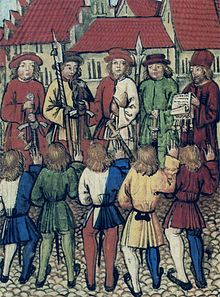
The lateral processes in some embodiments may be sharpened blades. Variants in which the lateral processes are not blades, depending on their shape, can be considered a kind of combat (or assault) pitchfork, or speetum , also known as the Friulian spear . The difference between such types of runes as speetum and fighting pitchfork (or trident) is that in the fighting pitchfork, the tips of the lateral processes look forward, while at the speetum they look slightly to the side, or even bent back, actually representing hooks .
Literature
- Beheim Wendalen . Encyclopedia of weapons / Per. with him. A. A. Devell et al. Ed. A. N. Kirpichnikova . - St. Petersburg: Orchestra, 1995 .-- 576 p.: Ill. - ISBN 5-87685-029-X . Orig.: Boeheim W. Handbuch der Waffenkunde. Das Waffenwesen in seiner historischen Entwicklung vom Beginn des Mittelalters bis zum Ende des 18 Jahrhunders. - Leipzig 1890.