Nuri al-Saeed or Saeed Nuri ( Arabic: نوري السعيد ; October 23, 1887 , Baghdad , Baghdad vilayet , Ottoman Empire - July 15, 1958 , Baghdad , Iraq ) - Iraqi politician and statesman, eight once serving as Prime Minister of Iraq. Killed by rebel residents of Baghdad during the Iraq Revolution of 1958 .
| Nuri al-Said | |||||||
|---|---|---|---|---|---|---|---|
| Arab. نوري السعيد | |||||||
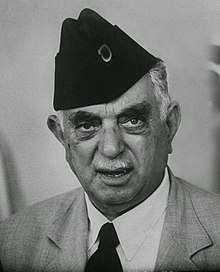 | |||||||
| Predecessor | Daud Pasha Al-Haidari | ||||||
| Successor | Abdul Illah Al-Hafiz | ||||||
| |||||||
| Predecessor | Ali Javdat al-Ayyubi | ||||||
| Successor | Ali Mahmoud al-Sheikh | ||||||
| |||||||
| Predecessor | Suleiman Tawfik al-Suveidi | ||||||
| Successor | Ali Javdat al-Ayyubi | ||||||
| |||||||
| Predecessor | Suleiman Tawfik al-Suveidi | ||||||
| Successor | Naji al-Asil | ||||||
| |||||||
| Predecessor | Abdul Qadir Rashid | ||||||
| Successor | Abdullah Bey al-Damluji | ||||||
| |||||||
| Predecessor | Suleiman Tawfik al-Suveidi | ||||||
| Successor | Abdullah Bey al-Damluji | ||||||
| Birth | October 23, 1887 Baghdad ,, vilayet Baghdad , Ottoman Empire | ||||||
| Death | July 15, 1958 (aged 70) Baghdad ,, Iraq | ||||||
| Children | |||||||
| Education | |||||||
| Religion | Islam , Sunni | ||||||
| Awards |
| ||||||
| Battles | |||||||


Biography
Born in a Sunni family of an accountant of North Caucasian descent. In 1906 he graduated from the Military Academy of Istanbul , served in the Turkish army. In 1912, as an officer, he participated in the Italo-Turkish war in Libya, organized a resistance movement to the Italian invaders.
In 1913, he participated in an anti-Turkish conspiracy organized by Arab officers of the Turkish army, after the discovery of which he emigrated to Egypt . where for some time he was captured by the British. In 1916 he joined the Arab anti-Turkish uprising in Hijaz , held high posts in the army of Emir Faisal , and led the Arab troops that took Damascus. In 1921 he returned to Iraq, following King Faisal, expelled from Syria by the French. In 1922 he was appointed first chief of police, and in 1924 - deputy chief of staff of the army.
In 1930-1958 (intermittently) he headed the government 8 times; repeatedly was Minister of Foreign Affairs and Minister of War. He acted as the most ardent defender of British interests in Iraq. The name of Nuri al-Said is associated with the signing of the Anglo-Iraqi treaty of 1930, which granted Britain unlimited right to deploy its armed forces and transit military units through Iraq, as well as legitimizing British control over the country's oil industry. In the last years of Faisal’s rule, their relationship deteriorated and the politician was dismissed as prime minister.
During the military coup led by Siddy Beckry (1936) he took refuge in the British Embassy, and then fled to Egypt. As a result of domestic political intrigues, he was sent by the ambassador to London, then began cooperation with the Saudi royal family. After the coup of Salah ad-Din al-Sabbah in late December 1938 , Nuri again becomes the Prime Minister of Iraq. He sought to oust King Ghazi I by supporting his half-brother, Prince Zeid. In response, in March of the following year, a campaign began against the head of the cabinet, spreading rumors about an alleged plot to kill Gazi, followed by a “purge” of the officer corps from Nuri supporters. After the death of the head of state in a car accident on April 4, 1939, Nuri was openly suspected of involvement in his death. At the royal funeral, the crowd chanted: "You will be responsible for the blood of Gazi, Nuri." The new regent of the minor at that time Faisal II was initially influenced by Nuri.
After coming to power, led by Rashid Ali al-Gaylani , allied with Germany, the former prime minister was forced to flee to British-controlled Transjordan from 1941 to 1944. led the government under actual British occupation. After the conclusion of a new treaty with Great Britain (1948) and the brutal suppression of mass protests against this document, Nuri finally lost the support of the population. Following this, he signed the Iranian-Turkish and Anglo-Iraqi agreements of 1955 , which laid the foundation for the creation of the Baghdad Pact . Within the country, he pursued a policy of suppressing the labor and national liberation movements. Having thus secured the support of the United States and Great Britain, he intensified repressions against his domestic political opponents and introduced censorship of the media. After the Suez crisis in Iraq, public discontent over the Baghdad Pact sharply increased, mass protests and riots took place throughout the country: in Baghdad, Basra, Mosul, Kufa, Najaf and Al-Hill. In response to the ensuing repression, civilian and military opposition unified with the pro-British regime. The formation of the Arab Federation of Iraq and Jordan in response to the creation of the United Arab Republic and its appointment as Prime Minister Nuri could no longer affect the negative development of political processes for him.
Death
On the day of the overthrow of the monarchy, Nuri al-Said hid. His son Sabah al-Saeed was captured, killed and dragged along the streets of Baghdad. The body was doused with gasoline and burned to the glee of the crowd. As-Said managed to board a boat tied to a pier near his home and climb up the Tigris . He was sheltered by his old friend. But Nuri al-Said understood that the rebels would soon come here, and having dressed in women's clothing, he tried to get through Baghdad to Iran. The commander-in-chief of the army received information that Nuri al-Said was hiding in one of the houses of the Baghdad quarter Bab al-Sharki. Troops were immediately sent there and the search began, but the former prime minister managed to escape. He made his way through the Iraqi capital, but on Freedom Square, a teenager saw pajama pants sticking out from under women's clothing. He screamed, and people gathered around al-Saeed. A nearby soldier, without hesitation, shot the old prime minister. According to another version, Nuri managed to grab a gun and commit suicide.
The former prime minister was buried the same day, but an angry mob ravaged his grave, and the politician’s corpse was dragged along the streets of Baghdad, where he was hanged, burned and mutilated, after being repeatedly hit by municipal buses until he became unrecognizable.
Sources
- Batatu, Hanna: The Old Social Classes and New Revolutionary Movements of Iraq, al-Saqi Books, London, 2000, ISBN 0-86356-520-4
- Gallman, Waldemar J .: Iraq under General Nuri: My Recollection of Nuri Al-Said, 1954-1958, Johns Hopkins University Press, Baltimore, 1964, ISBN 0-8018-0210-5
- Lukutz, Liora: Iraq: The Search for National Identity, pp. 256-, Routledge Publishing, 1995, ISBN 0-7146-4128-6
- O'Sullivan, Christopher D. FDR and the End of Empire: The Origins of American Power in the Middle East. Palgrave Macmillan, 2012, ISBN 1137025247
- Simons, Geoff: Iraq: From Sumer to Saddam, Palgrave Macmillan, 2004 (3rd edition), ISBN 978-1-4039-1770-6
- Tripp, Charles: A History of Iraq, Cambridge University Press, 2002, ISBN 0-521-52900-X