Senior zhuz ( kaz. Ұly Zhuz ) is a group of Kazakh clans and tribes that dominated the territory of Semirechye and modern Southern Kazakhstan and part of the modern territory of western China and Uzbekistan ( Tashkent region ).
| Historical State | |
| Senior zhuz | |
|---|---|
| kaz Ұly Zhuz | |
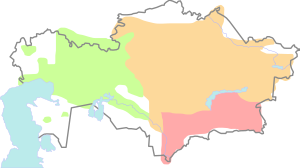 Approximate territories of nomadic zhuzes at the beginning of the 20th century. Senior zhuz (indicated by pink color on the map), Middle zhuz (orange), Younger zhuz (green). | |
←   → →1718 - 1822 | |
| Capital | 1718 - 1798 Tashkent |
| Languages) | Kazakh language |
| Population | Kazakhs |
| Continuity | |
| ← Kazakh Khanate | |
| Kokand Khanate → | |
In the middle of the 18th century during the Kazakh-Dzungar wars, the Kazakh Khanate , as in the Mongol Empire, applied division of troops and military-administrative divisions of the territory into three parts - the eastern or left hand (Mong. "Djun gar"), the western or right hand ( Mong. "Baruun Gar") and central or main (Mong. "Goal"). The division of territories under the authority of nomads into right and left "wings", with each subordinating to a special chief, was used in the states of the steppe from the 3rd century BC. e., since the formation of the Hun Empire. The senior zhuz consisted of 11 related tribes . Subsequently, the overgrown “wings” were divided into their own, smaller ones, but with the same ratios, in which the left wing was considered the elder and the right one the younger . Naturally, in the war with the Dzungars, the left wing cannot be called “Juan Gar” in Mongolian style because of elementary inconsistency . Following military traditions of the steppe, the left (senior) branch (juz) is transformed into Kazakh Uly, and the right (younger) into Kazakh Kishi juz. The theory was expressed by Baisarin Aibek .
In the XIX century, the population of the older zhuz was about 1,500 thousand people.
History
As a result of the collapse of the Chagatai ulus , the territory of the state of Mogulistan was formed . Khan Mogulistan Togluk-Timur , trying to restore the Chagatai ulus in the years 1360-1361, twice made trips to Maverannahr. Having won them, he raised his son Ilyas-Khoja to the Khan's throne of Maverannahr. Returning to Mogulistan, Togluk-Timur Khan died, which forced Ilyas-Khoja to leave Maverannahr to take up the affairs of the throne, which changed the political situation in Central Asia. Emir Timur rose to fight against Ilyas-Khoja. There have been several battles between them. Ilyas-Khoja suffered a humiliating defeat. After that, he gathered a new army in Mogulistan, and again spoke out against Timur. The battle took place on June 22, 1365 near Tashkent and is known in history as the famous Batpak battle (“The Mud Battle”). After the Batpak victory, the Mogul Khan went to Samarkand and besieged it. However, the population of the city had fierce resistance. The Khan's troops failed to take the city. A long siege weakened the army. At the same time, a horse plague epidemic began among the Mogul cavalry population. Moghulam had to retreat from the city and return to Mogulistan. Thus, the attempt of the Moguls to restore their power in the territory of the former Chagatai Ulus ended in failure.
After that, the notable emirs of the Dulat tribe Kamar ad-din and his younger brother Shame ad-din ruled in the Mogul Khanate strengthen the dominant position of the nobility - representatives of the Dulat tribe.
Disintegration of the Mogul Khanate
When the Mogul Khanate was extremely weakened by internal strife, the emir Timur seized power in Maverannahr in 1370 began a war of conquest against Mogulistan.
At the end of the XIV century, Emir Timur repeatedly made campaigns against Mogulistan. The first of them was made in the years 1371-1372. During this campaign, he reached the town of Almalyk. But, having failed to take the city, he plundered all settlements along the way and captured many prisoners. He made another conquest in 1375-1377. During this hike through the south of Kazakhstan, he reached the Zhetysu river Charyn. In the battle with the Mogul commander Kamar ad-din he won a victory. Kamar ad-din fled to East Turkestan, to Turfan. In the years 1380-1390, the emir Timur made raids on Mogulistan several times. They were catastrophically devastating for the state, since the total number of troops of Timur with the troops of his sons was 120 thousand people.
Thus, as a result of repeated invasions of troops of the Emir Timur, the Mogul Khanate was drained of blood. It fell apart into several independent domains. Khan Khizr-Khoja recognized his vassal dependence on Emir Timur. Only after the death of the emir Timur (1405) during the reign of Mohammed Khan - Khizr-Khoja's heir: Mogulistan regained its independence. The Mogul Khan used internal feuds among the descendants of Timur for his own purposes. So, for example, in the confrontation over the capture of Fergana between the grandsons of Timur - Ahmed Myrza and Ulugbek, Mohammed Khan and his army took the side of the first and together they won. Since that time, Mogulistan has again become an independent state. However, after the death of Mohammed Khan, divisions again began in Mogulistan. Taking advantage of this, the grandson of Timur Ulugbek erected the throne of Sher-Mohammed, the grandson of his supporter Khizr Khan. His opponents chose Khan Moogu listan, the second grandson of Khizr-Khoja-Weiss. In response to this, in 1425, Ulugbek made a trip to Mogulistan and plundered the country.
After the death of Wise Khan in 1428, Mogulistan was again fragmented into parts. The internecine struggle for the Khan, the power was continued by the sons of Wise Khan - Junus and Yesen-Bug. With the support of emirs of the Dulat Yesen-Bug tribe, he occupied the Khan's throne (1433-1462). However, Zhunus did not stop his struggle for khan power. He turned for help to the descendant of Timur Abu Said. The struggle for Khan's power stopped only after the death of Esen-Boogie in 1462. Zhunus from Zhetikent (near Fergana) returned to Mogulistan and declared himself heir to the Khan's throne. The collapse of the Khanate began during the reign of grandson Zhunus Khan. The territory of Zhetysu was removed from Mogulistan by the newly formed Kazakh Khanate .
Childbirth and Tribes
In the Middle Ages, the tribes of the Elder Zhuz were collectively called Uysun , as most of the representatives come from Usun.
“Asia Uysuns are the ancient Issedons, the eastern branch of the Massagets ” (A.N. Bernshtam) According to the descriptions in the Chinese chronicles, the Usuns were of medium height, had blue eyes and red hair. Originally, the Usuns lived in the region of Gansu Province next to Yuezhi , and then because of discord with them in the II century BC. (160 BC) moved to the lands of the Saky-Tigrahaud in Semirechye. In the 170s BC. er the leader of the Huns Mode broke Uysun. A legend was born here as a little boy named Ashina, left without support and relatives, and a blue wolf fed her. Ashina is the ancestor of all modern Türks and a noble family of rulers of the Turkic Kaganats .
Below are the kind of Kazakh Senior zhuz:
- Albanians lived from the modern city of Almaty, then in Semirechye on the southeast side of the Altynemel ridge, in the north of the Trans-Ili Alatau, in the upstream Ili, on Kolsay lake on the banks of the Tekes and Charyn mountain rivers. Their cry is “ Raiymbek! ". Presumably descend from the Chigil tribe included in the Turkic nomadic Karluk conference. They participated in the Talas Battle of 751, together with the Abbasid Caliphate against the army of Tan China for control of Central Asia. As a result of the victory in the battle, the expansion of China was stopped for 1000 years. Karluks founded the Karluk Kaganate , the Karluk Khanate , the Karakhanid state , the Samanid state .
- Dulats lived along the banks of the Ili , up to Chu and Talas and the middle course of the Syr Darya . Dulats are divided into four major genera: botpay, shymyr , syky , zhanys. Their slogan was “ Baktyar! ". Originate from the ancient Turkic tribe Dulu . The history of the tribe is traced from the Turkic kaganate . They entered the Turgesh kaganat (704 - 1120) participated in the Talas Battle of 751 . Representatives of the tribe founded the Dulo (dynasty) in the first Bulgarian kingdom .
- The Suans lived in the foothills of Altynamelya, in Semirechye, on the southeast side of the Dzungarian Alatau, on the bank of Koktelek near the town of Korgaska. Their slogan-cry is “ rayimbek, baysuan ”. One of the ancient Hun families. Related to the Alban family
- Shapyrashty mostly lived in the foothills of the Trans-Ili Alatau. Their cry is Karasai! ". They come from the ancient nomadic tribe of Usun . The history of the Usuns can be traced back to the 2nd c. BC er
- The Zhalayiry lived in the foothills of the Dzungarian Alatau , Arkarly, Malaysay, on the banks of the Karatal and Ili rivers, on the southeast coast of Balkhash . Their cry is “ cabaret .” The Zhalayir is a Mongol tribe that inhabited the shores of Onon. Representatives of the tribe founded in Iraq, the State of Jalayrid and their own dynasty Jalayrid
- Kanly occupied the territory of the modern South Kazakhstan region, the slopes of Karatau and Semirechye. Their cry is “ Baiterek .” Comes from the Turkic tribe Kangly . They founded the empire of Kangüy (about the II century BC. - IV century AD.) In the II century BC. er The Kangüis took part in the rout of the Greco-Bactrian kingdom. The history of Kangüy in the legend dates back to the times of the Avesta , where Kangha is referred to as the capital of the empire. Kangly played a significant role in the medieval Central Asian states, especially in the State of Khorezmshahs. In the 10th century A certain Seljuk , the founder of the famous Seljuk dynasty, has emerged from Kanli (see: M. Tynyshpayev. Materials on the history of the Kirghiz-Kazak people. Tashkent, 1925, p.6). In the XI century. The Oghuz , led by the Seljuks , began the conquest of Iran . In 1055 Togrul-bek conquered Iran, captured Baghdad , after which the Abbasid Caliph al-Qaim proclaimed him the Sultan. Thus was born the Great Seljuk Empire, which encompassed a significant part of Central Asia (Khorezm, Maverannahr), Iran, Syria, Palestine, Azerbaijan, Armenia, Georgia and Asia Minor. At the end of the XII century. it broke up into separate Seljuk sultanates, which with difficulty repulsed the onslaught of the crusaders and the Mongols. In the thirteenth century On the territory of the Koniysky Sultan , located in Asia Minor, he brought his yurts, beat Ertogrul also from the Cayi-Khanli kayi-kangly family at that time fleeing from the advancing Mongols from Khorezm . The leader of this group and his son Osman founded a small principality, which grew two centuries later into a powerful Ottoman empire . Kangles are also the ancestors of the Kumyks . The French orientalist De-Guigne (Deguignes) , which connects the origin of the Kumyks with the Kai-Kanli branch, agrees with this.
- Sary-Uysyn mostly wandered along the left side of Ili, in the foothills of Zailiysky Alatau, on the right bank of Talas, along the banks of the Kargaty river until it merged with Chu. They come from the ancient nomadic tribe of Usun . The history of the Usuns can be traced back to the 2nd c. BC er
- Sirgeli lived in the middle course of the Chu, the lower reaches of the Talas, in the foothills of the Karatau, as well as in the territory of modern South Kazakhstan region, bordering Uzbekistan and the territory of modern Tashkent region. Their cry is “ bactiyar ” and “ toganas ”. They come from the ancient nomadic tribe of Usun . The history of the Usuns can be traced back to the 2nd c. BC er
- Oshakty wandered in the lower reaches of the Talas, the south-eastern spurs of Karatau. At the end of the XIX century. their number has reached 20 thousand people. The Oshakty was the son of Abak, the grandson of the legendary Mike-biy and the great-grandson of Uysun, from whom all the main tribes of the Elder Zhuz begin. It follows that the ancestors of the Oshakty were on an equal footing in the Usuni II tribal alliance. BC.
- Ysty lived in the northern part of Lake Balkhash and the territory of Zhambyl region. Their cry is “ zhauatar ”. The ancestors of the ysty were part of the confederation of the ancient Usuns , known from Chinese sources II. BC. er
- Shanyshkyly lived in the South Kazakhstan region, on the territory bordering with Uzbekistan and in the Tashkent region of Uzbekistan. Their cry is “ ayrylmas ”. The Shanshykyls came from the Mongolian tribe Katagan (Khatagin), originating from Bukh-Khatagi, the eldest son of the Mongolian mother Alan-goa . According to sources, the catagans were related to the genus of Genghis Khan himself.
Composition of the tribal union
- Senior zhuz on Rodovod . Tree of ancestors and descendants
| Union tribes | Uysun | ||||||
|---|---|---|---|---|---|---|---|
| Tribe [1] | Alban [2] | Dulat [3] | oshakty | Suana | shadyrashty [3] | Ysty [3] | Sara Uysyn |
| Childbirth |
|
|
|
|
|
|
|
| Tribe [1] | Canals | Zhalayiry [3] [4] | Sirgeli [5] | Shanyshkyly [6] | Shaksam [3] |
|---|---|---|---|---|---|
| Childbirth |
|
|
|
|
|
Haplogroups
Y haplogroups of the birth of the Senior zhuz as a percentage. Error in footnotes ? : Invalid call: invalid keys, for example, too many keys were specified or the key was incorrect
| No. | Haplogroup | Senior zhuz | Zhalayir | Dulata | Albans | Suana | Сарыуйсуны | Ошакты | Шапрашты | Шанышкылы | Шакшам | Канлы | Сиргели | Ысты |
| one | C3(x) | 2.1 | 1.1 | 3.1 | 2.2 | 0.0 | 0.0 | 0.0 | 6.7 | 0.0 | 0.0 | 7.5 | 0.0 | 0.0 |
| 2 | C3-M401 | 45,0 | 41.3 | 62,3 | 65.2 | 61.0 | 87,5 | 36.7 | 46.7 | 53,8 | 100,0 | 5.0 | 15.6 | 3.5 |
| 3 | C3-M407 | 0.2 | 0.0 | 0.0 | 2.2 | 0.0 | 0.0 | 0.0 | 0.0 | 0.0 | 0.0 | 0.0 | 0.0 | 0.0 |
| four | C3c-M86 | 5.3 | 4.3 | 8.9 | 8.7 | 0.0 | 0.0 | 0.0 | 6.7 | 15.4 | 0.0 | 2.5 | 0.0 | 1.8 |
| five | E1b-M35 | 0.7 | 1.1 | 0.5 | 0.0 | 0.0 | 0.0 | 3.3 | 0.0 | 0.0 | 0.0 | 0.0 | 3.1 | 0.0 |
| 6 | G(x) | 0.2 | 0.0 | 0.0 | 2.2 | 0.0 | 0.0 | 0.0 | 0.0 | 0.0 | 0.0 | 0.0 | 0.0 | 0.0 |
| 7 | G1-M285 | 2.3 | 5.4 | 1.0 | 2.2 | 0.0 | 0.0 | 10.0 | 0.0 | 0.0 | 0.0 | 2.5 | 0.0 | 1.8 |
| eight | G2-P287 | 1.6 | 6.5 | 0.0 | 0.0 | 0.0 | 0.0 | 0.0 | 6.7 | 0.0 | 0.0 | 2.5 | 0.0 | 1.8 |
| 9 | I1-M253• | 0.4 | 0.0 | 0.0 | 0.0 | 0.0 | 0.0 | 0.0 | 0.0 | 0.0 | 0.0 | 0.0 | 0.0 | 3.5 |
| ten | I2a-L460• | 1.2 | 2.2 | 1.0 | 0.0 | 0.0 | 0.0 | 6.7 | 6.7 | 0.0 | 0.0 | 0.0 | 0.0 | 0.0 |
| eleven | I2b-L415• | 0.7 | 0.0 | 2.1 | 0.0 | 0.0 | 0.0 | 0.0 | 0.0 | 0.0 | 0.0 | 0.0 | 0.0 | 0.0 |
| 12 | J(x) | 0.7 | 0.0 | 0.5 | 0.0 | 0.0 | 0.0 | 0.0 | 0.0 | 15.4 | 0.0 | 2.5 | 0.0 | 0.0 |
| 13 | JI-M267• | 7.9 | 3.3 | 1.6 | 0.0 | 0.0 | 12.5 | 0.0 | 13.3 | 0.0 | 0.0 | 0.0 | 0.0 | 63.2 |
| 14 | J2a-M410• | 5.6 | 14.1 | 7.9 | 0.0 | 0.0 | 0.0 | 0.0 | 6.7 | 0.0 | 0.0 | 2.5 | 3.1 | 1.8 |
| 15 | L• | 0.4 | 0.0 | 0.0 | 0.0 | 4.9 | 0.0 | 0.0 | 0.0 | 0.0 | 0.0 | 0.0 | 0.0 | 0.0 |
| sixteen | N (x) | 0.2 | 1.1 | 0.0 | 0.0 | 0.0 | 0.0 | 0.0 | 0.0 | 0.0 | 0.0 | 0.0 | 0.0 | 0.0 |
| 17 | N-P43 | 0.4 | 0.0 | 0.5 | 0.0 | 0.0 | 0.0 | 0.0 | 6.7 | 0.0 | 0.0 | 0.0 | 0.0 | 0.0 |
| 18 | N-M46 | 6.3 | 9.8 | 1.0 | 4.3 | 0.0 | 0.0 | 0.0 | 0.0 | 0.0 | 0.0 | 0.0 | 65.6 | 3.5 |
| nineteen | O(xM122) | 1.1 | 0.0 | 0.5 | 0.0 | 0.0 | 0.0 | 0.0 | 0.0 | 0.0 | 0.0 | 0.0 | 0.0 | 8,8 |
| 20 | O-M122(xM134) | 0.2 | 0.0 | 0.0 | 0.0 | 0.0 | 0.0 | 0.0 | 0.0 | 0.0 | 0.0 | 0.0 | 3.1 | 0.0 |
| 21 | O-M134 | 1.1 | 1.1 | 1.0 | 2.2 | 2.4 | 0.0 | 0.0 | 0.0 | 0.0 | 0.0 | 0.0 | 3.1 | 0.0 |
| 22 | Q | 5.3 | 0.0 | 0.5 | 2.2 | 0.0 | 0.0 | 0.0 | 0.0 | 0.0 | 0.0 | 67,5 | 3.1 | 0.0 |
| 23 | R(x) | 0.4 | 0.0 | 0.5 | 0.0 | 0.0 | 0.0 | 0.0 | 0.0 | 0.0 | 0.0 | 2.5 | 0.0 | 0.0 |
| 24 | R1a1a-M198 | 6.5 | 3.3 | 3.7 | 6.5 | 31.7 | 0.0 | 26.7 | 0.0 | 7.7 | 0.0 | 5.0 | 0.0 | 0.0 |
| 25 | R1b-M478 | 2.1 | 0.0 | 2.1 | 0.0 | 0.0 | 0.0 | 6.7 | 0.0 | 0.0 | 0.0 | 0.0 | 0.0 | 10.5 |
| 26 | R1b-M269 | 0.5 | 0.0 | 0.0 | 2.2 | 0.0 | 0.0 | 3.3 | 0.0 | 0.0 | 0.0 | 0.0 | 3.1 | 0.0 |
| 27 | R2-M124* | 1.4 | 5.4 | 0.5 | 0.0 | 0.0 | 0.0 | 3.3 | 0.0 | 7.7 | 0.0 | 0.0 | 0.0 | 0.0 |
| 28 | Undetermined | 0.4 | 0.0 | 0.5 | 0.0 | 0.0 | 0.0 | 3.3 | 0.0 | 0.0 | 0.0 | 0.0 | 0.0 | 0.0 |
| число пробантов | 567 | 92 | 191 | 46 | 41 | eight | thirty | 15 | 13 | 2 | 40 | 32 | 57 | |
| Генетическое разнообразие | 0.773 ±0,017 | 0.793 ±0,036 | 0.597 ±0,041 | 0.570 ±0,085 | 0.538 ±0,059 | 0.250 ±0,18 | 0.798 ±0,052 | 0.791 ±0,105 | 0.705 ±0,122 | 0 | 0.544 ±0,094 | 0.557 ±0,097 | 0.588 ±0,073 |
Rulers
| No | Khan | Portrait | Начало правления | End of the board | Origin | Tamga | Note |
|---|---|---|---|---|---|---|---|
| one | Карт-Абулхаир (каз. Қарт-Әбілқайыр) | 1718 | 1730 | внук Тауке-хана | |||
| 2 | Жолбарыс | 1730 | 1740 | сын Абдолла-султана | |||
| 3 | Абульфеиз (каз. Әбілпейіз) | 1740 | 1750 | сын Жолбарыс-хана |
Военные деятели Старшего жуза
- Хангелды батыр — род Сары племени Албан Старшего жуза
- Райымбек батыр — род Сары племени Албан Старшего жуза
- Оракты батыр — подрод Оракты род Шуманак племени Жалайыр Старшего жуза
- Ажибай батыр — подрод Кызылборик род Шыбыл племени Албан Старшего жуза
- Наурызбай батыр — подрод Толемис род Асыл племени Шапырашты Старшего жуза
- Отеген батыр — подрод Жарлыкамыс род Жаныс племени Дулат Старшего жуза
- Койгелды батыр — род Жаныс племени Дулат Старшего жуза
- Сыпатай батыр — род Ботпай племени Дулат Старшего жуза
Известные представители Старшего жуза (бии, деятели искусства, общественные деятели и др.)
- Толе би — подрод Жанту род Жаныс племени Дулат Старшего жуза
- Джамбул Джабаев — подрод Екей род Шапрашты Старшего жуза
- Шерхан Муртаза — род Шымыр племени Дулат Старшего жуза
- Мукагали Макатаев — род Албан Старшего жуза
- Турар Рыскулов — род Шымыр племени Дулат Старшего жуза
- Есей би — подрод Кызылкурт род Ойык племени Дулат Старшего жуза
- Болтирик Алменулы — подрод Малай род Ойык племени Дулат Старшего жуза
- Балпык би — подрод Андас род Шуманак племени Жалайыр Старшего жуза
- Алибек би — подрод Жанту род Жаныс племени Дулат Старшего жуза
- Кудайберди би — подрод Жанту род Жаныс племени Дулат Старшего жуза
- Ескелды би — подрод Сиыршы род Бирманак племени Жалайыр Старшего жуза
- Кабан жырау — подрод Мырза род Шуманак племени Жалайыр Старшего жуза
- Суйинбай Аронулы — род Екей племени Шапырашты Старшего жуза
- Динмухамед Кунаев — из племени Ысты Старшего жуза
- Канабек Байсеитов — подрод Андас род Шуманак племени Жалайыр Старшего жуза
Современники
- Нурсултан Назарбаев — род Шапрашты Старшего жуза
- Тимур Кулибаев — род Сикым племени Дулат Старшего жуза
Notes
- ↑ 1 2 Деление казахов на жузы: карта расселения, анализ. | BRIF Research Group BLOG - блог о маркетинговых исследованиях . Дата обращения 21 февраля 2013. Архивировано 26 февраля 2013 года.
- ↑ Старший жуз / Албан /
- ↑ 1 2 3 4 5 http://www.kazakh.ru/about/clan/zhuzy.jpg
- ↑ Старший жуз / Жалайыр /
- ↑ Старший жуз / Сиргели /
- ↑ atababa.kz/ru/generation/eldeer_juz/shanyshkyly
Literature
- Толеубаев А. Т., Касымбаев Ж. К., Койгелдиниев М. К., Калиева Е. Т., Далаева Т. Т. — История Казахстана. Перевод с казахского языка С. Бакенова, Ф. Сугирбаева — Алматы: Мектеп, 2006. — 240 с. — ISBN 9965-33-628-8