Carp-shaped ( Latin Cypriniformes ) - a detachment of ray-finned fish (Actinopterygii). They are characterized by the presence of a Weber apparatus ; the swim bladder is connected to the intestines. Mostly freshwater fish. The number of species in the order is about 15% of all bone fish. Among the cyprinids there are herbivorous, predatory and omnivorous. Many cyprinids are of great commercial importance. Specially bred in many fish farms.
| Cyprinids |
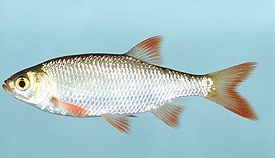
Redfin ( Scardinius erythrophthalmus ) |
| Scientific classification |
|---|
| No rank : | Bilateral symmetrical |
|
| International scientific name |
|---|
Cypriniformes |
|
In the fresh waters of Russia - about 110 species of carp-like.
Content
This group includes most freshwater representatives of the class of ray-finned fish. The length varies from 1 cm ( Paedocypris progenetica from Southeast Asia) to 3 m ( Catlocarpio siamensis also from Southeast Asia) [1] . They live on all continents except Australia and Antarctica . Representatives of the Cyprinidae order are widespread in the water bodies of Europe (331), Asia (3232), Africa (543 species), North (394) and South (2) America [1] . Despite significant differences in conditions and lifestyle, in the structure and shape of the body, they all have a number of common features. Among the most important is the presence in the vast majority of fish of the swimming bladder , which connects to the digestive tract, and a kind of “Weber apparatus”, which serves to perceive the pressure of water. The abdominal fins are mostly located behind the pectoral fins. The jaws do not carry teeth, but there are strong teeth on the lower pharyngeal bones of the gill apparatus, forming the pharyngeal chewing apparatus. The body, as a rule, is covered with scales; in very few, it is bare; head is bare; there is no fat fin, the mouth is more or less retractable and is often equipped with antennae; the swim bladder is divided into two or more sections.
In most cyprinids, sticky caviar is deposited on stones or vegetation. Caviar of some species, for example, grass carp ( Ctenopharyngodon idella ), develops in the water column. The propagation of mustard ( Rhodeus sericeus ), which lays eggs in a mantle cavity of bivalves, is peculiar. In some species, parental behavior is highly developed. For example, the black thick-headed ( Pimephales promelas ), northern semotilus ( Semotilus atromaculatus ) and other American cyprinids build a nest and take care of the masonry. Among the cyprinids there are also “cuckoos”, tossing their eggs in the nests of other fish. Some cyprinids are characterized by the formation of interspecific and intergeneric hybrids. Known artificially produced karasekarpovye hybrids. Some of them are fertile and several times mistakenly described as independent species.
The detachment has 13 modern families with 489 genera and 4423 species and 1 fossil family [2] :
- Superfamily Cyprinoidea - Carp - like
- Family Cyprinidae - Carp
- Psilorhynchidae Family - Psilorinchids
- Superfamily Cobitoidea - Loch - like
- Family Gyrinocheilidae - Girinokheylovye
- Catostomidae Family - Chukuchany
- The Botiidae Family
- Family Vaillantellidae
- Family Loach
- Family Balitoridae - Balitoridae
- Gastromyzontidae Family
- Family Nemacheilidae
- Family Barbuccidae
- Ellopostomatidae Family
- Family Serpenticobitidae
- Family † Jianghanichthyidae
Many cyprinids are the subject of fishing.
- ↑ 1 2 FishBase: specieslist of Order Cypriniformes
- ↑ Nelson D.S. Fishes of World Fauna / Transl. 4th rev. English ed. N. G. Bogutskaya, scientific. Ed. by A. M. Nasek, A. S. Gerd. - M .: Book House "LIBROCOM", 2009. - S. 217—229. - ISBN 978-5-397-00675-0 .
