The Wailers is a Jamaican vocal group. It was formed in 1963. Initially, it consisted of: Bob Marley , Bunny Weiler (real name Neville ORiley Livingston; b. April 10, 1947, Kingston , Jamaica), Peter Tosh (real name Winston Hubert Mackintosh; October 19, 1944, Westmoreland, Jamaica - September 11, 1987, Kingston), Junior Braithwaite , Beverly Kelso and Cherry Smith .
| The wailers | |
|---|---|
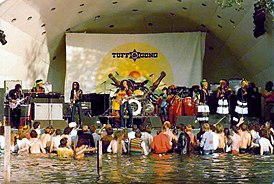 The wailers | |
| basic information | |
| Genre | Ska , rocksteady , reggae |
| Years | 1963 - 1981 |
| A country |  Jamaica Jamaica |
| City | Kingston |
| Label | Island records |
| Structure | Bob Marley Junior braithwaite Beverley kelso Bunny livingston Peter Tosh Cherry smith |
| wailers.com originalwailers.com | |
Content
- 1 members
- 2 Group History
- 2.1 Bob Marley & The Wailers
- 3 Discography
- 4 References
Members
Original composition
- Bob Marley - vocals, guitar
- Bunny Weiler - vocals, percussion
- Peter Tosh - guitar, keyboards, vocals
- Junior Braithwaite - vocals
- Beverly Kelso Backing Vocals
- Cherry Smith backing vocals
Group History
In 1962, Bob and his friends, Bunny Livingston and Peter Tosh, were auditioned by local entrepreneur Leslie Kong, who recorded several tracks with them in the studio. The following year, Bob gathered a group of friends. First it was called The Teenagers, then The Wailing Rudeboys, The Wailing Wailers, and finally The Wailers ("The Weepers"). There was no irony in this - the traditions of crying are strong in any Negro culture.
In 1966, Braithwaite, Kelso, and Smith left the band, leaving a trio from Livingston, Marley, and Tosha.
That was the time of the popularity of ska , the Jamaican variety of New Orleans rhythm and blues , and the huge speakers placed along the streets of Kingston ( Reggae adherents claim that this is the way street music has led to raves ). Marley and her comrades who performed fashionable music were quickly spotted and over the next five years became an island celebrity.
Until the early 70s, The Wailers were virtually unknown outside of Jamaica. After unsuccessful attempts to conclude a contract with a number of companies, Marley found himself on the threshold of the now famous Island Records . The founder of the studio, Chris Blackwell , initially focused on the distribution of Jamaican music and, having settled in London in 1962 , popularized ska , rocksteady and reggae in the Old World, and later the founders of the prog rock Jethro Tull and King Crimson . Knowing well the fame of Marley in his homeland, Blackwell offered him the contract, inconceivable in the history of reggae bands, that he was put on equal terms with rock bands.
Marley’s first album on Island, “ Catch a fire, ” immediately set new standards in pop music: newspapers wrote about the appearance of a new, completely different style, new rhythm and melody, combined with an unusual, religious-Protestant theme of the song. From this point on, the Marley group gains international fame. In 1973, invited to perform at the opening act of Sly & The Family Stone, “The Wailers” were soon thrown out of the tour, as the audience received them warmer than the headliners.
Some of The Wailers recorded songs with Lee Scratch Perry and his band The Upsetters . In the early 1970s , The Upsetters member Aston Family Man Barrett and his brother Carlton Barrett formed The Wailers Band .
“The Wailers” recorded reggae hits such as “ Simmer Down ”, “Trenchtown Rock”, “Nice Time”, “ Stir It Up ”, “ Get Up, Stand Up ”, and many others.
The Wailers broke up in 1974 . All three members began their solo career. Bob Marley gained worldwide fame and popularity with Bob Marley & The Wailers (with the participation of The Wailers Band and I Threes ). Peter Tosh was also quite successful, while Bunny Weiler remained virtually unknown outside of Jamaica.
Bob Marley & The Wailers
Bob Marley included a female vocal trio on The Wailers , changed his name to Bob Marley and The Wailers and went on tour with his former mentor Higgs in Africa, Europe and the Americas. By the mid -1970s , Bob Marley and his group became recognized reggae leaders, and in the UK almost all of Marley’s new songs were featured in Thor 40 ( No Woman, No Cry , 1975; Exodus, 1977; Waiting In Vain ", 1977;" Satisfy My Soul ", 1978) and Top 10 (" Jamming ", 1977;" Is This Love ", 1978).
In the USA , however, only the song “Roots, Rock, Reggae” got into the hit parade of the “pop” category (1976, 51st place), and “Could You Be Loved” went through the soul category (1980, 56th place ), but the group’s albums invariably occupied high places, and the songs of “love, faith and rebellion,” as journalists called their works, were incredibly popular among the intellectual elite. In Jamaica, Bob Marley became a real cult figure, the public perceived his political and religious performances as revelations of the saint. In 1976, an assassination attempt was made against him, involuntarily finding himself drawn into local politics. Despite the severe wound, he held all the planned concerts, explaining that there was too much evil in the world and he had no right to waste at least one day.
After the death of Bob Marley, his friend, Joe Yamanaka, became the lead vocalist for The Wailers until 1986, the band released three albums under the title Reggae Vibration.
Discography
- 1965 - The Wailing Wailers
- 1970 - Soul Rebels
- 1971 - Soul Revolution
- 1971 - The Best of the Wailers
- 1973 - Catch a Fire
- 1973 - African Herbsman
- 1973 - Burnin '
- 1974 - Natty Dread
- 1976 - Rastaman Vibration
- 1977 - Exodus
- 1978 - Kaya
- 1979 - Survival
- 1980 - Uprising
- 1983 - Confrontation
Links
Sample group 1963-1974:
- The Wailers Profile at Last.fm
- The Wailers at Discogs
- The Wailers at MusicBrainz
Sample group 1974-1981:
- Bob Marley & The Wailers Profile at Last.fm
- Bob Marley & The Wailers at Discogs
- Bob Marley & The Wailers on MusicBrainz
- BBC Music Page