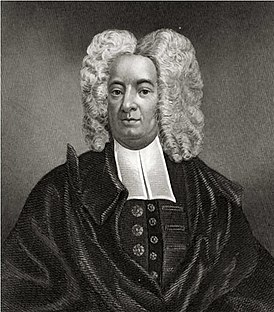
Cotton Mather Cotton Mather ( February 12, 1663 - February 13, 1728 ) - American preacher, religious moralist, biologist and medic, prolific writer and pamphletist, publicist, essayist (about 450 essays), who had a significant influence on American political thought of the 18th century, as well as on American literature. He used biblical subjects as an occasion for reasoning about the pressing problems of our time.
| Cotton Mather | |
|---|---|
| Cotton mather | |
 | |
| Birth name | Cotton Mather |
| Date of Birth | |
| Place of Birth | |
| Date of death | |
| A place of death | |
| Citizenship (citizenship) | |
| Occupation | preacher , nerd , writer |
| Language of Works | English |
| Awards | member of the Royal Society of London |
| Autograph | |
Content
- 1 Biography
- 2 Main works
- 3 Bibliography
- 4 notes
- 5 Links
- 6 See also
Biography
The third offspring of the Maser dynasty, over four generations living in the bay of Massachusetts . His father Inkriz Maser (1639-1723) - a priest, a Puritan preacher , president of Harvard (1685-1701). Cotton from childhood discovered amazing intellectual abilities: at the age of 17 he graduated from Harvard with a bachelor 's degree , and two years later received a master 's degree in theology at Holy Trinity College in Dublin (1658). Then he preached in various parishes of England, and returning to America, he received the pulpit of the church in Boston. In 1674 he was elected censor, in 1679 - a member of the synod, and in 1685 - president of Harvard.
He was the first American elected to be a full member of the Royal Society of London for research in zoology (Curiosa Americana, 1712-1724). Of his many works and writings, the most significant are: “Miracles of the invisible world” (“The Wonders of the Invisible World”, 1693); “The Great Acts of Christ in America” (“Magnalia Christi Americana, or The Ecclesiastical History of New England”, 1702) is a multi-volume work, an exhaustive history of settlements in New England, set forth in the form of biographies of leading public and church figures of New England in the 17th century. (a huge book tells about the holy mission of the Puritans who went to the wilderness to establish the Kingdom of God; it is structurally constructed as successive stories about the life of “American saints”; the pomp of this ambitious work is to some extent atoned for by the zeal of its creator: “I write about the miracles of the Christian religion, oppressed in Europe and fled to the shores of America "); the treatise "Christian Philosopher" ("Christian Philosopher", 1721); Manuductio ad Ministerium (1726); Ratio Disciplinae (1726). Especially popular was his ethical and philosophical essay “Striving for Good” (Essays to Do Good, 1710): B. Franklin admitted that this book left a deep imprint in his life (this did not prevent him from making a witty parody of his work teachers - a series of essays signed by the pseudonym Silence Dogood , in which, from the standpoint of enlightening rationalism, he criticized the concept of the original sinfulness of human nature).
He was on friendly terms with many of the judges who participated in the Salem witch trial; in connection with the process, he wrote a treatise on the evidentiary power of certain evidence, written in such a vague manner that it is difficult to understand his true attitude to the process: whether he supported the prosecution or doubted it. He probably participated in the lawsuit against William Fly .
For some time, he represented the interests of the American colonies in England at the court of James II (1633-1701, king 1685-1688) during the difficult relationship between the English crown and the American colonies. After the overthrow of King James II in England, Maser was one of the leaders of the uprising against Jacob's influential supporters in the American colonies.
The greatest success was accompanied by his book, An Essay for the Recording of Illustrious Providences , 1684; also known as Remarkable Providences . The content of the book: a collection of oral and written stories of "eyewitnesses" about various incredible and implausible events; the author’s goal was to prove the constant “impact” of otherworldly forces on human life and society. Other works include A Brief History of the Warr with the Indians (1676), Cases of Conscience concerning Evil Spirits Personating Men (1693).
Maser was also known as an amateur scientist. He conducted experiments on plant hybridization, studied seeds, and also conducted vaccination experiments.
He was married three times, had 15 children (but only two of them survived him).
Main Works
- Wonders of the Invisible World (1693) ISBN 0-7661-6867-0 Online edition (PDF)
- Magnalia Christi Americana (1702) ISBN 0-674-54155-3
- The Negro Christianized (1706) Online edition (PDF)
- Theopolis Americana: An Essay on the Golden Street of the Holy City (1710) Online edition (pdf)
- Bonifacius (1710) ISBN 0-7661-6924-3
- The Christian Philosopher (1721) ISBN 0-252-06893-9
- Religious Improvements (1721)
- Manuductio ad Ministerium (1726)
- A Token for the Children of New England (1675) ISBN 1-877611-76-X (inspired by the book by James Janeway and published together with his account in the American volume)
Bibliography
- Christopher D. Felker, Reinventing Cotton Mather in the American Renaissance: Magnalia Christi Americana in Hawthorne, Stowe, and Stoddard (Boston: Northeastern University Press, 1993), ISBN 1-55553-187-3
- Richard F. Lovelace, The American Pietism of Cotton Mather: Origins of American Evangelicalism , (Grand Rapids, Mich .: American University Press, 1979), ISBN 0-8028-1750-5
- Robert Middlekauff, The Mathers: Three Generations of Puritan Intellectuals, 1596-1728 , ISBN 0-520-21930-9
- E. Jennifer Monaghan, Learning to Read and Write in Colonial America, ISBN 978-1-55849-581-4
- Kenneth Silverman, The Life and Times of Cotton Mather , ISBN 1-56649-206-8
- Reiner Smolinski, The Threefold Paradise of Cotton Mather , ISBN 0-8203-1519-2
Notes
- ↑ 1 2 Encyclopædia Britannica
- ↑ 1 2 Internet Speculative Fiction Database - 1995.
Links
See also
- The rapture of the church