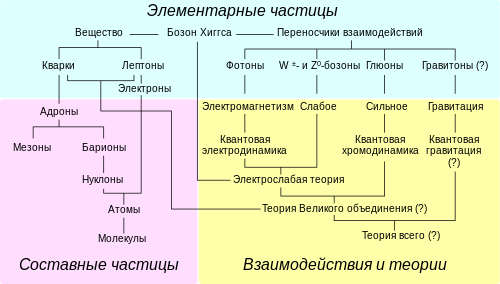
Quantum gravity is a field of research in theoretical physics , the purpose of which is a quantum description of gravitational interaction (and, if successful, the union of gravity in this way with the other three fundamental interactions , that is, the construction of the so-called “ theory of everything ”).
Creation Issues
Despite active research, the theory of quantum gravity has not yet been constructed. The main difficulty in its construction lies in the fact that the two physical theories that it is trying to connect together - quantum mechanics and general theory of relativity (GR) - are based on different sets of principles. So, quantum mechanics is formulated as a theory that describes the temporal evolution of physical systems (for example, atoms or elementary particles) against the background of external space-time . In general relativity there is no external space-time - it is itself a dynamic variable of the theory, depending on the characteristics of classical systems located in it.
In the transition to quantum gravity, at least, it is necessary to replace systems with quantum ones (i.e., to quantize ), while the right-hand side of the Einstein equations - the energy-momentum tensor of matter - becomes a quantum operator . The emerging connection requires some quantization of the geometry of space-time itself, and the physical meaning of such a quantization is absolutely unclear and there is no successful consistent attempt to carry it out [1] . For quantization of the space-time geometry, see also the Planck length article.
Even an attempt to quantize the linearized classical theory of gravity (GR) encounters numerous technical difficulties - quantum gravity is a non-renormalizable theory due to the fact that the gravitational constant is a dimensional quantity [2] [3] . Namely, in the system of units 


The situation is aggravated by the fact that direct experiments in the field of quantum gravity, due to the weakness of the gravitational interactions themselves, unfortunately, are not yet available to modern technologies. In this regard, in the search for the correct formulation of quantum gravity, one has so far to rely only on theoretical calculations.
Attempts are being made to quantize gravity based on the geometrodynamic approach and on the basis of the method of functional integrals [5] .
Other approaches to the problem of quantization of gravity are taken in the theories of supergravity and discrete space-time [4] .
Promising Candidates
The two main directions trying to build quantum gravity are string theory and loop quantum gravity .
In the first of them, instead of particles and background space-time, strings and their multidimensional analogues - branes act. For multidimensional problems, branes are multidimensional particles, but from the point of view of particles moving inside these branes, they are spatio-temporal structures.
In the second approach, an attempt is made to formulate quantum field theory without reference to the spatio-temporal background; space and time according to this theory consist of discrete parts. These small quantum cells of space are connected in a certain way with each other, so that on small scales of time and length they create a mottled, discrete structure of space, and on large scales they smoothly pass into a continuous smooth space-time. Although many cosmological models can describe the behavior of the universe only starting from Planck time after the Big Bang , loop quantum gravity can describe the explosion process itself, and even look further. Loop quantum gravity may possibly describe all the particles of the Standard Model .
The main problem here is the choice of coordinates. The general theory of relativity can also be formulated in a coordinateless form (for example, using external forms), however, the Riemann tensor is calculated only in a specific metric. Lyubosh Motl, one of the most active and witty propagandists of string theory, put it this way so that to speak, for example, of the “background independence” of the spin network propagator of the loop theory of gravity without indicating a single state is the same as calculating the Taylor series at a point x 0 without specifying x 0 .
Another promising theory that removes L. Motl’s objection is causal dynamic triangulation . In it, the space-time manifold is built from elementary Euclidean simplexes ( triangle , tetrahedron , pentachor ), taking into account the principle of causality . The four-dimensionality and pseudo-Euclidean space-time at macroscopic scales are not postulated in it, but are a consequence of the theory.
Other approaches
There are countless approaches to quantum gravity. Approaches differ depending on the characteristics that remain unchanged, and those that change [6] [7] . Examples include:
- Acoustic metrics and other analog gravity models
- Asymptomatic safety
- Causal dynamic triangulation [8]
- Causal sets [9]
- Group field theory (see the book "Approaches to Quantum Gravity. Toward a New Understanding of Space, Time and Matter" [10] and the references therein)
- MacDowell – Mansouri action
- Noncommutative geometry
- Integral Paths Model Quantum Cosmology [11]
- Calculus regge
- String liquid network (which leads to gapless helicity ± 2 excitations without any other gapless excitations [12] )
- Superfluid vacuum or BEC vacuum theory
- Supergravity
- Twistor-models (see chapter 33 of the book by R. Penrose, “The Path to Reality, or the Laws Governing the Universe. A Complete Guide” [13] and references therein)
- Digital Physics [14]
Experimental Verification
The first experiments are carried out to identify the quantum properties of gravity by studying the gravitational field of very small massive bodies, which can be transferred to the state of quantum superposition [15]
See also
- Theory of Everything
- String theory
- M-theory
- Loop quantum gravity
- Quantum field theory in curved spacetime
- Unresolved problems of modern physics
Notes
- ↑ Moreover, the naive "lattice approach" to the quantization of space-time, as it turns out, does not allow the correct limit transition in the theory of gauge fields when the lattice pitch tends to zero, which was noted in the 1960s. Bryce DeWitt is now widely taken into account when performing lattice calculations in quantum chromodynamics .
- ↑ Frolov V.P. Quantum Theory of Gravity (based on the materials of the II International Seminar on the Quantum Theory of Gravity, Moscow, October 13-15, 1981) , Usp. Fiz . 151.
- ↑ Weinberg S. Gravity and Cosmology - Moscow: Mir , 1975 .-- S. 307.
- ↑ 1 2 Khlopov Yu. M. Gravitational interaction // Physical Encyclopedic Dictionary. - ed. A. M. Prokhorova - M., Big Russian Encyclopedia, 2003 .-- ISBN 5-85270-306-0 . - Circulation 10000 copies. - with. 137
- ↑ Ivanenko D.D. , Sardanishvili G.A. Gravity. - M .: URSS editorial, 2004 .-- 200 p. - 1,280 copies. - ISBN 5-354-00538-8 .
- ↑ Isham, Christopher J. Canonical Gravity: From Classical to Quantum. - Springer, 1994. - ISBN 3-540-58339-4 .
- ↑ Sorkin, Rafael D. . Forks in the Road, on the Way to Quantum Gravity (Neopr.) // International Journal of Theoretical Physics . - 1997. - T. 36 , No. 12 . - S. 2759—2781 . - DOI : 10.1007 / BF02435709 . - . - arXiv : gr-qc / 9706002 .
- ↑ Loll, Renate. Discrete Approaches to Quantum Gravity in Four Dimensions // Living Reviews in Relativity : journal. - 1998. - Vol. 1 . - P. 13 . - . - arXiv : gr-qc / 9805049 .
- ↑ Sorkin, Rafael D. Lectures on Quantum Gravity. - Springer, 2005 .-- ISBN 0-387-23995-2 .
- ↑ Oriti, 2009 .
- ↑ Hawking, Stephen W. 300 Years of Gravitation. - Cambridge University Press, 1987. - P. 631–651. - ISBN 0-521-37976-8 . .
- ↑ Levin M., Wen Xiao-Gang . Detecting Topological Order in a Ground State Wave Function // Physical Review Letters , 2006, 96 (11). - P. 110405. - DOI : 10.1103 / PhysRevLett . 96.110405.
- ↑ Penrose, 2007 .
- ↑ Klara Moskowitz Entangled by space-time // In the world of science . - 2017. - No. 5-6. - S. 118-125.
- ↑ Tim Folger. Quantum gravity in the laboratory // In the world of science . - 2019. - No. 5-6 . - S. 100-109 .
Literature
- Gorelik G.E. Matvey Bronstein and quantum gravity. To the 70th anniversary of the unresolved problem. // Advances in Physical Sciences , Volume 175, No. 10 (October 2005).
- Penrose R. The Way to Reality, or the Laws Governing the Universe. The Complete Guide = The Road to Reality: A Complete Guide to the Laws of the Universe / Transl. from English A.R. Logunova, E.M. Epstein. - M. — Izhevsk: IKI , SRC “Regular and chaotic dynamics”, 2007. - 912 p. - ISBN 978-5-93972-618-4 .
- Approaches to Quantum Gravity. Toward a New Understanding of Space, Time and Matter / Ed. by D. Oriti. - Cambridge: Cambridge University Press , 2009 .-- xix + 583 p. - ISBN 978-0-521-86045-1 .
Links
- Quantum gravity // Lecture by D. I. Kazakov in the Post-Science project (11/13/2012)
- Paul Schellard et al. Quantum Gravity . // Per. from English V. G. Misovets. Link checked on 08:45, November 23, 2007 (UTC).
- Smolin, Lee . Physics troubles: the rise of string theory, the decline of science, and what follows
- Merali, Zeeya. Separation of time and space. New quantum theory rejects Einstein's space-time // Scientific American. (December 2009).