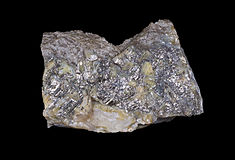
Calaverite is a rare mineral , gold telluride . It was first discovered in Calaveras County ( California , USA ) in 1861 , from where it got its name.
| Calaverite | |
|---|---|
 | |
| Formula | AuTe 2 |
| Physical properties | |
| Colour | Yellow, yellowish white |
| Trait color | Green |
| Shine | Metal |
| Transparency | Opaque |
| Hardness | 2.5 |
| Cleavage | Missing |
| Kink | ragged to conch |
| Density | 9.04-9.35 g / cm³ |
| Syngonia | Monoclinic |
The chemical formula is AuTe 2 . Calaverite is dimorphic with krennerite, having the same composition but differing in the crystal lattice [1] . The chemical composition is close to telluride of gold and silver to sylvanite . The tellurium content is 56.44%, gold - 43.56%.
Calaverite is found in the form of prismatic and needle crystals . Monoclinic syngony . It does not have cleavage . Color from silver white to brass yellow. Density from 9.04 to 9.35 g / cm³, hardness on the Mohs scale - 2.5. It is well soluble in concentrated sulfuric acid .
Finding
The mineral is found in Criple Creek ( Colorado , USA ), in the region of Calaveras ( California , USA ), Sacarimb ( Romania ), Kirkland Lake ( Ontario , Canada ), Rouen ( Quebec , Canada ), Kalgoorlie ( Australia ).
In the 1890s , during the gold rush in Kalgoorlie, almost all calaverite was mistaken for pyrite (“fools gold”) and thrown into the dump , stones from which were later used as filler in the arrangement of city streets. A few years later, the mineral was identified, which caused another gold rush, accompanied by excavation of roads.