Count Ivan Petrovich Saltykov (June 28, 1730 - November 14, 1805 [1] ) - Russian Field Marshal , Moscow Commander- in -Chief in 1797-1804, owner of the Marfino estate. The only son of Field Marshal Pyotr Semenovich Saltykov .
| Ivan Petrovich Saltykov | |||||||||
|---|---|---|---|---|---|---|---|---|---|
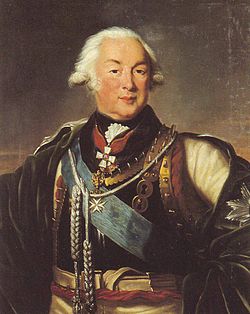 | |||||||||
| Date of Birth | June 28, 1730 | ||||||||
| Date of death | November 14, 1805 (75 years old) | ||||||||
| Affiliation |  Russian empire Russian empire | ||||||||
| Rank | Field Marshal | ||||||||
| Battles / wars | Seven year war Russian-Turkish war (1768-1774) , Russian-Turkish war (1787-1791) , Russian-Swedish war (1788-1790) | ||||||||
| Awards and prizes |
| ||||||||
| Communications | Father Field Marshal P. S. Saltykov | ||||||||


Content
Biography
He began his service at the age of 15 in the Life Guards Semyonovsky Regiment with a private soldier . In 1758, Mr .. was at the imperial court in the rank of chamber junker.
During the Seven Years' War he distinguished himself in the capture of Koenigsberg and Elbing , in the battle of Zorndorf . After the conclusion of the peace he was promoted to major general and received the Order of St .. from Peter III . Anne of the 2nd degree, and in the coronation of Catherine II - Alexander’s tape .
In the first war with the Turks, Lieutenant General Saltykov, under the banner of Rumyantsev, participated in the battle of Cahul . Present at the capture of Khotin . Commander of the heavy cavalry, he drew attention to the courage noted by George the 2nd degree and a golden sword with diamonds.
At the end of the war, General-General Chef Saltykov commanded a corps in the Polish provinces, and in 1784 he was appointed adjutant general and head of two governorates - Vladimir and Kostroma .
In 1780, the Saltykov family went abroad to improve their health; they visited Berlin , Dresden , Brussels . The couple lived for three months in London and spent more than a year in Paris , where they did such enormous debts that the Russian envoy at the French court in letters to Count Vorontsov called them “dishonor of our entire nation” [2] .
In 1788, the renewed war with Turkey again called Saltykov into the ranks of the troops, and he marked himself by the repeated capture of Khotin. In 1790, Catherine entrusted him with command of the Finnish army and, upon conclusion of the Werel peace, granted the rank of lieutenant colonel of the Horse Regiment guard and diamond insignia of the Order of St. Andrey .
As a military leader, Saltykov was more brave than a military talent, about which Suvorov , for example, spoke very skeptically. Disagreements with Rumyantsev forced him to resign in 1795, but the next year, Paul I again called him up for service, renamed him generals from the cavalry and appointed him chief of the Cuirassier regiment , Kiev governor general , general marshal and inspector general over the whole cavalry.
At the end of 1797, Count I.P. Saltykov received the position of Moscow Governor-General, which his father had once held. Virtually all reins were usurped by the favorite of Emperor Paul - Police Officer Ertel . Count Ivan Petrovich reserved only the command of military parades and the splendor of representation. Muscovites for a long time later recalled his magnificent and wasteful lifestyle.
The death of his wife in 1802 became a heavy blow for Saltykov, and, having completely upset his health, prompted him to retire. In 1804, he asked for his resignation and moved to Petersburg to the house of his son-in-law Myatlev , where he soon died. He was buried beside his father in the Nikolskoye family estate near Rostov .
- Sergeant (1748). Warrant Officer (1750). Second Lieutenant (1756) [3] .
- Having received the rank of chamber junker (July 24, 1759) [3] , he joined the court.
- 1760 - Foreman .
- 1761 - Major General .
- 1762 (September 22) - awarded the Order of St. Alexander Nevsky [3]
- 1766 - Lieutenant General .
- 1768-1774 - Participated in the Russian-Turkish war .
- Contributed to the defeat of the Turkish army near Khotyn .
- He was under Larg under the command of P. A. Rumyantsev , where he commanded part of the cavalry, but missed time without receiving an order to pursue the enemy in time.
- In the battle of Cahul, he commanded heavy cavalry and contributed to the complete defeat of the Turkish army.
- 1772 - Having under its command more than twenty infantry and cavalry regiments, he was the first to cross the Danube , besieging Ruschuk .
- 1773 - General-General .
- 1775 (July 10) - awarded the Order of St. George of the 2nd degree "For the repeated renunciation of the enemy in the Turkish war and the passage over the Danube" [4]
- 1780 - Commanded a strong detachment on the southern border of Russia, then - corps in the Polish provinces.
- 1784 - Adjutant General . Governor-General of Vladimir and Kostroma governorates.
- 1787-1791 - Participated in the Russian-Turkish war as a division commander.
- 1788 - Participated in the capture of Khotyn .
- 1789 - Commander of the Kuban Division in the Caucasus.
- 1790 - Participated in the Russian-Swedish war as commander in chief of the Finnish army. After the conclusion of peace with Sweden, he was granted the rank of lieutenant colonel of the Life Guards of the Horse Regiment .
- 1790-1795 - Corps commander.
- 1795 - Resigned.
- With the accession to the throne of Paul I, the emperor’s re-enactment returned to military service and was renamed general from the cavalry, appointed chief of the cuirassier regiment , inspector of the cavalry and the Kiev governor.
- December 15, 1796 - Field Marshal , Inspector General of the cavalry with the subordination of the Ukrainian Army to him (until Count Rumyantsev recovered).
- November 2, 1797 - The first Moscow military governor and commander in the Moscow province for the civilian part.
- 1797 (December 1) - Chief of the Ekaterinoslav cuirassier regiment (until May 01, 1804) [5] .
- November 2, 1804 - Resigned of his own free will.
- Order of the Holy Apostle Andrew the First-Called (November 24, 1782)
- Diamond signs to the Order of the Holy Apostle Andrew the First-Called (1790)
- Order of St. George 2nd degree (July 10, 1775)
- Order of St. Vladimir 1st degree (1789)
- Order of St. Alexander Nevsky (September 22, 1762)
- Diamond signs to the Order of St. Alexander Nevsky (1770)
- Order of St. Anne (June 9, 1762)
- Order of St. John of Jerusalem , Grand Commander's Cross (November 29, 1798)
- Golden sword with diamonds (July 10, 1775)
- Golden sword with diamonds (1790)
Lifestyle
One of the richest nobles of his time, Count Saltykov was a big sybarite, he loved diners and women, but his main passion was hunting , to which he devoted all his free time, having up to a hundred people hounds. Philip Vigel , who often visited the hospitable Saltykovsky estate Marfino near Mytishchi , left the following description of her master:
In the column of Ivan Petrovich Saltykov it was possible to see the type of old nobility, but already accustomed to the European way of life; he loved to live not so much whimsically as widely, had a numerous, but well-dressed maid, expensive carriages, beautiful horses, a brilliant harness; if not everyone, then at least very many had the right to sit daily at his plentiful and tasty table. In his circumvention, which was very simple, the skill of primacy and superiors was always noticeable; in general, he was not a high mind, but not without ability and sharpness; he was not even a stranger to cunning, but she was so mixed in him with good nature that he was praised for that .
Sixty appliances were laid out every day at lunch and dinner at Saltykov; every Sunday several hundred people gathered at his ball. Together with a private theater and crowded hunting trips, such a lifestyle introduced it at a great expense. As a result, Count Saltykov left his only son sixteen thousand peasants, including one thousand two hundred people in the yard, and two million eight hundred thousand debt [6] .
Family
Married to Countess Daria Petrovna Chernysheva (1739-1802), daughter of diplomat P. G. Chernyshev , a very colorful woman who was revered as one of the pillars of the Moscow pre-fire society. Children:
- Praskovya Ivanovna (1772–1859) was a maid of honor, in 1795 she married Senator Pyotr Vasilyevich Myatlev (1756–1833), their son was the famous comedian poet Ivan Myatlev .
- Ekaterina Ivanovna (1776-1815) - maid of honor since 1795, she died a girl.
- Anna Ivanovna (1777-1824) - maid of honor, in February 1800 she married Senator Count Grigory Vladimirovich Orlov (1777-1826), son of V. G. Orlov . She was an attractive and smart woman. Due to illness she constantly stayed abroad; she had a literary salon in Paris. Died childless in France.
- Pyotr Ivanovich (1784-1812), since 1799 chamberlain. The holder of the orders of St. George 4th grade and St. Vladimir 4th degree , was seriously wounded in the battle of Austerlitz . In the unforgettable 1812, he formed his own hussar regiment (called Saltykovsky), sacrificing a significant part of his fortune to his armament. Visiting sick soldiers every day in hospitals, he contracted a fever and, at the age of 28, died in the rank of colonel single.
- Children
Praskovya
Anna
Peter
Notes
- ↑ Volkov S.V., Generals of the Russian Empire. M .: Tsentrpoligraf, 2009.V. 2.P. 449
- ↑ E.P. Karnovich . Remarkable wealth of individuals in Russia.- SPb., 1874.- S. 95.
- ↑ 1 2 3 Knights of the Imperial Order of St. Alexander Nevsky. M.: Russkiy Mir, 2009.V. 1.P. 493
- ↑ Shabanov V.M., Military Order of the Holy Great Martyr and Victorious George. M .: Russian World, 2004.S. 116
- ↑ Podmazo A. Chefs and commanders of regular regiments of the Russian army (1796-1815). M., 1997.
- ↑ dm. Bantysh-Kamensky. "Biographies of Russian Generalissimo and Field Marshals." St. Petersburg 1840
Sources
- Grand Duke Nikolai Mikhailovich . " Russian portraits of the XVIII and XIX centuries ." Issue 2, No. 104.
- Bantysh-Kamensky, D.N. 33rd General-Field Marshal Graf Ivan Petrovich Saltykov // Biographies of Russian Generalissimo and Field Marshal General. In 4 parts. Reprint reproduction of the 1840 edition . - M .: Culture , 1991.