Urethritis is an inflammation of the urethra ( urethra ) caused by damage to the canal wall by various bacteria and viruses .
By the nature of the course of urethritis, an acute and chronic form of the disease is distinguished. Urethritis is divided into gonorrheal (a venereologist deals with their treatment) and non-gonorrheal. Non-chronic urethritis can be infectious and non-infectious, for example, radiation, toxic, allergic urethritis. Another pathology can develop after diagnostic procedures, for example, after catheterization of the bladder or administration of drugs [3] .
| Urethritis | |
|---|---|
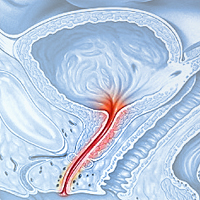 Urethra inflammation | |
| ICD-10 | N 34. |
| ICD-10-KM | |
| ICD-9 | 597 099.4 |
| ICD-9-KM | and |
| Diseasesdb | 27902 |
| Medlineplus | |
| eMedicine | med / 2342 |
| Mesh | D014526 |
Content
Classification
Urethritis is mainly divided into gonococcal ( gonorrhea ) and non-gonococcal [4] .
Epidemiology
Gonococcal urethritis (gonorrhea)
According to international statistics, gonorrhea continues to be one of the most common sexually transmitted diseases. The main route of transmission is through sexual contact, but a common way of infection is possible. The probability of infection in men with a single sexual contact is 17%, which increases in direct proportion to the number of contacts with an infected partner. Gonococci can be transmitted through anal and oral sex.
Non-neococcal urethritis
In recent decades, the incidence of non-gonococcal urethritis has increased dramatically. In 1972, she exceeded the incidence of gonorrhea. More often, young men are sick. Socio - economic status in patients is usually higher than in patients with gonorrhea. [four]
Etiology
Gonococcal urethritis (gonorrhea)
Called by intracellular gram-negative diplococci - Neisseria gonorrhoeae . The incubation period is 3-10 days from the moment of infection (contact), however, some strains of N.gonorrhoeae lead to the development of the disease after 12 hours, while with other strains, urethritis develops only after 3 months.
Non-neococcal urethritis
It is considered a polyetiological disease and is caused by various pathogens. The most common and potentially dangerous etiotropic agent is Chlamydia trachomantis , which causes non-gonococcal urethritis in 40 to 50% of cases. Other causes of non-gonococcal urethritis may be Ureaplasma realticum and Mycoplasma genitalium , detected in 20-30% of patients.
In 20% of patients, the etiology of urethritis cannot be established. The incubation period for non-gonococcal urethritis is 1 to 5 weeks from the time of sexual contact, but more often the incubation period is longer. [four]
Clinical picture
Gonococcal urethritis (gonorrhea)
Patients complain about:
- purulent discharge from the urethra;
- sharp cutting pain
- pain during urination
In 50% of cases, the disease is asymptomatic.
Non-neococcal urethritis
Patients complain:
- on mucous (sometimes profuse, purulent) discharge from the urethra;
- sharp cutting pain;
- pain during urination [4] .
Diagnostics
Gonococcal urethritis (gonorrhea)
Inspection is recommended not earlier than 1 hour (preferably 4 hours) after the last urination. When examining the external genitalia, hyperemia and clumping of the external opening of the urethra, purulent discharge of yellow and white color, which can appear independently or with compression of the urethra, are noted.
The foreskin, scrotum, prostate, rectum, and inguinal lymph nodes should be examined.
The diagnosis of gonorrhea is made on the basis of a history of sexual contact, complaints of purulent discharge from the urethra, dysuria, a positive Gram smear (smear is taken from the urethra). A highly informative method for detecting gonococcal antigens is a smear test using PCR.
Non-neococcal urethritis
Physical examination is absolutely similar to that for gonococcal urethritis.
The diagnosis of non-gonococcal urethritis is established on the basis of a history of sexual intercourse, relevant complaints, the absence of gonococci and the presence of signs of urethritis when examining a Gram smear (smear is taken from the urethra). Currently, various non-cultural methods for the diagnosis of pathogens have been developed and are being used: PCR and NASBA. These methods give results after 24 hours [4] .
Treatment
Gonococcal urethritis (gonorrhea)
For the treatment of the acute uncomplicated form of gonorrhea, the use of ceftriaxone 250 mg intramuscularly (single injection) is recommended, followed by the administration of tablet doxycycline 100 mg 2 times a day for 7 days (treatment of concomitant chlamydia). As an alternative to ceftriaxone, a single dose of tableted spectinomycin 2 g is used. At the same time, sexual partners are treated regardless of the results of their examination.
Non-neococcal urethritis
Therapy is prescribed based on the causative agent of the disease. The following therapeutic regimens are recommended:
- doxycycline - 100 mg, 1 tablet 2 times a day for 7 days or
- azithromycin - 1 g orally single dose
with trichomonas urethritis, the appointment of metronidazole is recommended either a single dose of 2 g, or 500 mg 2 times a day for 7 days.
At the same time, sexual partners are treated regardless of the results of their examination.
If it is not possible to establish an etiotropic agent, then additional treatment with antibiotics of other groups (a wide spectrum, except penicillins) is required [4] .
Complications
Gonococcal urethritis (gonorrhea)
Gonococcal urethritis can be complicated by epididymitis , prostatitis , vesiculitis, and subsequently urethral stricture .
Non-neococcal urethritis
Reiter's syndrome is a rare complication of chlamydial urethritis, manifested by arthritis, conjunctivitis, balanitis and / or blenorrheic keratoderma (the classic triad is urethritis + conjunctivitis + arthritis) [4] .
Urethritis Prevention
For prevention, it is important to observe the rules of personal and sexual hygiene, timely treat inflammatory and infectious diseases . The main method of prevention is the use of condoms.
Urethritis in animals
With this disease, frequent urination is noted, blood and pus impurities are found in the urine. The disease may be due to urethral injuries due to unsuccessful catheterization or infringement of urinary stone. It is treated with disinfectant solutions, which are used to rinse the urethra [5] .
Notes
- ↑ Disease Ontology release 2019-05-13 - 2019-05-13 - 2019.
- ↑ 1 2 Monarch Disease Ontology release 2018-06-29sonu - 2018-06-29 - 2018.
- ↑ What Is Urethritis: Types, Characteristic Symptoms, Treatment Methods (October 5, 2018). Date of treatment January 8, 2019.
- ↑ 1 2 3 4 5 6 7 Glybochko P.V., Alyaev Yu.G. Urology. - 1. - Phoenix, 2013 .-- 528 p. - ISBN 978-5-222-20733-8 .
- ↑ B.V. Usha. Internal diseases of animals. - M .: KolosS, 2010 .-- 311 p.
Literature
- Home Medical Encyclopedia. Ch. ed. V.I. Pokrovsky. M .: " Medicine ", 1993. S. 431.