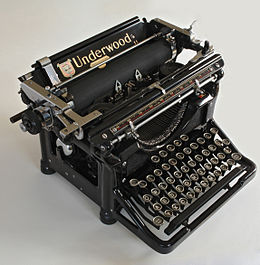

Typewriter ( read simple. Modern [1] “typewriter”) - a mechanical, electromechanical or electronic-mechanical device equipped with a set of keys , pressing which leads to printing the corresponding characters on the medium (in most cases this is paper ). It was widely used in the XIX - XX centuries . Currently, typewriters are mostly obsolete; personal computers equipped with printers began to perform their function.
The principle of operation of most typewriters is to apply characters to paper using special levers ending in pads with metal or plastic letters . When you press the appropriate key, the lever strikes the ink- saturated ribbon, thus leaving an imprint of the letter on the input sheet of paper. Before printing the next character, the paper sheet is automatically shifted (as well as scrolling the ink ribbon, as a rule). To print multiple copies of the same document, sheets of carbon paper are placed between normal paper sheets.
If in the middle of the XX century it was impossible to imagine the office of an organization without a typewriter, then by the beginning of the XXI century only a small number of traditional manufacturing companies such as Smith-Korona , Olivetti , Adler-Royal , Olympia , Brother , Nakajima and others continued to produce such devices, and most of the listed companies at that time were engaged in the production of electronic models of typewriters.
In April 2011, the Mumbai typewriter plant, owned by the Indian company Godrej and Boyce, closed, prompting several media reports to close the "last typewriter plant" [2] [3] [4] , which was soon rebutted [5] [6] [7] .
In November 2012, Brother launched a typewriter called "The Last Made in the UK"; the car was donated to the London Museum of Science [8] .
Content
Creation History
Like most other technical devices and inventions , the development of a typewriter mechanism was not the result of the efforts of a single person. Many people, jointly or independently, came up with the idea of quickly printing texts. The first patent for a car of this kind was issued by the English Queen Anne Henry Mill ( Eng. Henry Mill ) back in 1714 . The inventor patented not only a machine, but also a method of sequential printing of characters on paper . Unfortunately, no detailed information about his invention has been preserved. Also, information about the actual creation and application of the described machine was not preserved [9] .
Only after almost 100 years, people again became interested in the possibility of performing fast printing. Around 1808, Pellegrino Turri ( Pellegrino Turri ), also known as the inventor of carbon paper , creates his own printing press. Details of his invention are unknown today, however, texts printed on this device have survived to our time [10] .
In 1870, Russian inventor Mikhail Ivanovich Alisov invented a typesetting machine , known as the “ typographer ” or “scribbler,” in order to replace the calligraphic rewriting of papers and manuscripts, a machine for translating into lithographic stone . The print printer was suitable for its purpose, received medals and high reviews at three world exhibitions in Vienna (1873), Philadelphia (1876) and Paris (1878), the Russian Imperial Technical Society awarded the medal. In terms of printing device and appearance, it was significantly different from most of the machines we knew, wax paper was punched on it, which was then propagated on a rotator .
The machine did not become popular because of the high cost of printing. When the first production batch of machines made in England was received in 1877 , they were equated with printing machines, and everything that was printed on them should be censored. This was due to the fact that she gave prints of excellent quality, completely similar to typographic. Due to mandatory censorship, no one wanted to buy these typewriters, and the inventor had to open his own institution for printing lectures, which had existed for a very short time [11] [12] .
On June 23, 1868, Christopher Latham Scholes of Wisconsin patented his typewriter; with significant changes and improvements six years later, she saw the light under the name Remington No. 1 [9] .
In pre-revolutionary Russia, typewriters were not produced, but used. However, due to the peculiarities of pre-revolutionary spelling, the key placement was somewhat different from the current one:
- the letters "C" and "E" were located in the uppermost "digital" row on the right;
- in the upper letter row at the place where the letter “Ts” is now, “I” was placed;
- in the middle row between the keys “B” and “A” there was “b”, because then this letter was used very often, at the end of all words ending in a consonant;
- in the bottom row between the keys “C” and “C” was a key with the letter “Ѣ” [13] .
On portable machines, in order to reduce the number of letter levers, the numbers "0", "1" and "3" were missing, which were replaced by the letters "O", "I" and "Z", respectively.
In Soviet times, the letters "I" and "Ѣ" (on portable machines as well as "b") were excluded from keyboards, in their place for some time there were other symbols (No., +, =,?,!). Later, all non-letter characters were placed in the upper “digital” row, and the letters “C” and “E”, on the contrary, were transferred to the letter rows, after which the layout acquired a modern look.
The first typewriter in Russia was produced in 1928 in Kazan, it was called "Yanalif" [14] . In later times, the most common domestic brands of typewriters in the USSR were Ukraine (clerical), Moscow (portable), Lyubava (portable) and Yatran (clerical). From abroad, typewriters of the Optima and Robotron brands (GDR, stationery, in various modifications), Erica (GDR, portable), UNIS tbm de luxe (SFRY, portable under Olympia license) were widely distributed (Germany)) and "Consul" (Czechoslovakia, portable) [15] .
Design Features
Most typewriter designs can be attributed to one of four main types:
- cylindrical
- lever
- ball
- "chamomile"
The most widely used are lever-segmented typewriters and machines with daisies.
The writing cylinder is not widely used in typewriters. There were only a few machines with a writing cylinder: Mignon (1924), Plurotyp (1933), Helios-Klimax (1914), Heady (1921).
On typewriters with levers, the imprint is obtained as a result of hitting the levers located in the slots of the segment on the paper. Machines with writing levers include Olympia machines (SG, SGE, SM, SF, etc.), Adler machines (Adler Gabriele 2000, Adler Primus, Adler Tippa, etc.), Remington cars (Remie Scout, Monarch / Monarch Pioneer, Remington Rand, etc.), Hermes cars, "Hermes 3000", "Hermes Rocket", etc.), Soviet cars ( "Yatran" , "Lyubava" , "Larch" , etc.).
Writing heads or balloons are associated with IBM machines because in 1961 they first appeared on the machines of this company ( IBM Selectric ). Later, the writing heads / balls were used on both Remington machines (eg, on the Sperry Remington SR 101 model) and Quelle machines (eg on the Privileg 910C lift-off model). Writing balls are convenient because they can be replaced and thus can be printed in several fonts on the same machine.
Writing chamomile is a specific carrier of matrices from which an imprint is made (there is one sign on each chamomile petal). Daisies are convenient because they are easy to replace, and on one machine, replacing one daisy with another, you can print in several fonts. Writing daisies gained great popularity and were used on machines of different manufacturers: on IBM machines (eg, on IBM 3000, IBM 6787, IBM 6747 and Wheelwriter), on Olympia machines (ES 70-Line ”,“ Carrera ”,“ Mastertype ”,“ Mini-Office ”, etc.), on Canon machines (eg on Typestar and Typemate models), on Triumph- Adler ”(eg, on the Triumph-Adler Gabriele 150, Triumph-Adler Junior Electronic models), on Olivetti machines (eg on the ET Compact, ET Personal and Linea models) , on Hermes machines (for example, on Toptronic and Mediatronic models), on machines of other manufacturers (Samsung SQ, Samsung TW, Brother CE, Brother SX, Brother WP / WPT , Optima SB / SP, Erika 3004 Electronic, Erika 6005/6006, Erika Electronic Portable, Casio 130CE / 140CE, Citizen Scribona 10/11/15, Lexmark Wheelwriter). In the USSR, in the second half of the 1980s and in the early 1990s, a petal-type machine was produced — the Romashka typewriter (type PELP-305, portable electronic [16] ). Chamomile is used only on electronic typewriters.
By design, there is a division into mechanical, electrical ("electromechanical") and electronic typewriters. For mechanical, refers, for example, Lyubava , and for electromechanical, Yatran .
In addition, depending on the purpose and size, the typewriters are divided into office and portable. Stationery machines are used, as a rule, in stationary conditions. Portable cars are small-sized, placed in a small suitcase such as a case and are intended for people of creative professions and those who travel often (these are cars of journalists, writers, students, scientists, businessmen, etc.).
Stationery and typewriters also differed in the number of keys (on portable typewriters there were fewer keys). So, for example, on portable typewriters with Russian Cyrillic alphabet, the number of keys — depending on the make and model of the machine — ranged from 42 to 46. The reduction in the number of keys was achieved the expense of rejecting the key with the letter “ E ”, the use of homography of some letters and numbers (instead of the number “ 0 ” the letter “ O ” could be used, instead of “ 3 ” - “ Z ”), and some other forms of practicality and economy. On stationery machines, carriages are long, so you can print on such machines along the wide side of a sheet of A4 format and, accordingly, in A3 format. On portable machines, the carriages were short and printing was possible only along the narrow side of an A4 sheet.
Carriage
The typewriter carriage arrangement depends on the design of the printing mechanism.
In a typewriter with a lever-segment letter carrier on the carriage is the entire mechanism of the paper drawer, the width of the carriage corresponds to the width of the print area, the carriage with paper moves relative to the stationary printing mechanism. When printing each character, the carriage shifts by one familiarity, usually there is a call signaling several characters before the end of the line. In a mechanical typewriter, the carriage is returned manually by a special lever; at the same time, the line is run for a given line spacing. The carriage return of the electric typewriter is mechanized and is started by a key on the keyboard.
On the typewriter carriage with a ball or chamomile letter-carrier, a printing mechanism and a mechanism for drawing a ribbon are mounted. The carriage with the printing mechanism moves within the size of the typewriter relative to the paper.
Paper Guide
Typewriters use a friction paper feed consisting of a support shaft and a pinch roller. The paper support shaft usually has handles for manual paper feed. To release the paper, the pressure roller is retracted from the paper support lever. In electronic typewriters, paper feeding can be automated.
The printing mechanism
Enhancements
A two- color ribbon allowed printing, if necessary, in a different color than black. The color changer could even completely disable the ribbon lift, and the machine switched to colorless printing, for example, to create a label on the foil.
In an electric typewriter, impact and auxiliary operations are carried out by an electric drive, which allows you to press keys with low effort and automate carriage return; in addition, you can print a series of identical characters by simply holding the key down. In general, the print speed is higher, but only when using the blind ten-finger printing method.
An electronic typewriter is a specialized computer . The keyboard does not have a mechanical connection with the printing mechanism, which can be chamomile or matrix type, the processes of typing and printing of text can be separated in time. Most electronic typewriters have service functions such as memory, basic text editing capabilities, and spell checking. An electronic typewriter with advanced service functions, a display and the ability to work with removable media is called a word processor . Some models may be connected to a computer for use as a printer .
In the printing machine, simultaneously with the printing of the text, the punched tape is perforated, which allows you to collect a kind of library of standard documents - the printing machine can then print the text from the punched tape; in addition, by cutting and gluing the punched tape, you can "edit" the typed text.
In a typewriter , a proportional rather than a fixed font is used; in addition, carbon paper tape is used instead of ink ribbon. The result is a very clear typographic text with which photographic forms can be photographed, thus avoiding the traditional typing process.
A multi-keyboard typewriter is actually several typewriters placed side by side and connected so that the carriage can move from one typewriter to another. This allows you to print, for example, alternately in Latin and Cyrillic. Because of the bulkiness, they were rarely used - usually the text in the "alien" alphabet was entered by hand.
Design typewriter is used to inscribe on drawings; usually mounted on a Kuhlman ruler.
Application
For a significant part of the 20th century, almost all official documents emanating from state authorities (and their internal document flow) were typed. Moreover, in the USSR, statements, receipts and autobiographies of citizens were written by hand; protocols were often compiled by hand. Publishers also demanded to bring manuscripts in typewritten form, which greatly facilitated the work of typesetters, who now did not need to parse the often obscure handwriting of the authors.
Reprinting of handwritten texts on a typewriter was the work of special workers - typists [17] (since the profession was mainly female, the male version of the term did not take root); previously they were also called remingtonists or remingtonists [18] (according to the Remington brand of cars). The work of printing documents on typewriters was called typewriting work and was carried out in special organizations or departments ("typewritten bureaus").
Starting from the last third of the 20th century, printers and electronic document management began to gradually replace typewriters. However, the use of the latter is still considered advisable in a number of areas, for example, for the preparation of secret documents, where the absence of a digital copy of the text is an advantage, since it complicates the leakage of information [19] .
In music, a typewriter can be used as noise percussion ; The most famous piece of music using a typewriter is The Typewriter , a piece for typewriter and orchestra (1950).
Typewriter
Typewritten text has the following characteristics:
- most often all signs occupy an equal space on paper ; however, there are also machines with proportional fonts (eg, Graphika mechanical machines from Olivetti, IBM electric and electronic machines, etc.).
- due to the limited character set, some characters were combined - for example, left and right quotes are not distinguished, hyphen and dash are combined.
All this made it possible to simplify the design of the typewriter.
When creating teletypes and computer printers, these features were repeated - also in order to simplify the hardware and software. Many early word processors (such as Lexicon , ChiWriter ) were designed to simulate typewritten text, partly because the design of many documents was governed by state standards created in the era of typewriters.
Courier family computer fonts, used as default monospaced fonts in many operating systems, are based on a typewriter font. In addition, there are designer fonts that imitate the "dirty" text printed on a real typewriter (for example, "Trixie").
Mechanical typewriters made it possible to obtain text with different spacing between lines: single, one-and-a-half, double, etc. [20] The concept of line spacing is now also used in word processors . The regulatory documents and standards governing the design of text documents still use the concept of "typewriter spacing" ("typewriter spacing"), which is numerically equal to the distance between the baseline divided by the height of the character.
See also
- Printer
- Word processor
- Linotype
- Typesetter
- Yatran (typewriter)
- Lyubava (typewriter)
- Typewritten page
- Blind Printing Method
- Projection keyboard
- Letter (writing)
- Japanese typewriter
- Ibrahim al-Yaziji
- Samizdat
Notes
- ↑ Maxim Krongauz. “To the death of a typewriter” . Arzamas .
- ↑ Andrey Velichko. The era of typewriters Ended . Compulent (April 26, 2011). Date of treatment December 12, 2011.
- ↑ CBC News . World's last typewriter plant stops production (April 26, 2011). Date accessed May 29, 2014. “A previous version of this story did not clearly state that Godrej & Boyce appears to be the world's last maker of mechanical typewriters, which operate solely on human power. Numerous other manufacturers continue to make several types of electric typewriters. ".
- ↑ India has closed the world's last typewriter factory . Newspaper.ru (April 26, 2011). Date of treatment May 29, 2014. Archived on August 26, 2011.
- ↑ Wite Out? World's 'last typewriter factory' apparently isn't . Content.usatoday.com (April 26, 2011). Date of treatment March 30, 2012. Archived July 15, 2013.
- ↑ Romenesko, Jim Reports of typewriter's death are premature (link not available) . Poynter.org (April 26, 2011). Date of treatment March 30, 2012. Archived July 15, 2013.
- ↑ Memmott, Mark Has The Last Typewriter Factory Closed? Not Really Npr.org (April 26, 2011). Date of treatment March 30, 2012. Archived July 15, 2013.
- ↑ UK's 'last typewriter' produced . BBC (November 20, 2012). Date of treatment May 29, 2014.
- ↑ 1 2 Oden, Charles Vonley (1917), Evolution of the Typewriter , New York: Printed by J. E. Hetsch, p. 17-22 , < https://archive.org/details/evolutionoftypew00oden > (eng.)
- ↑ Kupriyanov Alexey. Black rectangle. 200 years marks of carbon paper . Polit.ru (October 20, 2006). Date of treatment April 30, 2010. Archived on August 26, 2011.
- ↑ Lermantov V.V. Brockhaus and Efron Encyclopedic Dictionary. - St. Petersburg. - T. 23A. - S. 753-754.
- ↑ Goizman Shimon Ruvimovich. Mikhail Ivanovich Alisov - inventor of the typesetting machine . Date of treatment April 30, 2010. Archived on August 26, 2011.
- ↑ http://nt.ru/tp/it/pm.htm .
- ↑ writing machine
- ↑ The assortment of Soviet and foreign-made typewriters (usually from socialist countries) that were present on the USSR market in the mid-1980s is described in the book of G.M. Belousov (See: G. Belousov, Organizational Technique Tools; catalog - reference book. M., Publishing House "Economics", 1985, p. 4-8; Collection of useful articles about typewriters. Issue No. I. M., Club of fans of typewriters, 2016).
- ↑ Produced by the Kursk Production Association “Schetmash”.
- ↑ Typewriter // Explanatory Dictionary of the Russian Language: 4 t. / Ed. D.N. Ushakova . - M .: Soviet encyclopedia ; OGIZ ; State Publishing House of Foreign and National Dictionaries , 1935-1940.
- ↑ Remingtonist // Explanatory Dictionary of the Russian Language: 4 t. / Ed. D.N. Ushakova . - M .: Soviet encyclopedia ; OGIZ ; State Publishing House of Foreign and National Dictionaries , 1935-1940.
- ↑ Alexander Yunashev. After the scandal with Snowden, the FSO buys typewriters . Printing secret documents in electronic form is not always safe, according to the intelligence agency . Izvestia (July 11, 2013) . - “After the scandal with the“ resignation ”of the head of Russian Railways, Vladimir Yakunin, and the“ plums ”of Edward Snowden, the FSO decided to purchase 20 typewriters for printing classified documents. The corresponding order in the amount of 486.5 thousand rubles has been placed on the public services portal. ” Date of treatment July 11, 2013. Archived July 15, 2013.
- ↑ The shift of the next line relative to the previous one was done automatically with the so-called “carriage transfer” - the transition to printing the next line by moving a special lever. As a rule, the interval could be manually adjusted by turning the paper feed shaft.