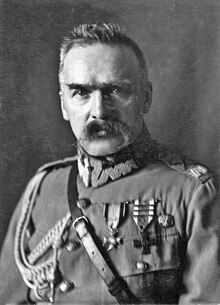
Sanation ( Polish Sanacja from Latin sanatio “recovery”) is the common name for a political movement that arose in connection with the proclamation by Jozef Pilsudski of the slogan of “ moral sanitation ” of public life in Poland , which was put forward during the preparation and during the May 1926 coup . Parliament played a minor role. Political opposition was suppressed.
The movement was based on former army officers who loathed corruption in Polish politics. Remediation was a coalition of various political forces with an emphasis on eliminating corruption and reducing inflation .
The main political organization of the rehabilitation was the Non-Party Bloc of Cooperation with the Government (1928-1935) ( Polish Bezpartyjny Blok Współpracy z Rządem Józefa Piłsudskiego (BBWR) ), and since 1937 - the National Association Camp .
In August 1926, significant amendments were made to the 1921 Constitution . The President received the right to prematurely dissolve the Seimas and the Senate and call new elections, issue decrees that have the force of law until they are approved or not approved by Parliament. The diet began to work on a sessional, but not on an ongoing basis. Only the president had the right to open and close his sessions. Preliminary censorship of the press was introduced.
Remediation established authoritarian rule, fought against communism , proclaimed theses on the crisis of democracy , the need for strong power and the elimination of opposition parties. In general, the Pilsudski regime was of a center-right , conservative - paternalistic nature.
Examples of the fight against the opposition, among others, were the creation of a concentration camp in the Birch-Kartuz , the Brest process , the outlawing of the Great Poland Camp , as well as the National Radical Camp , and restrictions on freedom of the press and assembly.
In April 1935 , shortly before the death of Pilsudski, a new Constitution was adopted in Poland, which included the basic principles of Reorganization: a strong centralized state with a presidential system of government. Soon after the death of Pilsudski, the movement faced a number of internal problems and disagreements: in the end, it broke up into three separate areas:
- Left reorganization ( Polish. Lewica sanacyjna ), with leader Valery Slawek ( Polish. Walery Sławek ), who sought an agreement with the opposition;
- The castle group ( Polish Zamek ), formed around President Ignatius Moscitzky (who lived in Warsaw Castle - hence the name) - are centrists;
- The right-wing sanitation ( Polish: Prawica sanacyjna ), grouped around Edward Rydz-Smigly in alliance with the National Association Camp, is nationalists.
The first of these areas soon lost its significance, while the other two continued to struggle for influence before the outbreak of war .
On March 17, 1938, Poland, with German support, presented an ultimatum to Lithuania demanding that the Vilnius region , occupied by Lithuania in 1920, be recognized as an integral part of the Polish state. Otherwise, Poland threatened to occupy the country. Polish troops began shelling Lithuanian territory. The government of Lithuania on March 19, 1938 accepted the demand of Poland to open the borders. Lithuania and Poland established diplomatic relations .
The Second World War put an end to the reorganization government, but its leaders retained significant ties in the emigrant government and its underground structures in Poland. The ideology of rehabilitation is now supported by the Confederation of Independent Poland .
See also
- The May coup in Poland (May 14, 1926)
- Colonel Group
- Prometheism
- Non-partisan government cooperation unit
- Concentration camp in Birch-Kartuzskaya
- 1935 Polish Constitution
- Central industrial region
- National Association Camp
- Munich agreement
- Occupation by Hungary of Transcarpathian Ukraine (1939)
Links
- Sanacja // nationmaster.com (Polish)
- Przemiany ustroju Polski w latach 1921-1935 (Polish)