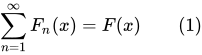
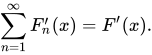
Without loss of generality, all functions can be considered {\ displaystyle F '(x)} non-negative and equal to zero for {\ displaystyle x = a} ; otherwise you can replace {\ displaystyle F_ {n} (x)} on {\ displaystyle F_ {n} (x) -F_ {n} (a)} . The sum of a number of non-decreasing functions is, of course, a non-decreasing function.
Consider the set {\ displaystyle E} full measure on which all exist {\ displaystyle F_ {n} '(x)} and {\ displaystyle F '(x)} . At {\ displaystyle x \ subset E} and any {\ displaystyle \ varepsilon} we have:
- {\ displaystyle {\ frac {\ sum \ limits _ {n = 1} ^ {\ infty} [F_ {n} (\ varepsilon) -F_ {n} (x)]} {\ varepsilon -x}} = { \ frac {F (\ varepsilon) -F (x)} {\ varepsilon -x}}.}
Since the terms on the left are non-negative, for any {\ displaystyle N}
- {\ displaystyle {\ frac {\ sum \ limits _ {n = 1} ^ {N} [F_ {n} (\ varepsilon) -F_ {n} (x)]} {\ varepsilon -x}} \ leqslant { \ frac {F (\ varepsilon) -F (x)} {\ varepsilon -x}}.}
Passing to the limit at {\ displaystyle \ varepsilon \ to x} we get:
- {\ displaystyle \ sum _ {n = 1} ^ {N} F_ {n} '(x) \ leqslant F' (x),}
where, rushing {\ displaystyle N} to {\ displaystyle \ infty} and considering that everything {\ displaystyle F_ {n} '(x)} non-negative, we find:
- {\ displaystyle \ sum _ {n = 1} ^ {\ infty} F_ {n} '(x) \ leqslant F' (x). \ qquad (2)}
We show that in reality for almost all {\ displaystyle x} there is an equal sign. Find for a given {\ displaystyle k} private amount {\ displaystyle S_ {nk} (x)} row (1) for which:
- {\ displaystyle 0 \ leqslant F (b) -S_ {nk} (b) \ prec {\ frac {1} {2 ^ {k}}}. \ quad (k = 1, \; 2, \; \ ldots )}
Since the difference
- {\ displaystyle F (x) -S_ {nk} (x) = \ sum _ {j \ succ nk} F_ {j} (x)} - non-decreasing function, then for all {\ displaystyle x}
- {\ displaystyle 0 \ leqslant F (x) -S_ {nk} (x) \ prec {\ frac {1} {2 ^ {k}}}}
and therefore a number of non-decreasing functions
- {\ displaystyle \ sum _ {k = 1} ^ {\ infty} [F (x) -S_ {nk} (x)]}
converges (even evenly) over the entire segment {\ displaystyle a \ leqslant x \ leqslant b} .
But then, according to what was proved, a number of derivatives converge almost everywhere. Common member of this series {\ displaystyle F '(x) -S_ {nk}' (x)} tends to zero almost everywhere, and, therefore, almost everywhere {\ displaystyle S_ {nk} '(x) \ to F' (x)} . But if in inequality (2) there was a sign {\ displaystyle <} , then no sequence of partial sums could have a limit {\ displaystyle F '(x)} . Therefore, in inequality (2) for almost every {\ displaystyle x} there should be an equal sign, which we argued.