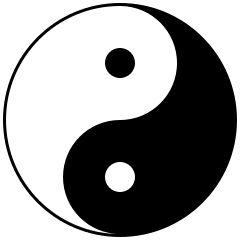
Yin and yang ( Chinese trad. 陰陽 , ex. 阴阳 , pinyin : yīn yáng ; yap. 陰陽 yin-yo:) is the stage of initial cosmogenesis in the view of Chinese philosophy , the acquisition of the greatest separation of two opposite properties. It is graphically indicated by the appearance of two different colors in two opposites - light and dark.
Origin
According to the famous Russian orientalist, Doctor of Historical Sciences Aleksei Maslov , Yin-Yang symbolism may have been borrowed by Taoists from Buddhists in the 1st – 3rd centuries: “they were attracted by Buddhist hand-drawn symbolism - and Taoism has its own“ mandala ”: the famous black and white "fish" yin and yang " [1] .
Philosophical Concept
Historical Review
In the “Book of Changes” (“I Ching”), yang and yin served to express light and dark, hard and soft. In the process of the development of Chinese philosophy, yang and yin more and more symbolized the interaction of extreme opposites: light and darkness, day and night, sun and moon, heaven and earth, heat and cold, positive and negative, even and odd, etc. An exclusively abstract meaning they received yin-yang in speculative schemes of neo-Confucianism , especially in the doctrine of "li" ( Chinese 禮 ) - absolute law. The concept of the interaction of the polar yin-yang forces, which are regarded as the main cosmic forces of motion, as the root causes of constant variability in nature, is the main content of most dialectical schemes of Chinese philosophers. The doctrine of the dualism of yin-yang forces is an indispensable element of dialectical constructions in Chinese philosophy. In the V - III centuries. BC e. in ancient China there was a philosophical school of yin yang jia . Representations of yin-yang also found diverse application in the development of the theoretical foundations of Chinese medicine, chemistry, music, etc.
Discovered in China several millennia ago, this principle was originally based on physical thinking. However, as it developed, it became a more metaphysical concept. In Japanese philosophy, the physical approach has been preserved; therefore, the division of objects according to the yin and yang properties differs between the Chinese and Japanese [2] . In the new Japanese religion, oomoto-kyo are the concepts of the divine Izu (fire, yo ) and Mizu (water, ying ).
The single primordial matter of tai chi gives rise to two opposite substances - yang and yin , which are one and indivisible. Initially, "yin" meant "northern, shadow", and "yang" - "southern, sunny slope of the mountain." Later, yin was perceived as negative, cold, dark and feminine, and yang as a positive, bright, warm and masculine.
The Nei-Ching treatise on this occasion says:
The pure substance of yang is transformed in the sky; the muddy substance of yin is embodied in the earth ... Heaven is the substance of yang, and earth is the substance of yin. The sun is the substance of yang, and the moon is the substance of yin ... The substance of yin is peace, and the substance of yang is mobility. The substance yang gives birth, and the substance yin nurtures. The substance yang transforms the breath-qi, and the substance yin forms a bodily form.
The meaning of the concept
Being the main (fundamental) model of everything, the concept of yin-yang reveals two points that explain the nature of Tao . Firstly, everything is constantly changing. And, secondly, opposites complement each other (there cannot be black without white, and vice versa). The goal of human existence, therefore, is the balance and harmony of opposites. There can be no “final victory”, for there is nothing final, there is no end as such [3] .
The Five Elements as Spawned by Yin and Yang
The interaction and struggle of these principles give rise to five elements (primary elements) - y-sin : water, fire, wood, metal and earth, from which all the diversity of the material world arises - "ten thousand things" - wan u , including man. The five elements are in constant motion and harmony, mutual generation (water gives rise to wood, tree - fire, fire - earth, earth - metal, and metal - water) and mutual overcoming (water extinguishes fire, fire melts metal, metal destroys wood, tree - the earth, and the earth falls asleep water).
Yin and Yang in Traditional Chinese Medicine
The doctrine of yin and yang is one of the theoretical foundations of traditional Chinese medicine . All phenomena of the world, including man and nature, are interpreted by Chinese medicine as the interaction between the two principles of yin and yang , which are various aspects of a single reality.
One example of the application of the yin-yang concept in Chinese medicine is the system of restrictions placed on a recently born woman.
Similar concepts in other teachings.
- Purusha and Prakriti are fundamental concepts of Hinduism . Male and female beginnings.
- Anima and animus are terms coined by Jung in psychology. Feminine and masculine beginnings.
- The Ohr and Kli (light and vessel) in Kabbalah are two sides of one action, the root of which is the interaction of the Creator and creation.
- Algiz and Ir (Yr) - in the Junior Futhark runes, symbolizing protection and death, male and female, upper and lower worlds.
See also
- Chinese horoscope
- Flag of south korea
- Tai chi
- en: Taijitu
- The law of unity and struggle of opposites
Notes
- ↑ http://ec-dejavu.ru/t-2/Taoism.htm (inaccessible link)
- ↑ Shiro Matsuoki The Beginning of Yin and Yang Archived copy of February 4, 2010 on the Wayback Machine (unavailable link from 11/05/2013 [2291 days]) // Applied Macrobiotics.
- ↑ Miller, J. Daoism. c. 54. Archived copy (inaccessible link) . Date of treatment February 19, 2014. Archived December 23, 2014.
Literature
- Maslov A.A. Yin and Yang: chaos and order .
- Martynenko N.P. Prerequisites for the emergence of the concept of "yin-yang" in Chinese culture // Arbor mundi. World tree. International Journal of Theory and History of World Culture. M., 2006. Issue. 12, pp. 46–69.
- Markov L. The system of dual opposites Yin - Yang in comparative coverage. // East. M., 2003. No. 5. P. 17-31.
- Demin R.N. Yin Yang School // Cultures in Dialogue. Vol. 1. - Yekaterinburg, 1992.S. 209-221. ISBN 5-7525-0162-8
- Zinin S. A. Five Elements and the Yin Yang Concept // Quantitative Methods in the Study of the History of the East. M., 1986. S. 12-17.