Moskhovaittsia [2] ( Latin Moschowhaitsia ) is a genus of terocephals that lived during the Permian period ( Vyatka century , 265.0–252.3 million years ago) in the territory of modern Vladimir and Nizhny Novgorod regions ( Russia ) [3] . The only genus in the Moschowhaitsiid family [2] (Moschowhaitsiidae) [1] or one of the genera of the Whaitsiidae family [4] . It is part of the so-called Vyaznikov fauna of Eastern Europe.
| † Moskhovitesia |
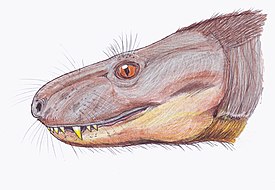
Head reconstruction |
| Scientific classification |
|---|
| No rank : | Bilateral symmetrical |
| Family: | † Moschowhaitsiidae Tatarinov, 1963 |
|
| International scientific name |
|---|
Moschowhaitsia Tatarinov , 1963 |
| Synonyms |
|---|
- Hexacynodon Tatarinov, 1963 [1]
|
| Single view |
|---|
† Moschowhaitsia vjuschkovi
Tatarinov, 1963 - synonyms [1] :
- Hexacynodon purlinensis
Tatarinov, 1974
|
Geochronology265.0–252.3 Ma | million years | Period | Era | Aeon |
|---|
| 2,588 | Even | | | Ka | F
but
n
e
R
about
s
about
th | | 23.03 | Neogene | | 66.0 | Paleogen | | 145.5 | a piece of chalk | M
e
s
about
s
about
th | | 199.6 | Yura | | 251 | Triassic | | 299 | Permian | P
but
l
e
about
s
about
th | | 359.2 | Carbon | | 416 | Devonian | | 443.7 | Silur | | 488.3 | Ordovician | | 542 | Cambrian | | 4570 | Precambrian |
◄ Nowadays◄ Cretaceous-Paleogene extinction◄ Triassic extinction◄ Mass Permian Extinction◄ Devonian extinction◄ Ordovician-Silurian extinction◄ Cambrian explosion |
|---|
|
The only species, Moschowhaitsia vjuschkovi , was described by L.P. Tatarinov in 1963 from the Oka River basin in the Vladimir Region. These deposits belong to the boundary Permo-Triassic. Gorgonops at that time was gone and the main predators were primitive archosaurs and large terocephals. The length of the skull of Moscovitesia exceeded 20 cm - the animal was the size of a wolf. The muzzle is massive, relatively short, the teeth are powerful, few in number. Zygomatic arches wide, occipital part of skull low.
A related terocephalus of Vyatkosuh ( Viatkosuchus sumini ) was found in more ancient deposits of Kotelnich . A significant part of the skeleton is known for vyatokozuh - it had massive relatively short legs, and the front legs were "spread out", like a crocodile. Perhaps such terocephals were relatively inactive and preyed on small prey from an ambush. Moskhovaitsya could eat carrion. Imprints of blood vessels are developed on the facial bones of Moskhovaysia - the soft integuments of the muzzle were not very thick, but they were well supplied with blood. The animal almost certainly possessed vibrissae , but did not have soft lips. Thus, terocephals showed some signs of mammals, although they did not belong to their direct ancestors.
