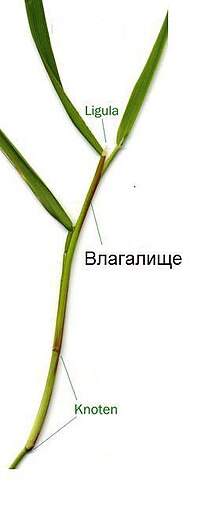
Vagina ( English sheath , lat. Vaginula ) - part of the leaf located at the base, expanded in the form of a groove or tube and covering the stem . In many plants, the lower leaves, and in some all, are reduced, and are represented only by vaginas.
Examples of different plants
In some plants (in most monocotyledons), the base of the leaf grows strongly and, covering the entire node, forms a leaf vagina. However, in different species, it varies in shape. So, the vagina in umbellate does not cover the stem very much, and in cereals it reaches the following leaf nodes. In some plants, for example, bananas , the leaf sheath, embracing each other, form a high false stalk .
The function of the vagina is that it protects the kidney located in its sinus . For science, this concept is important, since the presence or absence, as well as the form, is a constant feature that is used in the taxonomy of plants .
Other meanings in biology
A vagina is also called a small saccular fringe at the base of the leg of some cap mushrooms (for example, fly agaric , pale grebe ) - the remainder of the so-called common veil surrounding the fruit body of a young fungus and later bursting.
Literature
- Vagina // Veshin - Gazli. - M .: Soviet Encyclopedia, 1971. - (The Great Soviet Encyclopedia : [in 30 vol.] / Ch. Ed. A. M. Prokhorov ; 1969-1978, vol. 5).