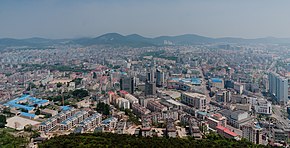
Lushunkou [1] [2] ( Kit. Ex . 口 , Pinyin : Lǚshùnkǒu ) - the area of urban subordination of the city of sub-provincial importance Dalian . Located on the site of the former city Lüshun, which in 1960 was annexed to the city of Dalian.
| Dalian City Submission Area | |
| Lushunkou | |
|---|---|
| whale. 旅顺 口 , pinyin : Lǚshùnkǒu | |
 | |
| A country |  China China |
| Provinces | Liaoning |
| City | Dalian |
| History and geography | |
| Square | |
| Timezone | |
| Population | |
| Population | |
| Digital identifiers | |
| Zip Codes | |
Content
History
The settlement on the site of Lüshunkou, which existed since the time of the Jin Empire (晋朝, 266–420), was called Mashitszin ( Chinese reg . 马 石津 ). In the period of the Tang Empire (唐朝, 618-907), it was renamed Dulichzhen ( wh. Ex . 都 ). In the years of the Mongol Empire, Yuan (—, 1271–1368), the city was called Shitszykou ( Chinese. Ex . 狮子 口 , literally: “Mouth of the Lion”), presumably, according to the statue, now located in the park adjacent to the military port. During the time of the Ming Empire (—, 1368–1644), the settlement was subordinated to the coastal defense department ( Chinese command 海防 哨所 ) of Jinzhou Way ( Chinese Chinese command 金 卫 ), and left and central from this country were located in the territory of the modern district ( Chinese reg. 金 州 中 左 所 ). At the same time, the modern name appeared - in 1371, the future emperor of China, Zhu Di , who led the defense of the north-eastern borders, sent 2 envoys to these places to familiarize themselves with the terrain. Since their way was calm and comfortable ( Chinese ex. 旅途 顺利 , pall .: Luytu shunli ), then by the order of Zhu Di, this area was named Lüshunkou (literally, “the bay of peaceful travel”)
The English name Port Arthur Lüshunkou received in connection with the fact that in August 1860 in this harbor the ship of English Lieutenant William C. Arthur was repaired. This English name was later adopted in Russia and other European countries.
The construction of a naval base in the strategically important Lushun Bay was started by the Chinese government at the insistence of Beiyang Dachen Li Hongzhang , in the 1880s. Already in 1884, a detachment of Chinese troops was stationed in the city to protect the coast from possible landings of the French landing force, and the commander of the Chinese Weiyuan warship in the bay Fang Boqian built one of the first land coastal batteries of the fortress with his crew. The battery was called "Weiyuan Paotai" (lit. "Fort Weiyuan").
Between 1884 and 1889, Lüshunkou became one of the bases of the Beiyang fleet of the Qing Empire. The works were supervised by German major Konstantin von Ganneken. The main repair facilities of the Beiyang fleet were located in Lüshunkou - a 400-foot dock for the repair of battleships and cruisers, and a small dock for the repair of the destroyers. Dredging works carried out in the bay allowed the depth of the inner raid and the entrance to the bay to be 20 feet.
On November 21, 1894, during the first Japanese-Chinese war, Lüshunkou fell due to the complete collapse of the defense system and desertion of the commander of defense, General Jiang Guiti, and the Beiyang Navy’s government ban and Li Hongzhan personally to give a decisive battle to the Japanese fleet on the outside Lüshunkou raid. The remnants of the garrison under the command of General Xu Bandao broke through and joined up with the main forces of the commander-in-chief of Chinese troops in Manchuria, General Song Qing . Japan occupied Lüshunkou, seizing huge trophies in the fortress. Japanese troops staged a merciless 4-day massacre in Lüshunkou on the pretext that the remains of captured Japanese soldiers captured by Xu Bando’s troops during a sally were found in the city. According to Chinese estimates, about 20,000 civilians died, regardless of gender and age. Of the total population of the city, according to Frederick Villers, only 36 people left who were to bury the dead bodies. On their caps, on the orders of the Japanese command, it was written: "These should not be killed." The collection of bodies lasted for a month, after which, by order of the Japanese, a huge mountain of bodies was poured over with oil and set on fire, maintaining the fire for 10 days. Ash and burnt bones were buried at the foot of Mount Baiuishan in 4 large coffins on the east side of the mountain. Currently, this place is known as the Grave of 10,000 Remaining Loyal. In 1895, under the Treaty of Shimonoseki, Port Arthur passed to Japan, but due to strong pressure from Russia , Germany and France ( Triple Intervention ), Japan was soon forced to return the Gulf to China.
In 1898, the city of Lüshun, together with the adjacent Kwantung Peninsula, was leased to Russia for 25 years. The Kwantung Peninsula with the adjacent islands later constituted the Kwantung Region and in 1903, together with the Amur Governor-General, became part of the Far Eastern governorship. The Russian authorities built the Russian Port Arthur on the site of the Chinese city of Lüshun.
In 1904, the Russo-Japanese war began , one of the main episodes of which was the defense of Port Arthur . After the 159-day siege, Port Arthur capitulated.
After the end of the Russo-Japanese War, under the Portsmouth Peace Treaty of 1905, the rental rights to Port Arthur and the entire Liaodong Peninsula were ceded to Japan. Later, Japan put pressure on China and forced the latter to extend the lease term. In 1932, the city formally became part of Manchukuo , but de facto continued to be controlled by Japan (it was officially believed that Japan rented the Kwantung Region from Manchukuu).
During the Soviet-Japanese war of 1945, Soviet troops paratrooped the city from the Japanese military forces on August 22, 1945. According to the Soviet-Chinese treaty of August 14, 1945, the Port-Artur area was transferred by China to the Soviet Union for a period of 30 years as a naval base. According to other sources, a joint Soviet-Chinese base was envisaged.
On February 14, 1950, simultaneously with the conclusion of the Treaty of Friendship, Alliance and Mutual Assistance, an agreement on Port Arthur was concluded between the USSR and the PRC, providing for the joint use of the base of the USSR and the PRC until the end of 1952.
At the end of 1952, the PRC government, given the aggravation of the situation in the Far East, appealed to the Soviet government with a proposal to extend the stay of the Soviet troops in Port Arthur. The agreement on this issue was formalized on September 15, 1952.
On October 12, 1954, the government of the USSR and the government of the People's Republic of China concluded an agreement that Soviet military units were being withdrawn from Port Arthur. The withdrawal of Soviet troops and the transfer of facilities to the Chinese government were completed in May 1955.
After being transferred to the jurisdiction of the People's Republic of China, Lüshun in 1960 was merged with Dalian into a single agglomeration, called the “Lyuda City” (旅大 市). By the resolution of the State Council of China on February 9, 1981, the city of Lyuda was renamed Dalian; the former city Lüshun became a district Lüshunkou in its composition.
Administrative divisions
The district of Lushunkou is divided into 13 street committees .
Notes
- ↑ Lüshun / Samburova Ye. N. // Lomonosov - Manizer [Electronic resource]. - 2011. - P. 240. - (The Great Russian Encyclopedia : [in 35 tons.] / Ch. Ed. Yu. S. Osipov ; 2004–2017, Vol. 18). - ISBN 978-5-85270-351-4 .
- ↑ Official site of Lüshunkou District
Links
- Luyshunkou - information on the territory, population and history of changes in the administrative-territorial division on the site 行政 区划 网(whale.)