Talsu district ( Latvian: Talsu rajons ) is a former administrative district in the north-west of Latvia , located in the Kurzeme region on the coast of the Gulf of Riga . It bordered on Ventspils , Kuldiga , Saldus and Tukums regions. Population - about 47 thousand inhabitants (2.1% of the country's population); territory - 2.751 sq. m. km (4.1% of the territory of Latvia).
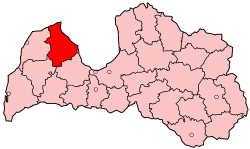 | |
| Administrative center | Tulsi |
| Cities | Talsi , Stand , Sabile , Valdemarpils |
| Square | 2811.0 km² |
| Population • Total ( 2002 ) • density | 49,662 17.7 people / km² |
Content
Geographic data
The district occupied the north-eastern part of the Kurzeme Peninsula . The Irbensky Strait separates the island of Saaremaa ( Estonia ). At the northern end is the famous Cape Kolka . In the east it is washed by the waters of the Gulf of Riga of the Baltic Sea . The total length of the coastline (coast of the Baltic Sea and the Gulf of Riga) is 96 km. The surface is mostly flat, there are dunes, hills covered with forests. On the coast of the Gulf of Riga, sandy beaches alternate with rocky shores. In the north, there are sandy beaches that are dangerous for shipping, so back in the days of the Russian Empire, the Kolka lighthouse was installed here. About 14.5% of the territory of the modern district is protected nature reserve. The most interesting of them are: Slitere National Park, natural parks: Lake Engure , Talsi Hills, Abava River Valley, cultural and historical territory of the Livsky Bank (Liv Bank).
Territorial-administrative division
There are 20 local governments in the district, including 4 cities :
- Talsi - district center (12 854 inhabitants);
- Valdemarpils city;
- city of stand ;
- Sabile city;
- 16 volosts.
Population
The population of Talsi district is 47.062 inhabitants (2008, estimate), or 2.1% of the total number of inhabitants of Latvia, including: men: 47.4%, women 52.6%. The area has a predominantly rural, agrarian character, characterized by a predominance of the Latvian population; the number of Russian speakers in it is small. The population is declining due to migration and natural decline.
National composition (2008)
- Latvians 43.383 (92.2%)
- Russians 1.543 (3.3%)
- Belarusians 368 (0.8%)
- Ukrainians 338 (0.7%)
- Poles 305 (0.6%)
- Lithuanians 242 (0.5%)
- other 883 (1.9%)
In the area of the Livonian coast, the almost disappeared Livans were preserved - traditional fishermen and the indigenous inhabitants of these places before the advent of Latvians, Germans and Russians. The population is about 50 people.
Population and national composition according to censuses
| 2000 census [1] | Terria km² | Population, Total | Latvians | Russians | Belarusians | Ukrainians | Poles | Lithuanians |
|---|---|---|---|---|---|---|---|---|
| Talsi district | 2748.3 | 49,814 | 45,775 | 1,799 | 418 | 369 | 329 | 257 |
| Tulsa city | 7.8 | 12,374 | 11 202 | 452 | 85 | 73 | 98 | 37 |
| Sabile city (in 2000-2009, as part of the Sabil region) | 4.3 | 1,626 | 1,445 | 47 | ten | 6 | four | sixteen |
| City Stende | 4.8 | 2014 | 1 800 | 116 | 26 | 17 | 20 | 15 |
| City Valdemarpils | 3.4 | 1,474 | ||||||
| Valdemarpils rural area | 134.5 | 1 327 | 2 614 | 62 | 15 | 20 | 21 | 21 |
| Balgal volost | 74.8 | 1,110 | 1,075 | 21 | four | 2 | four | 2 |
| Dundag volost | 558.7 | 4 164 | 3 954 | 105 | 20 | 32 | 15 | 23 |
| Gibul volost | 320,2 | 2 649 | 2,486 | 47 | thirty | 23 | sixteen | 17 |
| Willow parish | 70.7 | 649 | 617 | ten | 9 | one | eight | 2 |
| Kolka volost | 116.9 | 1,280 | 1,158 | 39 | five | 17 | 3 | 6 |
| Külciem parish | 67.7 | 541 | 507 | eight | one | 12 | 3 | four |
| Lajd volost | 74.1 | 1,765 | 1,671 | 40 | ten | 18 | eight | 3 |
| Lubsky volost | 83.4 | 647 | 622 | 7 | five | 7 | four | one |
| Lauciena parish | 180.3 | 2015 | 1,728 | 136 | 32 | 25 | 15 | 21 |
| Liebagas parish | 143.9 | 2 185 | 2,050 | 43 | 52 | 9 | 14 | 14 |
| Mersrag volost | 109.0 | 2 084 | 1 951 | 64 | eight | 13 | 14 | ten |
| Roya parish | 200.5 | 4,742 | 4,437 | 161 | 34 | 36 | 36 | 18 |
| Sabil region Existed in 2000-2009) | 160,5 | 1 956 | 1,795 | 114 | eleven | eleven | five | 12 |
| Strazda volost | 42.3 | 524 | 479 | nineteen | eleven | - | eight | five |
| Valdgal volost | 205.3 | 1,531 | 1,445 | 49 | 3 | five | five | 9 |
| Wanzen parish | 145.9 | 2 081 | 2 017 | 18 | 7 | eleven | 13 | 7 |
| Virba parish | 39.6 | 1,078 | 722 | 241 | 40 | 29th | 17 | sixteen |
Religious composition:
The vast majority of the population of the Talsi district professes Lutheranism . The population of Russian nationality living in the region professes Orthodoxy .
Economy and Economics
Historically, the main occupation of the local population is fishing, now also tourism and recreational facilities, tourists come from Russia and the CIS countries as well . In the past, there were Soviet military bases, the area was of strategic importance.
Famous People
- Viltsin, Velta Einovna - ballerina, People's Artist of the USSR (1965).
Notes
- ↑ Enciklopēdija "Latvijas pagasti", A / S Preses nams, 2002. ISBN 9984-00-436-8