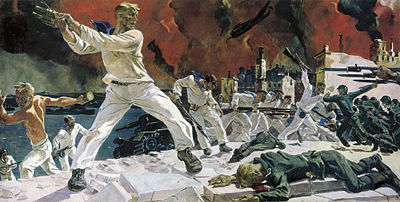
“The Defense of Sevastopol” ( 1942 ) - one of the most famous paintings of Alexander Alexandrovich Deineka . Created in Moscow , it is currently in the Russian Museum in St. Petersburg . The painting is rightfully one of the strongest in the artist’s work and one of the most dramatic works of all Soviet wartime art. The painting depicts the mournful and majestic feat of the Soviet soldiers who gave their lives in the defense of Sevastopol in 1942 .
| ||
| Alexander Alexandrovich Deineka | ||
| Defense of Sevastopol . 1942 | ||
| Oil on canvas . 200 × 400 cm | ||
| State Russian Museum , St. Petersburg | ||
| ( inv. ) | ||
Creation History
In February 1942, Deineka and his friend artist G. G. Nissky traveled to the war zone near Yukhnov [1] . On his return, he visited TASS where he was shown a photograph of the destroyed Sevastopol, printed in a German newspaper. Later, the artist recalled [1] :
There was a heavy war. It was a cruel winter, the beginning of the offensive with varying local success, heavy fighting, when the soldiers left red marks from the wounds in the snow and the snow from the explosions turned black. But nevertheless I decided to write ... “Defense of Sevastopol”, because I loved this city for cheerful people, the sea and airplanes. And he personally saw how everything flies up into the air, how women stopped laughing, how even the children felt what the blockade was.
Work on the painting by Deineka began at the end of February 1942, and finished for the exhibition "The Great Patriotic War", which opened in the autumn of that year. He himself later recalled: “ My picture and I in work merged together. This period of my life fell out of my mind, he was swallowed up with a single desire to paint a picture ” [1] .
Artistic decision
Deineka’s picture is not a documentary reproduction of a combat episode, but a symbolic depiction of a clash of two irreconcilable forces on the ruins of a burning city: the heroic figures of Soviet sailors in deliberately snow-white robes against an impending dark gray, almost faceless mass of invaders. The dynamics and drama of the composition are determined by the central figure of the sailor in the last desperate throw on a geometrically accurate series of enemy bayonets [1] .
In wartime, the artist could not find a male nature for the central figure, and in the end he invited a girl athlete of a suitable physique to pose, about which he later wrote: “ Then it occurred to me to resort to a female nature. One of my friends athletes with suitable physical data agreed to pose ” [1] .
Notes
- ↑ 1 2 3 4 5 Ioannina, 2002 .
Literature
- Deineka A. “Defense of Sevastopol” // Ioannina N. A. One hundred great paintings. - M .: Veche, 2002 .-- 512 p. - 12,500 copies.
- Soviet art of 1941-1945 // Ilyina T.V. History of art: Domestic art. Textbook. - 3rd ed., Revised. and additional .. - M .: Higher school , 2000. - 407 p. - ISBN 5-06-003705-3 .