Gegenbauer Transformation - Integral Transformation {\ displaystyle T \ left \ {F (t) \ right \}}  the functions {\ displaystyle F (t)}
  :
:
{\ displaystyle T \ left \ {F (t) \ right \} = \ int \ limits _ {- 1} ^ {+ 1} (1-t ^ {2}) ^ {\ rho -1/2} C_ {n} ^ {\ rho} (t) F (t) dt = f_ {n} ^ {\ rho},} 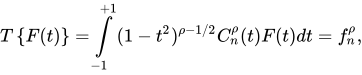 {\ displaystyle \ rho> -1 / 2, ~ n = 0, ~ 1, ~ 2, ~ \ ldots,}
Where {\ displaystyle C_ {n} ^ {\ rho} (t)}  - Gegenbauer polynomials . If a function is expanded in a generalized Fourier series in terms of the Gegenbauer polynomials, then the inversion formula holds
{\ displaystyle F (t) = \ sum _ {n = 0} ^ {\ mathcal {1}} {{n! (n + \ rho) \ Gamma ^ {2} (\ rho) 2 ^ {2 \ rho - 1}} \ over {\ pi \ Gamma (n + 2 \ rho)}} C_ {n} ^ {\ rho} (t) f_ {n} ^ {\ rho} (t), ~ -1 <t < one} 
Gegenbauer transform reduces a differential operation
{\ displaystyle R \ left [F (t) \ right] = (1-t ^ {2}) F ^ {\ prime \ prime} - (2 \ rho +1) tF ^ {\ prime}} ![R \ left [F (t) \ right] = (1-t ^ {2}) F ^ {{\ prime \ prime}} - (2 \ rho +1) tF ^ {{\ prime}}](https://wikimedia.org/api/rest_v1/media/math/render/svg/12fd19a3548a16501b371b6e0e4a78668138847d)
to algebraic
{\ displaystyle T \ left \ {R \ left [F (t) \ right] \ right \} = - n (n + 2 \ rho) f_ {n} ^ {\ rho}} ![T \ left \ {R \ left [F (t) \ right] \ right \} = - n (n + 2 \ rho) f_ {n} ^ {\ rho}](https://wikimedia.org/api/rest_v1/media/math/render/svg/0cca9e6a955693de3f8bc4fd66f8c2616606dd8c)
Named in honor of the Austrian mathematician Leopold Gegenbauer (1849-1903).