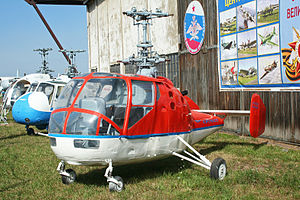
Ka-15 ( according to NATO codification : Hen - “Laying Chicken” ) - a coaxial-type helicopter developed by N. I. Kamov Design Bureau, developed on the basis of the Ka-8 helicopter (“Irkutyan” from 1948) .
| Ka-15 | |
|---|---|
 | |
| Type of | Multipurpose Helicopter [1] |
| Manufacturer | |
| The first flight | July 25, 1948 [2] |
| Start of operation | 1955 year |
| End of operation | 1970s |
| Units produced | 354 [1] |
| Base model | Ka-8 |
| Options | Ka-18 |
Content
- 1 History of creation
- 2 Flight performance
- 3 notes
- 4 References
Creation History
The Council of Ministers of the USSR adopted a resolution of September 29, 1948 “On conducting state tests and preparing for the introduction of serial production of a single-seat Ka-8 Irkutian helicopter designed by N. I. Kamov.” The first flight of the production Ka-15 was carried out on April 14, 1953 by test pilot Dmitry Efremov.
The helicopter was originally developed for the needs of naval aviation: as an anti-submarine helicopter, ship reconnaissance and liaison officer. The tests were conducted by the NII-15 Navy on the basis of OKB-4 in Moscow from January 28 to February 12, 1955. From March 23 to April 14 of the same year, the Ka-15 tests were continued on the ships of the Black Sea Fleet . State tests took place in Feodosia from April 15 to May 11, 1955. In 1956, serial production of these machines began at the aircraft factory in Ulan-Ude . In total, 354 helicopters of all modifications were built.
Beginning in 1957, the Ka-15 began to enter the combat forces of the Navy . Due to its low payload, the Ka-15 proved to be ineffective as an anti-submarine helicopter - it could take on board only two sonar buoys for tracking submarines; while the control equipment was on the second helicopter, and the means of destruction (depth charges) - on the third. In addition, the operation of the Ka-15 in the fleet was accompanied by numerous malfunctions, indicating the low reliability of this machine: rotor flutter , Earth resonance vibrations during taxiing, etc. In July 1960, one of the Ka-15, owned by The 710th separate helicopter regiment crashed due to the lashing of the blades after takeoff from the Novonezhino airfield; in November, the case of whipping was repeated, but the car was planted. These two cases were not the only ones. In May 1963, Ka-15 flights to the Navy were banned.
In Aeroflot and DOSAAF, helicopters were in operation until the early 1970s and were used to train cadets along with the Mi-1 , for pollination of crops for agricultural work in warm regions of the USSR — in Moldova and Kazakhstan . A number of Ka-15 were served by fishing and whaling fleets, based on board fishing vessels. In this role, the Ka-15 had advantages over the Mi-1 due to its smaller size and the absence of a long tail boom with a tail rotor. In 1959, two Ka-15 helicopters were enrolled in the Polar Aviation Directorate at the GUSMP and received registration numbers USSR-N-26 and USSR-N-27. Test flights were carried out from the icebreaker "Ermak" while he was in Murmansk. In the winter of 1959-1960, helicopters participated in a fishing expedition in the Arctic, based on board the flagship schooner Chistopol (Sovetskaya Rossiya newspaper dated 04/15/1960).
There is unconfirmed official information that some Ka-15s were sent to Vietnam during the Vietnam War : helicopters were allegedly transported by rail through China .
The last copies of the Ka-15 and Ka-18 were decommissioned in the Moldavian UGA , immediately after receipt of the first serial Ka-26 helicopters.
On these new helicopters, one of the main shortcomings of the Ka-15 was corrected: the small distance between the upper and lower rotors , due to which the blades sometimes clashed in flight. On the prototypes, the distance between the rotors was 150 mm greater than on the serial ones; it had to be reduced in order to solve the rotor flutter problem, and such refinement allowed the machine to be launched into series. The blades themselves were thin and very flexible (and so fragile that at the end of the flight day they were removed from the sleeve and hung back before a new flight - however, this procedure was not complicated and did not take much time). Pilots flying the Ka-15 noted that flying at a speed of more than 100 km / h became dangerous - the upper and lower rotor blades were so close that no more than 10 cm remained between the tips . Among the shortcomings were the low AI-14 engine power and sensitivity to the "earth resonance" - to steer the earth on the Ka-15 could only be on a perfectly flat surface. In general, the Ka-15 was assessed by the operators as an insufficiently reliable and safe helicopter, which was the reason for its quick “departure from the scene” .
A similar (collision of rotor blades) severe flight accident occurred in the summer of 1961 in 413 separate helicopter regiment of anti-submarine defense of the Red Banner Baltic Fleet . The Ka-15 link, consisting of two vehicles, took off from the airfield of the village of Donskoye, Kaliningrad Region . The night flight on instruments was worked out. The presenter Ka-15 crashed over the Curonian Spit , near the village of Rybachy . The car fell into the Curonian lagoon . The crew, pilot and navigator, died. Until the cause of the accident was clarified, the Ka-15 squadron did not fly.
- On July 1, 1964, the Ka-15 helicopter, tail number USSR-30123 of the Moscow Transport Administration of the TSA and the MVF of the Civil Air Fleet, of the Ryazan squadron, crashed near the village of Elatma , Ryazan Region . The catastrophe occurred due to a collision of the helicopter blades with the wires of the communication line with a further helicopter crash into the river 100 meters from the shore. [3]
- On February 4, 1965, a Ka-15 helicopter, tail number USSR-86633 of the Ukrainian Civil Aviation Administration and the Zaporizhzhya squadron crashed near the village of Chapaevka, Zaporizhzhya Region , and the Ukrainian SSR . The catastrophe occurred due to the destruction of the driven crown of the upper shaft of the rotor screws of the RV-15 gearbox, which led at the initial moment to the cessation of torque transmission and loss of the lifting force of the upper rotor. The random rotation of the upper rotor led to the lashing of the blades with the subsequent destruction of the tail unit by the rotors, as well as to a complete loss of lift and controllability. The helicopter from a height of 200 m, with a destroyed bearing system of propellers and tail, uncontrollable, in a state of random fall, fell to the ground and caught fire. [four]
- On June 16, 1965, a Ka-15 helicopter, tail number USSR-30150 of the Ukrainian CAA, the Simferopol air squad, performing aerochemistry work on spraying vineyards on the collective farm “Struggle for Peace” ( Crimean region , Kirovsky district , village of Aprikosovka ), due to the destruction of the carrier system and loss the lift went into a random fall at an angle of 80 °, collided with the ground on the left front of the fuselage (cockpit) in a wheat field adjacent to the vineyard being cultivated, turned 180 ° and lay down on the port side. The pilot died. The Commission established: the destruction of the blades in flight occurred due to a sharp braking of the bearing system, which led to a break in the blades in their closure to the hub nodes, which is confirmed by the nature of the break of the blades, deformation (compression) of the front edges of the blades and crushing of the front stops of the vertical hinges. A possible reason for the braking of the helicopter carrier system is the metal grabbing between the lead of the drive gear of the upper screw shaft and the drive shaft of the RV-15 gearbox. This is confirmed by the presence of burrs and envelopes of metal with tint colors on these parts. [5]
Flight performance
Data Source: [6]
- Specifications
- Crew : 1 pers.
- Passenger Capacity: 1 pers.
- Payload : 364 kg
- Length : 6.26 m
- The diameter of the rotor : 9.96 m
- Height : 3.35 m
- Empty weight: 968 kg
- Normal take-off weight: 1360 kg
- Maximum take-off weight : 1460 kg
- Powerplant : 1 × PD AI-14V
- Engine power: 1 × 188 kW
- Flight characteristics
- Maximum speed: 155 km / h
- Cruising speed : 120 km / h
- Practical range: 278 km
- Ferry range: 520 km
- Practical ceiling : 3500 m
- Static ceiling : 600 m
- Dynamic ceiling : 3500 m [1]
Notes
- ↑ 1 2 3 Ka-15 on the Kamov website Archive copy of December 17, 2004 on the Wayback Machine
- ↑ Helicopter, 2008 №3
- ↑ Catastrophe Ka-15 MTU ASP and MVF GVF in the area of Elatma
- ↑ Catastrophe Ka-15 of the Ukrainian CAA in Tokmak district of Zaporizhzhya region
- ↑ Catastrophe Ka-15 of the Ukrainian CAA in the Kirov district of the Crimean region
- ↑ Ka-15