Creeping wheatgrass ( lat.Elytrígia répens ) - a perennial herb ; the most famous species of the wheatgrass family of the cereals .
| Wheat grass creeping | |||||||||||||||||||||||||||
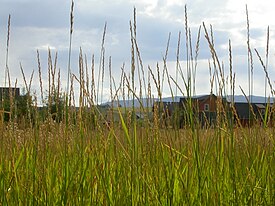 | |||||||||||||||||||||||||||
| Scientific classification | |||||||||||||||||||||||||||
|---|---|---|---|---|---|---|---|---|---|---|---|---|---|---|---|---|---|---|---|---|---|---|---|---|---|---|---|
| |||||||||||||||||||||||||||
| International scientific name | |||||||||||||||||||||||||||
Elytrigia repens ( L. ) Desv. ex Nevski , 1933 | |||||||||||||||||||||||||||
| Synonyms | |||||||||||||||||||||||||||
Content
- 1 Botanical Description
- 2 Distribution
- 3 Economic value and application
- 4 notes
- 5 Literature
- 6 References
Botanical Description
Rhizomes are long, horizontal creeping, cord-like, occur at a depth of 5 to 15 cm.
Stem height from 40 to 150 cm.
Leaves are bare, flat, linear, 15-40 cm long, 3-10 mm wide at the base of the plant and 2-8.5 mm higher along the stem.
Flowers (from three to eight) are collected in spikelets 1-2 cm long, 5-7 mm wide and 3 mm thick. Spikelets are collected in a rare spike from 7 to 30 cm long. Spikelets sit one at a time and face the axis of the spike with their wide side. Two spikelet scales, spiky. The lower floral scales are naked. Spikelet and lower floral scales gradually taper to the apex and pass into the spine . It blooms in June - July [2] .
Flower formula : .
Distribution
Comes from Europe , North Africa and Asia .
In Russia it is growing everywhere.
Naturalized around the world, in many places it is considered a malicious weed . For destruction in the garden, digging the soil with the removal of rhizomes by hand, mulching is used . Outside the soil, wheatgrass rhizomes quickly dry out and die.
It grows on the plains and in the mountains (mainly in the middle and upper mountain zones ), usually on fairly rich, sometimes solonchak soils of varying degrees of moisture. It occurs in water meadows in community with other cereals, like a weed on arable land. In floodplain meadows and deposits, it sometimes prevails in the grass stand [2] .
Economic Significance and Application
Leaves serve as food for many herbivores . The yield of dry aboveground mass is 20–70 kg / ha [2] . Seeds are eaten by some birds , such as bugs .
In scientific medicine, grass and rhizomes are used as a diuretic, diaphoretic, expectorant and laxative.
In folk medicine, fresh leaf juice is used to treat colds, bronchitis , pneumonia , gallstone and urolithiasis , osteochondrosis , furunculosis .
In folk medicine, dried creeping wheatgrass rhizomes are used. They contain poorly studied glycosides , mucus and other polysaccharides , traces of essential oil , ascorbic acid , carotene . Applied in the form of a decoction as an anti-inflammatory agent for rheumatism , gout , inflammation of the bladder , kidney stones , skin rashes [3] .
Creeping wheatgrass is a very harmful weed. Ten individuals per 1 m² of winter wheat sowing can reduce its yield by almost 500 kg per hectare. To form 100 kg of seeds, a creeping wheatgrass pulls out three times more water from 1 hectare of land than cereals . In addition, the plant absorbs a lot of nutrients ( nitrogen , potassium , phosphorus ), significantly depleting the fertile layer of the earth [4]
In this case, attempts are made to cultivate the plant. Scientists of the Omsk Agricultural University have created a long-term variety "Owl" cultivated from wild wheatgrass. For several years, he completely fills the field, surviving weeds from him. It is not affected by diseases and also does not require the use of herbicides. [one]
From left to right: rhizome in the soil; stem and leaves; flowers fruit; wheatgrass pierced potato | ||||||||||
Notes
- ↑ For the conventionality of indicating the class of monocotyledons as a superior taxon for the plant group described in this article, see the APG Systems section of the Monocotyledonous article .
- ↑ 1 2 3 Gubanov I.A. et al. Wild useful plants of the USSR / ed. ed. T.A. Rabotnov . - M .: Thought , 1976 .-- S. 54 .-- 360 p. - ( Reference guides to the geographer and traveler ).
- ↑ Blinova K.F. et al. Botanical-Pharmacognostic Dictionary: Ref. allowance / Ed. K.F. Blinova, G.P. Yakovleva. - M .: Higher. school, 1990. - S. 229. - ISBN 5-06-000085-0 .
- ↑ Healing plants. - Smolensk: Rusich, 1996 .-- S. 306-310.
Literature
- Gubanov I.A. et al. 142. Elytrigia repens (L.) Nevski - Creeping wheatgrass // Illustrated identifier of plants in Central Russia. In 3 t . - M .: T-in scientific. ed. KMK, Institute of Technology. ISS., 2002. - T. 1. Ferns, horsetails, crowns, gymnosperms, angiosperms (monocotyledons). - S. 236. - ISBN 8-87317-091-6 .
- Safonov N.N. Medicinal plants of the meadow . - M .: Fine Arts, 1993. - S. 46–47.
Links
- Creeping wheatgrass (English) : information on the GRIN website.
- Creeping wheatgrass (as Elymus repens (L.) Gould) on the USDA NRCS website