The Smolensk-Moscow elevation is located in the Yaroslavl , Vladimir , Moscow and Smolensk regions of Russia , as well as the Vitebsk region of Belarus .
| Smolensk-Moscow Upland | |
|---|---|
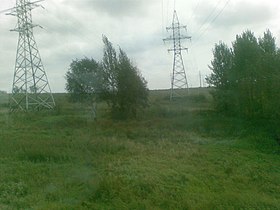 Smolensk-Moscow Upland in the Smolensk Region | |
| Location | |
| Country |
|


It stretches from the south-west to north-east from the Belarusian city of Orsha to Yuryev-Polsky [1] . Consists of Smolensk and Moscow hills [2] . In the southeast, the Central Russian Upland [3] adjoins the Smolensk-Moscow Upland, and in the north, the Valdai Upland [4] .
It has a length of about 500 km, the highest point - 320 m (in the north-eastern part of the Smolensk region). [5] The relief is hilly, erosive - moraine . In the west, the moraine chain passes into the Belorussian ridge .
The hill is drained by the rivers of the Dnieper basin (in the west) and the Volga (in the east).
It is covered with mixed forests ( spruce and birch prevail ). Peat bogs are frequent.
The soils are predominantly sod-podzolic loamy soils , except for the easternmost part of the hill, where more fertile gray forest soils are common, and the area is called the Vladimir (Yuryev) Opole .
The Smolensk-Moscow Upland is the watershed of three seas: the Baltic ( Caspian → Western Dvina ), Black ( Dnieper ) and Caspian ( Volga , tributaries of the Oka ).
Notes
- ↑ Great Encyclopedic Dictionary. Smolensk-Moscow Upland
- ↑ TSB. Smolensk-Moscow Upland
- ↑ Zhmakii E. Ya., Zhmakina N.V. The Baryatinsko-Sukhinichi plain is the Central Russian or Smolensk-Moscow Upland? / / Nature and history of the mountains. Issue 4. Kaluga: Information Center “Postscript” - 2006 ° C. 36-40. (inaccessible link) . Date of treatment November 29, 2013. Archived December 3, 2013.
- ↑ Basic orographic elements
- ↑ Geographic encyclopedia. Smolensk-Moscow Upland