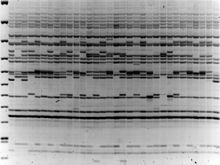

DNA markers (DNA markers), or molecular genetic markers - a polymorphic trait detected by molecular biology methods at the level of the nucleotide sequence of DNA for a particular gene or for any other part of the chromosome when comparing genotypes of different individuals, breeds, varieties, lines.
In recent years, a lot of data has accumulated on the effectiveness of using molecular genetic markers at the level of both proteins and DNA , RNA , for solving many problems of genetics, selection, conservation of biodiversity, studying the mechanisms of evolution, mapping of chromosomes, as well as for seed production and breeding.
The most widely used molecular genetic markers can conditionally be divided into the following types: markers of structural gene regions encoding protein amino acid sequences ( electrophoretic variants of proteins ), markers of non-coding structural gene regions and markers of various DNA sequences, the relation of which to structural genes, as a rule, is unknown - distribution of short repeats throughout the genome (RAPD - accidentally amplifiable polymorphic DNA; ISSR - inverted repeats; AFLP - polymorphism sites of restriction ) and microsatellite loci ( tandem repeats with the elementary unit of length 2-6 nucleotides).
There is a whole set of modern technologies for detecting polymorphism at the DNA level, among which the following can be distinguished:
- analysis of restriction DNA fragment length polymorphism (RFLP);
- analysis of polymorphism using polymerase chain reaction (PCR) and other methods based on the amplification of DNA between repetitive sequences in genomic DNA.
DNA probe markers
- RFLP (RFLP markers, from " restriction fragment length polymorphism "). Assessment of the length polymorphism of restriction DNA fragments can be carried out in different ways, but the most traditional method using blot hybridization) [1] . This method includes the isolation of DNA, obtaining restriction fragments, their electrophoretic separation, transfer to filters, followed by hybridization of specific DNA probes with the obtained DNA fragments. A DNA probe is a relatively short sequence of cloned DNA with a certain level of homology and the ability to hybridize with the corresponding region of genomic DNA. Combinations of restriction enzymes and probes produce highly reproducible polymorphic spectra of DNA fragments specific to each individual. Differences between the latter can be caused, for example, by mutations that change the restriction site. RFLP has a number of important advantages, including high reproducibility of spectra in different laboratories, and codominant “behavior” of the marker. RFLP is effective in genome mapping, gene labeling of many biological and economically important traits.
- VNTR ( Eng. Variable Number Tandem Repeat ) - a method called DNA fingerprint ("fingerprints") [2] . Tandem repeats are widespread in different genomes and highly polymorphic. As a result of the high variability of these DNA regions, RFLP analysis with probes for micro- and minisatellite sequences allows obtaining multilocus spectra with high resolution at the population level. Due to the very high level of polymorphism, this approach is currently a good tool for analyzing intrapopulation and interpopulation variability and determining genetic distances between groups of organisms. VNTR allelic variants have a codominant character of inheritance.
PCR markers
The polymerase chain reaction (PCR) method involves the use of specific primers and the production of discrete DNA amplification products of individual sections of genomic DNA. A large number of related technologies are built on this principle. The most widely used RAPD technology is based on the analysis of amplified polymorphic DNA fragments using single primers with an arbitrary nucleotide sequence [3] , [4] , [5] .
- SSR ( Simple Sequence Repeats ) - PCR with flanking primers for a short mini- or microsatellite repeat allows the identification of markers with codominant inheritance and, accordingly, is convenient for detecting heterozygotes at a given locus. However, one pair of flank primers in PCR allows the polymorphism of only one locus to be considered. For many microsatellite loci, polymorphism cannot be detected. As a rule, flanking sequences for a given microsatellite locus are species-specific.
- RAPD ( Eng. Random Amplified Polymorphic DNA ) is a polymerase chain reaction using a single short (usually 10-membered) primer with an arbitrary nucleotide sequence [6] , [7] . The primer sequence is not absolutely any, but is limited by the values of the GC composition of 40-70% and the linguistic complexity of the nucleotide sequence of 50-100%. In RAPD, you can use either a single primer or several RAPD primers. The RAPD product is formed by amplification of a fragment of genomic DNA flanked by the inverted sequence of the primer used. The method is universal for studies of different types, using the same primers. As a rule, a primer that reveals a high polymorphism for one species will be effective for other species.
- ISSR ( Eng. Inter Simple Sequence Repeats ) [8] [9] is a specialized version of the RAPD method in which the primer consists of a microsatellite sequence. In this method, as in RAPD, one or more primers of 15-24 nucleotides in length are used. But in this case, the primers consist of tandem short 2-4 nucleotide repeats, for example, 5'-CA CA CA CA CA CA CA CA CA G G , and one or two selective nucleotides at the 3'-end of the primer. ISSR amplification products contain an inverted microsatellite primer sequence on the flanks. Since in this method the sequence of primers is specific and is selected more strictly than in RAPD, annealing in PCR can be carried out at a higher temperature (55-60 ° C) than for the RAPD method, and therefore fingerprint is usually better reproduced.
- AFLP ( Amplified Fragment Length Polymorphism ) [10] is a technology that is a combination of RFLP and PCR methods. AFLP is a complex method consisting of several stages: genomic DNA is simultaneously restricted by two restriction enzymes ( EcoRI and MseI ) recognizing 4 and 6 bases, respectively, to obtain fragments with protruding 3'-ends. The restricted genomic DNA is then ligated to an adapter containing “sticky” ends for restriction sites ( EcoRI and MseI ). After this, two consecutive PCR is performed. The first PCR (preamplification) uses primers that are fully complementary to the EcoRI and MseI adapters . After the first PCR, a large number of amplification products are formed between the EcoRI and MseI adapters , which are difficult to differentiate by electrophoresis. Therefore, in the second PCR, primers with EcoRI and MseI adapters contain from the 3'-end additional and not complementary to adapters from 1 to 3 bases, for selective amplification. The separation of DNA fragments is performed in a polyacrylamide gel, with a radioactive or fluorescent label, respectively.
- SSAP ( Sequence Specific Amplification Polymorphism ) [11] was a modification of the AFLP method to detect polymorphism both at the restriction site and at the insert [ clarify ] in the genomic DNA of a transposon or retrotransposon . The genomic DNA of the studied samples is cleaved with restriction enzymes PstI and MseI , and fragments with protruding 3'-ends are obtained. The restricted DNA is then ligated with the PstI and MseI adapters . The first polymerase chain reaction (preamplification) is carried out with primers from the PstI and MseI adapters , that is, all possible combinations of the combination of these adapters in the restricted genomic DNA are amplified. After the first PCR, a large number of amplification products of DNA fragments localized between primers and adapters are formed. PCR products are diluted and used for the second, selective PCR. The second PCR is performed with a labeled primer for LTR and any adapter primer, or with PstI or MseI . In the second PCR, primers can be used for the adapter with additional nucleotides at the 3'-end, for example, one, two or three nucleotides that are not complementary to the adapter. Electrophoresis after the second PCR is carried out in a polyacrylamide gel or in a sequencer if a fluorescent label was used. Amplification products after the second PCR are formed as a result of amplification of a DNA fragment between the LTR sequence of the retrotransposon and the adapter. Obtaining amplification products between only LTR sequences is fundamentally possible, but, as a rule, the distance between two retrotransposons is longer than the usually obtained sizes of PCR products (2500 - 3000 base pairs). And amplification products between the adapters will not be detected, since the label is used only for LTR primer.
- IRAP ( Inter Retrotransposone Amplified Polymorphism ) [12] [13] is a polymerase chain reaction between primers complementary to the sequences of two adjacent LTR retrotransposons . The method has several options. In the first embodiment, IRAP uses a single primer from LTR. Amplification products are formed between two inverted LTRs with the same sequence, that is, in one chain, the 5'-end of one LTR is oriented to the 3'-end of another LTR. If the central part of the retrotransposon is longer than the usual size of the PCR products (about 3000 base pairs), then the PCR will take place only between two LTRs from different retrotranspositions. In this case, adjacent LTRs should be in an inverted position. In another variant of IRAP, two different primers for inverted LTRs are used: one primer at the 5'-end and the other at the 3'-end of the LTR, oriented in opposite directions from the retrotransposon. In this case, adjacent LTRs are arranged as straight long repeats. And finally, in the third version of IRAP, LTR primers from different retrotraposons in different orientations are used. LTR primers can be combined with other repeating DNA primers.
- REMAP ( Retrotransposone Microsatellite Amplified Polymorphism ) [12] [13] is a polymerase chain reaction between a primer to an LTR fragment of a retrotransposon and a primer from a nearby, simple microsatellite repeat (ISSR primer). In this case, the position of the amplified fragment of the retrotransposon is "anchored" by using a primer to the microsatellite locus. For example, in plants it is convenient to use a primer for LTR and a primer for microsatellite (5'- CA CA CA CA CA CA CA CA CA CA G ) with a single selective nucleotide at the 3'-end of the primer. REMAP uses LTR primer variants for both the 5'-end and the 3'-end of LTR, as in IRAP.
- RBIP ( Eng. Retrotransposon-Based Insertion Polymorphisms ) [14] is a method based on the use of primers for retrotransposon sequences and revealing codominant allelic variants. Its principle is based on multilocus PCR, which uses a pair of primers flanking a DNA region prior to retrotransposition and a primer for LTR retrotransposon, which is inserted into this region between the first two primers. As a result, one of the variants of fragments flanked by a pair of primers will be amplified by PCR, since the sequence between LTRs is too long for PCR between genomic DNA sites with a retrotransposon inside. This method reveals polymorphism only for a given polymorphic locus. Its advantages include the codominance of polymorphic variants, the possibility of using a large number of varieties for dot blot analysis.
- iPBS ( eng. inter PBS amplification ) [15] is a method based on the use of primers for PBS retrotransposon sequences ( eng. Primer binding site , tRNA binding site ). The method is effective for detecting polymorphism between samples, as well as for cloning new retrotransposons in eukaryotes .
- Single nucleotide polymorphism (SNP).
Notes
- ↑ Southern EM Detection of specific sequences among DNA fragments separated by gel electrophoresis (Eng.) // J Mol Biol : journal. - 1974. - Vol. 98 , no. 3 . - P. 503-517 . - DOI : 10.1016 / S0022-2836 (75) 80083-0 .
- ↑ Jeffreys AJ, Wilson V., Thein SW Hypervariable 'minisatellite' regions in human DNA (Eng.) // Nature. - 1984. - Vol. 314 . - P. 67-73 . - DOI : 10.1038 / 314067a0 .
- ↑ Kalendar R. The use of retrotransposon-based molecular markers to analyze genetic diversity // Field and Vegetable Crops Research: journal. - 2011. - Vol. 48 , no. 2 . - P. 261-274 . - DOI : 10.5937 / ratpov1102261K .
- ↑ Kalendar R., Flavell A., Ellis THN, Sjakste T., Moisy C., Schulman AH Analysis of plant diversity with retrotransposon-based molecular markers (English) // Heredity: journal. - 2011. - Vol. 106 . - P. 520-530 . - DOI : 10.1038 / hdy.2010.93 .
- ↑ Calendar R.N., Glazko V.I. Types of molecular genetic markers and their use (Russian) // Physiology and Biochemistry of Cultivated Plants: Journal. - 2002. - T. 34 , No. 4 . - S. 141-156 . (inaccessible link)
- ↑ Williams JG, Kubelik AR, Livak KJ, Rafalski JA, Tingey SV DNA polymorphisms amplified by arbitrary primers are useful as genetic markers (Eng.) // Nucleic Acids Research : journal. - 1990. - Vol. 18 , no. 22 . - P. 6531-6535 . - DOI : 10.1093 / nar / 18.22.6531 .
- ↑ Welsh J., McClelland M. Fingerprinting genomes using PCR with arbitrary primers (Eng.) // Nucleic Acids Research : journal. - 1990. - Vol. 18 . - P. 7213-7218 . - DOI : 10.1093 / nar / 18.24.7213 .
- ↑ Sivolap Yu.M., Calendar R.N., Chebotar S.V. Genetic polymorphism of cereal plants using PCR with arbitrary primers (rus.) // Cytology and Genetics: journal. - 1994 .-- T. 28 . - S. 54–61 .
- ↑ Zietkiewicz E., Rafalski A., Labuda D. Genome fingerprinting by simple sequence repeat (SSR) -anchored polymerase chain reaction amplification (Eng.) // Genomics : journal. - Academic Press , 1994. - Vol. 20 , no. 2 . - P. 176-183 . - DOI : 10.1006 / geno.1994.1151 .
- ↑ Vos P., Hogers R., Bleeker M., Reijans M., van de Lee T., Hornes M., Frijters A., Pot J., Peleman J., Kuiper M., et al. AFLP: a new technique for DNA fingerprinting (Eng.) // Nucleic Acids Research : journal. - 1995. - Vol. 23 . - P. 4407-4414 . - DOI : 10.1093 / nar / 23.21.4407 .
- ↑ Waugh R., McLean K., Flavell AJ, Pearce SR, Kumar A., Thomas BB, Powell W. Genetic distribution of Bare-1-like retrotransposable elements in the barley genome revealed by sequence-specific amplification polymorphisms (S-SAP ) (Eng.) // Molecular General Genetics: journal. - 1997. - Vol. 253 , no. 6 . - P. 687–694 . - DOI : 10.1007 / s004380050372 .
- ↑ 1 2 Kalendar R., Grob T., Regina M., Suoniemi A., Schulman AH IRAP and REMAP: Two new retrotransposon-based DNA fingerprinting techniques (Eng.) // Theoretical and Applied Genetics : journal. - 1999. - Vol. 98 . - P. 704-711 . - DOI : 10.1007 / s001220051124 .
- ↑ 1 2 Kalendar R., Schulman AH IRAP and REMAP for retrotransposon-based genotyping and fingerprinting (Eng.) // Nature Protocols : journal. - 2006. - Vol. 1 , no. 5 . - P. 2478-2484 . - DOI : 10.1038 / nprot.2006.377 .
- ↑ Flavell AJ, Knox MR, Pearce SR, Ellis THN. Retrotransposon-based insertion polymorphisms (RBIP) for high throughput marker analysis (Eng.) // The Plant Journal : journal. - 1998. - Vol. 16 , no. 5 . - P. 643-650 . - DOI : 10.1046 / j.1365-313x.1998.00334.x .
- ↑ Kalendar R., Antonius K., Smykal P., Schulman AH iPBS: A universal method for DNA fingerprinting and retrotransposon isolation (Eng.) // Theoretical and Applied Genetics : journal. - 2010 .-- Vol. 121 , no. 8 . - P. 1419-1430 . - DOI : 10.1007 / s00122-010-1398-2 .