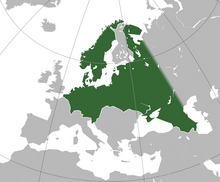
Living space in the East ( German: Lebensraum im Osten ) is a term of National Socialist propaganda , reflecting plans for the settlement of territories in Eastern Europe by Germanic peoples ( Aryans in the understanding of National Socialist leaders). This term first appeared in the William era , but later the Nazi movement gave it a racial and biological context. The desire to find vast territories for the “people without space” ( German: Volk ohne Raum ) served as one of the ideological foundations for the Ost Master Plan developed by Heinrich Himmler . Within its framework, a large-scale deportation of the "racially undesirable" population, its enslavement and economic exploitation was envisaged.

Content
Background
Friedrich Ratzel (1844-1904) coined this term in his scientific works Political Geography (1897) and Living Space (1901). At the same time, he transferred the theory of Charles Darwin on the struggle for survival in the animal world to relations between peoples and described the states as living beings that are in a constant struggle for living space, and whose further existence depends on its presence.
The term was picked up by the "Popular Movement" ( Völkische Bevegung ) and the All-German Union ( German Alldeutscher Verband ) and used in connection with the then numerous German minorities in Eastern Europe ( Volksdeutsche ) and plans for their expansion. It was believed that their land should not be lost, and the goal should be the establishment of new settlements. At the same time, the attitude towards the overseas colonies of the German Empire was negative. German colonial policy was seen as exclusively mercantile and composed under Jewish influence. Space was considered necessary for an "all-German" oriented "settlement policy on a large scale." For this, it was not the non-European colonies that were considered, but the "East directly bordering the German Fatherland." Destiny leads us there. The German compass points to the East. ” German immigrants to America were to be sent to the East. The dominant ideal of the Fölkisch Bevegung was a purebred German state on the "people's land" of the countries of Central and Eastern Europe, inhabited by German peasants and artisans, "fathers of future soldiers". Already in 1875, Paul de Lagarde presented a vision of the German state, the borders of which extend
in the west from Luxembourg to Belfort , in the east from the Neman to the "ancient Gothic lands" of the Black Sea region , in the south with access to the Adriatic Sea and with the potential for expansion into Asia Minor . [2]
The idea of space in the east was strongly popularized in 1926 with the release of the novel by Hans Grimm “ ” ( German: Volk ohne Raum ).
Mine Kampf
In a book published in 1925, Mein Kampf , Adolf Hitler described in detail in a separate chapter “Orienteering or Oriental Politics” his plans to seize living space and called for “to obtain for the German people the land to which they have a legitimate right”:
| We National Socialists consciously put an end to the entire foreign policy of the pre-war era. We want to return to the point at which our old development was interrupted 600 years ago. We want to suspend the eternal German aspiration to the south and west of Europe and we are definitely pointing our finger towards the territories located in the east. We finally break with the colonial and trade policies of the pre-war era and consciously move on to the policy of conquering new lands in Europe. When we talk about the conquest of new lands in Europe, we, of course, can mean first of all only Russia and those border countries that are subordinate to it. [3] Original text (German) Damit ziehen wir Nationalsozialisten bewußt einen Strich unter die außenpolitische Richtung unserer Vorkriegszeit. Wir setzen dort an, wo man vor sechs Jahrhunderten endete. Wir stoppen den ewigen Germanenzug nach dem Süden und Westen Europas und weisen den Blick nach dem Land im Osten. Wir schließen endlich ab die Kolonial- und Handelspolitik der Vorkriegszeit und gehen über zur Bodenpolitik der Zukunft. Wenn wir aber heute in Europa von neuem Grund und Boden reden, können wir in erster Linie nur an Rußland und die ihm untertanen Randstaaten denken. |
Key Documents
Many key documents demonstrate how consistently Hitler adhered to his military objectives.
- Immediately after coming to power, Hitler presented his meeting program with Generals in the house of General Hammerstein-Equord on February 3, 1933 (from a note by General Kurt Liebmann):
- How should we use political power? It's too early to say. It may be to gain new opportunities for export, or maybe - even better - to conquer new living space in the East and its unceremonious Germanization. [four]
- In a secret text on the four-year armament plan, in which Hitler demanded that the German army and the German economy be ready for war in four years, he said:
- The final decision is to expand the living space and food and raw material base of our people. The task of the political leadership is to resolve this issue soon. [five]
- On November 5, 1937, Hitler delivered a speech to the main representatives of the Wehrmacht that the German spatial issue can only be resolved through war ( Hossbach memorandum ).
- On May 23, 1939, Hitler said before the commanders:
- Living space, corresponding to the greatness of the state, is the foundation of any power. For some time you can refrain from this, but sooner or later the solution to the problems will come by itself. There is a choice between rising or falling. After 15 or 20 years, the solution of this issue will become inevitable. No longer will any German politician be able to avoid him. [6]
- On November 23, 1939, Hitler said before the commanders:
- "A growing population requires more living space. My goal is to create a reasonable balance between population and public space. The struggle must be waged for this. No people can escape this task, otherwise they are doomed to gradual death. [7]
Related topics
- Rush east
- Master Plan Ost
- Reich Commissariat Muscovy , Reich Commissariat Ostland , Reich Commissariat Ukraine
- Race of gentlemen , Subhuman
- The territorial and political expansion of the Third Reich
See also
- Ostarbeiters
- Hitler against the USSR
Notes
- ↑ Dokumentation Obersalzberg: Utopia: The "Greater Germanic Reich of the German Nation" (German) . www.obersalzberg.de. Date of appeal October 25, 2018.
- ↑ Quote from the chapter “Völkische Bevegung”; Uwe Puschner: Die völkische Bewegung im wilhelminischen Kaiserreich , Darmstadt 2001, ISBN 3-534-15052-X
- ↑ Quote from the chapter “Oriental Orientation or Oriental Politics”; Adolf Hitler: Mein Kampf
- ↑ Walther Hofer, Der Nationalsozialismus Dokumente 1933-1945, Frankfurt 1957, p. 181
- ↑ Wilhelm Treue, Hitlers Denkschrift zum Vierjahresplan, in VfZG 2/1955, p. 204
- ↑ Wolfgang Michalka, Deutsche Geschichte 1933-1945, Frankfurt 1999, p. 165
- ↑ Wolfgang Michalka, Deutsche Geschichte 1933-1945, Frankfurt 1999, p.