Carl Otrwin Sauer ( Eng. Carl Ortwin Sauer ; December 24, 1889 , Warrenton, Missouri - July 18, 1975 , Berkeley ) - American geographer , founder of modern cultural geography .
| Karl Ortwin Sauer | |
|---|---|
| English Carl Ortwin Sauer | |
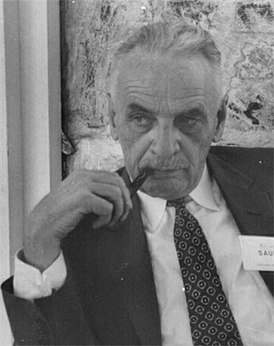 Karl Sauer in 1956 | |
| Date of Birth | December 24, 1889 |
| Place of Birth | Warrenon missouri |
| Date of death | July 18, 1975 (aged 85) |
| A place of death | |
| A country | |
| Scientific field | Geography |
| Place of work | |
| Alma mater | University of Chicago |
| Known as | founder of modern cultural geography |
| Awards and prizes | Guggenheim Scholarship ( 1931 ) [d] ( 1940 ) [d] ( 1957 ) [d] ( 1959 ) [d] ( 1975 ) |
Content
- 1 Biography
- 2 Contribution to science
- 3 Major works
- 4 Views
- 5 Works
- 6 notes
- 7 Literature
- 8 References
Biography
Carl Ortwin Sauer was born December 24, 1889 in a small town Warrenton ( Missouri ) in a family of German descent.
Karl Sauer studied at the University of Chicago , in which in 1915 he defended his doctoral dissertation. Later defending a dissertation taught at the University of Michigan .
From 1923 to 1954 he worked as dean of the Department of Geography at the University of California , and from 1957, Karl Sauer was an honorary professor at this university.
In 1940, Carl Sauer was elected president of the Association of American Geographers .
Contribution to Science
Karl Sauer is a multilateral scientist who has been interested in physical geography , anthropology , history , archeology and sociology . Karl Sauer was a supporter of a unified geographical science, since the culture of people in its spatial diversity is closely intertwined with natural diversity.
After analyzing the results of studies of territorial differences in culture and the economic structure of the tribes of the American Indians , Karl Sauer concluded that the economic development of territories with the destruction of traditional economies leads to the degradation of cultural diversity.
Major works
During his career, Carl Sauer has published more than twenty books and monographs and a huge number of articles. A significant part is devoted to the description of different regions and tribes of America , the formation of local cultures and the history of the colonization of continents by Europeans .
In 1925, the main theoretical work of Karl Sauer was published - The Morphology of Landscape . The concept of “cultural landscape” was introduced there as a spatial reflection of the accumulated evolution of cultures in a particular area, a peculiar projection of cultures on the natural landscape. Karl Sauer contrasted this concept with geographical determinism
Views
Karl Sauer's views on geography were very close to chorology and the French school of human geography . Richard Hartshorn was close in denying positivism and a discriminatory approach to research.
Compositions
- Foreword to historical geography // Annals of the Association of American Geographers. 1941. Vol. 31;
- Agricultural origins and dispersals. NY, 1952;
- The early Spanish main. Berk., 1966.
Notes
- ↑ Freebase data upload - Google .
Literature
- Sauer, Karl Ortvin / V.N. Streletsky // Iron Tree - Radiation. - M .: Great Russian Encyclopedia, 2008. - S. 293-294. - (The Big Russian Encyclopedia : [in 35 vols.] / Ch. Ed. Yu. S. Osipov ; 2004-2017, vol. 10). - ISBN 978-5-85270-341-5 .
- American geography. Current status and prospects / Comp. P. James, C. Jones. M., 1957.
- Schein RH The place of landscape: a conceptual framework for interpreting an American scene // Annals of the Association of American Geographers. 1997. Vol. 87. No. 4.
Links
- Land and Life: A Selection from the Writings of Carl Ortwin Sauer - Carl Ortwin Sauer, John Leighly - A Reprint of the Most Significant Works - Google Books https://books.google.com/books?id=TTgcNrf9eYYC&printsec=frontcover&dq=inauthor:%22Carl + Ortwin + Sauer% 22 & hl = ru & sa = X & ei = JnkNT_SHOcOUOr3rqLYH & ved = 0CDEQ6AEwAA # v = onepage & q & f = true