Boris Lvovich Brainin (birth name is German: Leer Brainin ; August 10, 1905 , Nikolaev - March 11, 1996 , Vienna , Austria) - Austrian and Soviet poet, poetry translator into German, polyglot (knew 15 languages fluently [1] , in his last book published translations from 26 languages) [2] , an anti-fascist .
| Boris Lvovich Brainin | |
|---|---|
| Boris Brainin | |
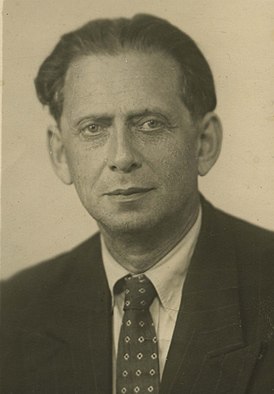 Nizhny Tagil, 1950 | |
| Birth name | Leer brainin |
| Aliases | Sepp Österreicher, Natalie Sinner, Berthold Brandt, Klara Peters |
| Date of Birth | August 10, 1905 |
| Place of Birth | Nikolaev  Russian empire Russian empire |
| Date of death | March 11, 1996 (90 years old) |
| A place of death | Vienna  Austria Austria |
| Citizenship |  Austria-Hungary Austria-Hungary  the USSR Austria the USSR Austria |
| Occupation | poet , translator , wrote in German |
| Years of creativity | 1922-1996 |
| Direction | humor , satire , lyrics , absurdism , translations of poetry into German, memoirs |
| Genre | poetry , translations of poetry into German, memoirs |
| Language of Works | German, Russian |
| Awards | medal to them. Kopleniga , GDR Prize for translating Eugene Onegin into German |
The main literary pseudonym is Sepp Österreicher (Austrian), other pseudonyms are Natalie Sinner, Berthold Brandt, Klara Peters [3]
Content
- 1 Biography
- 2 Literary activities
- 3 Famous Relatives
- 4 Interesting Facts
- 5 Favorites
- 6 References
- 7 Other sources
Biography
Came from the famous Viennese Brainin family. Parents: Leo Brainin (b. 6.3.1877) [4] and Rivitta (Riva Itta) Brainin (nee Trakhter, Nikolaev ). When B.L. Brainin was six weeks old, the family moved to Vienna. The fact of birth on the territory of the Russian Empire subsequently contributed to the acquisition of B. L. Brainin of Soviet citizenship. This saved his life, unlike his brother Wilhelm (Willy), who was born in Vienna and who later emigrated to the USSR, from where he was returned after the Anschluss (annexation of Austria to Germany), and died in Majdanek [5] .
He graduated from the University of Vienna (1934) with a doctorate in philology ( German studies ). He studied psychoanalysis directly from Sigmund Freud [6] . Member of the Communist Party of Austria (c 1927) [7] , leader of youth propaganda brigades. He was awarded the badge of Honorary Member of the Communist Party of Austria (in 1978) and a medal to them. Kopleniga for merits in the fight against fascism.
In 1934, he was forced to flee Vienna after the defeat of the Vienna Uprising , in which he participated on the side of the Schutzbund . Having fallen through Poland to the USSR (since 1935) he taught at the Pedagogical Institute of the Autonomous Soviet Socialist Republic of the Volga Germans ( Engels ), among his students were the parents of the composer A. Schnittke [8] . He was arrested by the NKVD on October 5, 1936 (on August 21, 1937, he was sentenced to 6 years in forced labor camps and to loss of rights) [9] and was in the camps of the Northern Urals and in the labor army [10] . He sat in the camp with Samad Vurgun [6] . Then (from August 16, 1946) [9] he was in exile in Nizhny Tagil and in Tomsk , he taught at schools and universities. Rehabilitated September 12, 1957 [11] Moved from Tomsk to Moscow with the assistance of S. Ya. Marshak and the famous translator Lev Ginzburg . He worked in the newspaper Pravda [12] (in fact, he was a literary consultant in Neues Leben, the newspaper of the Soviet Germans under Pravda). He did a lot for the formation, preservation and development of the literature of Soviet Germans. Member of the Union of Writers of the USSR (1959), Union of Writers of Moscow [13] .
He repatriated to Austria in 1992. [14] Five years before the repatriation, he wrote in Russian memoirs about being in the camp and in the labor army (“Memoirs of the Vredol”, “v.i.do.l.” - “temporarily fulfilling the post of horse”) . In Vienna, he translated his memoirs into German. At one time, A. T. Twardowski encouraged Brainin to write memoirs, to which Brainin, according to the memoirs of V. Ya. Kurbatov , replied to Twardovsky “I have not tired of walking without a convoy” [15] .
The Brainin archive is stored mainly in the Vienna Literature Museum (see de: Literaturhaus ) and partly in the University of Bremen (Germany).
Literary activity
He published about 1,500 translations of the lyrics of Soviet poets, translated without interlinear translations from many languages of the peoples of the USSR [2] . Translations of Brainin are distinguished, along with accuracy, by full or partial equirhythmicity , as well as the obligatory observance of the rhymed form of the source (in comparison with the philological translations of poetic texts generally accepted in Germany, Austria and Switzerland, as accurate as possible in German prose). Translator of "Eugene Onegin" into German [16] . According to the testimony of V. Ya. Kurbatov , Brainin said:
And one day, early in the early morning, getting up to the wind, I suddenly saw a guard reading a book. But I already forgot what the books look like ... It even hurt me to hold it in my hands, and even better to read a book, whatever it was ... "Guard, give me this book, please, and I will give you a perfectly dried newspaper on a smoke ”... The guard turned out to be a wonderful man. He said: “Stay there, I’ll put the book here, I’ll stand here myself, you will put the newspaper here, and look at me!” In general, we exchanged.
The book was without covers and many pages. These were poems! I rushed to read. It was "Eugene Onegin", which I once knew from the occasional slip of the tongue and jokes of the prisoners. I read it all day ... I remembered how a great word can work, from which I have lost touch ... And then I swore that if I leave the camp alive, I will certainly translate this book into my native German language. And I went out, and I had all my life here, in Russia, and I had nothing to do in Vienna. And I translated Onegin for the local Germans. Then, of course, I learned that there are better translations, but from this I was only happier, although I love mine more. He is dearer to me.
- Kurbatov V. Ya. Podorozhnik: Meetings on the Road, or An Unexpected History of Literature Autographed by Travel Companions. - Irkutsk: Publisher Sapronov , 2006. - 416 p. - S. 49-50.
Along with many “on-duty” translations of secondary Soviet poets, he translated verses from S. Yesenin , A. Akhmatova , M. Tsvetaeva , N. Gumilev , B. Pasternak , N. Zabolotsky , E. Bagritsky , I. Selvinsky , K. Simonov from Russian , M. Svetlova , Y. Smelyakova , B. Slutsky , L. Martynov , E. Vinokurov , E. Evtushenko , A. Voznesensky , R. Rozhdestvensky , B. Akhmadullina , B. Okudzhava , N. Matveeva and others. In particular, made equirhythmic translations of songs from the movie “The Irony of Fate ” [17] .
Famous Relatives
B. L. Brainin is the father of Russian and German musician and writer Valery (Willy) Brainin-Passek [18] [19] .
Other relatives:
- Max Brainin (1909-2002), Austrian-American advertising schedule
- Michael Brainin (b. 1951), Austrian neuroscientist
- Norbert Brainin (1923-2005), Austrian-British violinist, founder of the Amadeus quartet
- Reuben Brainin (1862–1939), Jewish publicist and public figure
- Harald Brainin (1923-2006), Austrian poet and writer
- Fritz (Frederick) Brainin (1913-1992), Austrian-American poet
- Elizabeth Brainin (born 1949), Austrian psychoanalyst and scientist
Interesting Facts
Andrei Sergeyev ’s story “Austrian Communist” was written about B. L. Brainin [20] .
Favorite
- Sepp Österreicher. Mit einem heitern, einem nassen Aug. - Moskau, nach 1956.
- Sepp Österreicher. Reise von A bis Z. - Moskau, 1970.
- Sepp Österreicher. Wo fängt denn unsere heimat an? Ausgewählte Nachdichtungen sowjetischer Poesie. - Moskau: Verlag Progress, 1973.- 176 p.
- Sepp Österreicher. Peter Ohneruh und andere . - Moskau, 1977.
- Sepp Österreicher. Potpourri (Humorsalat. Satirisches Intermezzo. Allerhand vom Kinderland) . - Moskau, 1981.
- Sepp Österreicher. Echo Ausgewählte Nachdichtungen sowjetischer Lyrik. - Moskau: Raduga-Verlag, 1986. - 295 pp. ISBN 5-05-000594-9
- Brainin B. L. Memoirs of Vridol . - Moscow, 1987. Typewriting, 197 p. [10] [21] .
- Brainin B. L. Camp memoirs , publication in the journal Khreshchatyk , 2010-2012
- Sepp Österreicher (Boris Brainin). Wridols Erinnerungen. Erinnerungen eines Arbeitspferdes . - Wien: Pilum Literaturverlag, 2019. ISBN 978-3-902960-98-6
Links
- ↑ Boris Brainin (Sepp Österreicher) translations
- ↑ 1 2 Sepp Österreicher. Echo Ausgewälte Nachdichtungen sowjetischer Lyrik. - Moskau: Raduga-Verlag, 1986.- 295 pp.
- ↑ Boris Brainin
- ↑ The Search Engine that Does at InfoWeb.net
- ↑ Reference: The Book of Memory. Brainin Wilhelm Lvovich
- ↑ 1 2 Journal Hall | Khreshchatyk, 2010 N1 | B. L. Brainin - Memories of Vridol
- ↑ Russian Jewish Encyclopedia
- ↑ Brainin B. L. Memories of vridol . - Moscow, 1987. Typewriting, 197 p.
- ↑ 1 2 Memorial Archive Archived July 31, 2009 on Wayback Machine
- ↑ 1 2 Memoirs, Brainin B.L.
- ↑ Reference: The Book of Memory. Brainin Boris Lvovich
- ↑ Kursk Truth (inaccessible link)
- ↑ Brainin B.L.
- ↑ musicbox.su
- ↑ Unknown Kurbatov | Number 38 (2009) | Literary Russia Archived October 19, 2011 on Wayback Machine
- ↑ "Eugene Onegin" in German
- ↑ Sepp Österreicher
- ↑ Journal Hall
- ↑ Musikschule Hannover
- ↑ Andrey Sergeev. Omnibus - M.: New Literary Review, 1997, p. 394-398. ISBN 5-86793-027-0
- ↑ Brainin, B.L. Memoirs. Summary. Name Index.