Tshinets culture is an archaeological culture of the Bronze Age ( XIX - XI centuries BC).
| Tshinets culture Bronze Age | ||||
|---|---|---|---|---|
 Tshinets-Komarov archaeological culture in the XV-XIII centuries BC. | ||||
| Composed of | Komarovskaya culture | |||
| Localization | Poland , Ukraine , Belarus and Russia | |||
| Dating | XIX - XI centuries. BC. | |||
| Carriers | supposedly great Balto-Slavs | |||
| Continuity | ||||
| ||||
Content
- 1 Geography
- 2 Genetic relationships
- 3 Settlements
- 4 Material culture
- 5 Paleogenetics
- 6 notes
- 7 Literature
Geography
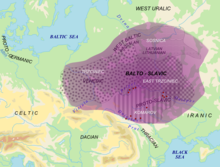
It was distributed in Poland , Ukraine , Belarus and Russia . It was named after the burial ground near the village of Trzciniec near Opole Lubelski ( Lubelskie Voivodeship , Poland). In the territory of Western Ukraine there was a kindred Komarovskaya culture , which often combines with Tshinetskaya into a single cultural complex. The Tshinets culture circle included 3 main cultures: the Komarov culture in the Right-Bank forest-steppe and the Carpathian region, the Tshinets culture in the west of the TKK range and the Sosnitsky culture in the forest zone in the east of this range [1] .
Genetic relationships
It arose as a result of the development and consolidation of the central group of cord ceramics cultures in Poland ( Mezhanovitskaya , Strzyzhowska , Ivensky ) and spread further to the East. Subsequently, over most of the territory, it became an integral element in the Luga and Belogrudovsk (which supposedly spoke the Proto-Slavic language ) and Milograd cultures, and also influenced (through Lebedov’s culture ) the Yukhnov culture .
  Tshinetskaya Belozerskaya
             ________ | __________________________________ |
            |  |  |
         Luzhitskaya Lebedovskaya Belogrudovskaya
            |  _________ | _____________ |
         Pomeranian |  |  Chernoleskaya
            |  Milogradskaya Yukhnovskaya
          Przeworská - |
                Zarubinetskaya
Settlements
Settlements are unreinforced. Dwellings are dugouts and small land dwellings.
Material Culture
The burial grounds are moundless and mound, burial places are most often corpses. Finds: various ceramic products, flint and stone tools, crafts made of bone and bronze. The main occupations of the tribes are animal husbandry and agriculture.
The social system is patrimonial.
Paleogenetics
The representative of the early Tshinets culture (sample PL_N17) identified the Y-chromosome haplogroup R1a-Z280> S24902 and the mitochondrial haplogroup J1c1b1a [2] .
Notes
- ↑ Luchinsky N.D. Tshinetsky cultural circle in the problem of ethnogenesis of the Slavs // Bulletin of Moscow State Regional University, 20188 / No.2
- ↑ Fernandes DM et al. A genomic Neolithic time transect of hunter-farmer admixture in central Poland , 2018
Literature
- Great Soviet Encyclopedia
- Berezanskaya S. S., Middle period of the Bronze Age in Northern Ukraine, K., 1972
- Gardawski A., Plemiona kultury trzcinieckiej w Polsce, “Materiały starożytne”, Warszawa, 1959, t. 5, s. 7-189.