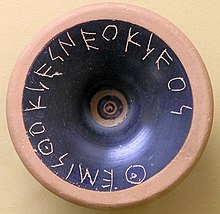
An ostracon or ostrac ( other Greek: τὸ ὄστρακον - a clay shard ) is a shard of an earthen vessel, as well as less commonly a sea shell, an egg shell, a fragment of limestone or slate [1] .
In ancient Egypt , because of its accessibility compared to expensive papyri , earthenware fragments were used for records, calculations, receipts and short letters. On the islands, the ancient students performed school homework. Text on the ostracons was written in ink or scratched [2] . Entire archives of ostracons were found (for example, the Archive of Nicanor ).
In ancient Greece , in particular in Athens , the ostrakons were used for voting in the procedure of ostracism and therefore are a valuable source of knowledge not only about everyday, but also political life.
Ostrakon is studying papyrology [3] . Collecting Ostracons refers to the Ballot .
Notes
- ↑ Ostrak (Rus.) // Vlasov V. G. New Encyclopedic Dictionary of the Fine Arts: 10 tons .. - SPb. : ABC Classic, 2007. - T. VI: H - O.
- ↑ Barbara Mertz. Red Earth, Black Earth. - M .: TSENTRPOLIGRAF, 2008 .-- S. 161. - 464 p. - ISBN 978-5-9524-3621-3 .
- ↑ Fikhman I. Introduction to documentary papyrology. - Science, 1987. - p. 215.