Peter Behrens ( German: Peter Behrens ; April 14, 1868 , Hamburg - February 27, 1940 , Berlin ) - one of the founders of modern industrial architecture and design , a representative of the Dusseldorf School of Art .
| Peter Behrens | |
|---|---|
| Date of Birth | |
| Place of Birth | |
| Date of death | |
| A place of death | |
| A country | |
| Occupation | , , , , , , |
Peter Behrens is known primarily as an architect. At the same time, he successfully worked in the field of an artist, graphic artist, book illustrator and font developer, which made him one of the most famous representatives of the Modern style (in Germany - Art Nouveau).
Content
- 1 Biography
- 2 Founder of industrial design
- 3 The building of the German embassy in St. Petersburg
- 4 Other works
- 5 notes
- 6 References
Biography
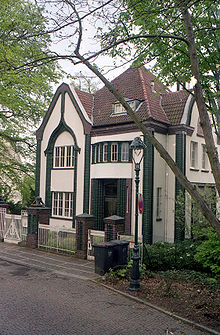
After training in Karlsruhe and Dusseldorf , Behrens in 1891-1899. settled in Munich , where he joined the ranks of the Secession . His works of those years gravitate to art nouveau , while preserving compositionally geometric clarity. In 1901, he designed his own house in the Darmstadt Art Colony , along with all the furniture and accessories.
In 1903, he became the director of the Düsseldorf School of Art and Industry and held this position until 1907.
Since 1907, he is an artistic consultant for AEG in Berlin. It was then that he showed himself to be the creator of Industrial Design and Industrial Architecture. Mies van der Rohe and Walter Gropius came out of his workshop in Berlin.
Founder of Industrial Design
In 1907, Behrens accepted the offer to become an adviser to the AEG concern and, for the first time in history, carried out his full “ rebranding ”, designing not only factory and office buildings in the same style, but also retail outlets, office furniture , billboards, products ( hair dryers , fans ), packaging and so on. One of the founders of the German Werkbund , a union of architects with the goal of reorganizing construction and artisans on a modern industrial basis. He defended the principles of functionalism , as well as the use of modern materials - glass and steel.
In his workshop, modernist architects such as Le Corbusier , Walter Gropius , Mies van der Rohe took their first steps.
German Embassy in St. Petersburg
In the years 1911-12. Behrens designed one of the key monuments of European neoclassicism - the building of the German Embassy on St. Isaac's Square in St. Petersburg .
Simplified, devoid of classical decor columns seemed to proclaim the brutal power of the German Empire . This idea was especially clearly expressed by the sculptural group of the Dioscuros and two horses by Eberhard Enke , which was discarded after the outbreak of the First World War.
The German embassy in St. Petersburg is a prototype of the architecture that was developed in the USSR and Germany in the 30s of the XX century .
Other work
In the following decades, Behrens designed mainly factory and factory buildings (in Berlin, 1909–12; Riga , 1912–14 (two buildings of the Union plant — now the WEF , together with F. Scheffel and F. Seiberlich ); Oberhausen , 1921–25 ; Höchste , 1925–26; Linz , 1932–36). The building of the port warehouse in Tilsit (1928). In 1922–36 headed the School of Architecture at the Vienna Academy of Arts . Despite the extreme laconicism of the decor, the later buildings of Behrens fit perfectly into the mainstream of the German tradition with its impressive imposing weightiness and massive severity.
Berlin-Moabit, Huttenstrasse 12-16
Notes
- ↑ 1 2 Peter Behrens
- ↑ Peter Behrens - 2006. - ISBN 978-0-19-977378-7 , 978-0-19-989991-3
- ↑ Encyclopædia Britannica
- ↑ 1 2 3 Berens Peter // Great Soviet Encyclopedia : [in 30 vol.] / Ed. A. M. Prokhorov - 3rd ed. - M .: Soviet Encyclopedia , 1969.
- ↑ BNF ID : 2011 Open Data Platform .
- ↑ artist list of the National Museum of Sweden - 2016.
Links
- Kirikov B.M. , Stiglitz M.S. Petersburg of German architects. SPb .: “A clean sheet”, 2002. ISBN 5-901528-04-2
- Krastins JA. Art Nouveau style in the architecture of Riga. Moscow, Stroyizdat, 1988.
- Frampton K. German Werkbund, 1898-1927 / Modern architecture. A critical look at the history of development. M .: Stroyizdat, 1990, p. 161-171.
- Scheurer, Ralf . Das Gebäude der Deutschen Botschaft in St. Petersburg von Peter Behrens. In St. Petersburg-Leningrad. Universität Karlsruhe (TH), Institut für Baugeschichte. Karlsruhe. 2000
- "Deutsche Botschaft 1911-1912 Peter Behrens", "DU". Die Zeitschrift der Kultur. Heft Nr. 12, Dezember 1998