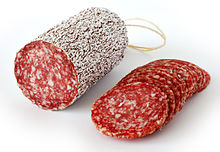
Sausage - a food product ; class-forming type of sausages , which is minced meat in an oblong shell. It may contain one or several types of meat, for example, poultry meat, various fillers, undergo heat treatment (cooking, sometimes multiple; frying) or fermentation [1] .
| Sausage | |

Content
History
Sausage has been known since antiquity: references to it are found in the sources of Ancient Greece , Babylon and Ancient China . In particular, blood sausage is mentioned by Homer in The Odyssey , the famous comedy Epicharmus with the mention of sausage, as well as the play by Aristophanes about the seller of sausage who won the election. There is evidence that sausage was a popular product in ancient Greece and ancient Rome . [2]
In medieval Europe, sausage was a rare and very expensive product.
In ancient Russia, the word "sausage" had a different meaning from modern; sausage was understood to mean food prepared from the blood of an animal, and therefore there was a ban on eating sausage. For example, in this meaning the word was used in Novgorod Kormchi in 1282: “Some of the blood of an animal prepare dishes called sausages”; and in Stoglava in 1551: "The rule prohibits all Orthodox Christians from being strangled and blood, that is, sausages."
In Soviet times, sausage was a scarce product and a symbol of wealth.
Etymology in Russian
The Slavic word "sausage" (originally - kalb- ) has been known since the 12th century ; it was found in Novgorod birch bark letter No. 842 [3] , where sausage appears in the list of sent products.
According to Korsch , the word "sausage" is formed from a tour. kul basti - "meat prepared in a special way." Fasmer concludes that, judging by the phonetic versions of this word in Slavic languages , there are reasons to think about borrowing, the source could be Turkic : cf. tour. külbasty (“meat fried on a rascher, fried meatballs”), while -t- could disappear in the adjective sausage [4] . It is also possible that the word sausage is formed from the Turkic words kul ( qol , “hand”) and bass ( -basdı , “crush”), according to the method of its preparation [5] , since the sausage was made by hand and ram intestines were stuffed with minced meat.
Sometimes there is a statement that the word "sausage" can come from Hebrew. Kolbāśār “meat, all flesh, living creature”, but this is unlikely [4] .
Types of Sausages
Sausages are classified mainly by the method of preparation.
Cooked sausages are made from salted minced meat. They are boiled at a temperature of about 80 ° C. Cooked sausages can contain a large amount of soy , and can be vegetarian with soy or seitan instead of meat. Due to the content of large quantities of water, they are not stored for a long time. Cooked sausages contain 10-15% protein , 20-30% fat , energy value 220-310 kcal per 100 g. One of the most famous varieties of cooked sausage is doctor's sausage .
Smoked sausages are first cooked and then smoked . Contain more spices than boiled sausages. Unlike cooked sausages (in which the meat is a homogeneous mass), smoked sausages can consist of small pieces of a certain size. As additives, milk , cream , flour , bacon and starch are used . Cooked smoked sausages contain 10-17% protein, 30-40% fat, their energy value is 350-410 kcal per 100 g, and the shelf life in the refrigerator is no more than 15 days.
Half-smoked sausages are first fried, then cooked and then smoked. Half-smoked sausages in appearance and taste are often almost indistinguishable from cooked smoked sausages, but during heat treatment there is less weight loss, and smoking is less pronounced.
Raw smoked sausages (formerly also called smoked sausages ) are not subjected to high-temperature heat treatment, cold smoking occurs at 20–25 ° C, and the meat is fermented and dehydrated. Raw smoked sausages contain the greatest number of spices, brandy can also be added. When using the traditional recipe, the ripening of smoked sausages lasts at least 30-40 days, from the end of the 20th century production technologies have been mastered in 21 days or less, a short ripening period is achieved due to glucono-delta-lactone (GDL, food supplement E575) - an acid that affects to change the pH , as well as the use of starter cultures - most often yeast microorganisms that feed on sugar added to the recipe, fermentation is carried out due to the release of waste products by them. Raw smoked sausages contain 13–28% protein, fat 28–57%, and energy value 340–570 kcal per 100 g.
Cured sausages are made from minced pickled meat. Smoked in cold smoke for 3-4 days. The meat is fermented and dehydrated, then dried at a temperature of 15-18 degrees. An example of such a sausage is sujuk .
Some types of sausages are distinguished by the raw materials used. Liver sausage is made [6] from offal (liver, meat trimmings and so on), mainly from cooked; eggs (sausage), vegetables, milk, butter and other additives can also be used. Liver liver sausages differ from other sausages in a pasty consistency and the gray or light gray color of both minced meat and the shell. In Russia, liver sausages are divided into 3 categories, depending on the content of muscle tissue: A (over 40%), B (from 20% to 40%) and C (less than 20%). Liver sausages contain 10–18% protein, 12–44% fat; energy value of 196–444 kcal per 100 grams. The shelf life of liver sausages in a natural shell is relatively small, up to 3 days; however, when using vacuum packaging or modified atmosphere packaging, as well as preservatives in sausages, the shelf life can be extended to 30 days.
Production
Production of sausages includes the following operations:
- boning - cutting carcasses of animals, separation of meat from bones;
- venation - the division of meat by grades (pork: fatty, nonfat, bold; beef: premium, first grade, second grade);
- minced meat - the production of minced meat by mixing the components and grinding them on sausage cutters ;
- molding - filling sausage casings with minced meat on sausage syringes and sealing the ends of the casings on clippers ;
- sludge - keeping sausage sticks with minced meat at a low temperature prior to the start of heat treatment in accordance with the technology for the production of specific sausages
- heat treatment - processes of drying, frying, cooking and smoking of sausages in sausage heat chambers , the process of choking (cooling sausages with water and air).
Sausage casings
Sausage casings have a significant role in the production of sausages. They can be divided into natural (rounds, bungs) and artificial , as well as barrier and permeable. Barrier casings allow sausages to be stored for a long time (up to 90 days); in their casings mainly boiled sausages are produced. Many permeable shells allow subsequent smoking, frying. Barrier casings primarily include polyamide sausage casings . Artificial permeable sausage casings include: cellulose, protein (collagen), fibrous, permeable polyamide, textile.
Nutritional Supplements
They are used to protect sausages from the multiplication of pathogens (for example, botulism ), as well as to improve color ( sodium nitrite ), enhance taste ( monosodium glutamate, sodium inosinate ), increase weight (water with salts and gelling agents, stabilizers), and prevent caking and lump formation, etc. [7]
Gallery
Sliced Chorizo Sausage
4 types of Polish sausages: white, ham , Silesian, shed
Drohobych sausage ( Ukraine , Lviv region )
Hungarian Sausages
Swojska (Polish)
Krajańska (Polish)
See also
Notes
- ↑ Sausage - an article from the Great Soviet Encyclopedia .
- ↑ (Polish) Eleonora Trojan, Julian Piotrowski, Tradycyjne wędzenie Archived on September 29, 2011. AA Publishing. 96 pages. ISBN 978-83-61060-30-7
- ↑ Novgorod birch bark letter No. 842. (Inaccessible link) . Date of treatment November 25, 2007. Archived December 3, 2013.
- ↑ 1 2 Fasmer M. Etymological Dictionary of the Russian Language. T. 2.P. 286.
- ↑ E.N. Shipova (compiler). Dictionary of Turkisms in Russian. - Alma-Ata: Publishing House "Science" of the Kazakh SSR, 1976. - S. 191. - 444 p.
- ↑ GOST R 54646-2011
- ↑ Why nutritional supplements sausage? , Komsomolskaya Pravda , September 13, 2006.
Links
- Sausages // Brockhaus and Efron Encyclopedic Dictionary : in 86 volumes (82 volumes and 4 additional). - SPb. , 1890-1907.
- Sausages // Brief Encyclopedia of Household. - M .: State Scientific Publishing House "Great Soviet Encyclopedia", 1959.
- National standard of the Russian Federation - Cooked sausages. Technical conditions GOST R 52196-2003
- USSR sausages