Radishes - annual or biennial plants from the genus Radish of the Cabbage family. Classification radishes - a group of varieties species Sowing Radish ( Raphanus sativus ).
| Radish |

Radish root vegetables |
| Scientific classification |
|---|
|
| International scientific name |
|---|
Raphanus sativus var. radicula Pers. , 1806 |
|

Radish with oblong root crops
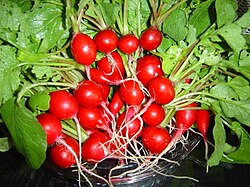
Radish with round root vegetables
Content
Radish is an edible plant and is grown as a vegetable in many countries of the world. Its name comes from lat. radix is the root.
Root crops, which have a diameter of 2.5 cm and are covered with thin skin, painted in red, pink or white-pink, are usually eaten. Radish root vegetables have a sharp taste. This typical taste of radish is due to the content of mustard oil in the plant, which under pressure is converted to mustard oil glycoside.
By origin, European, Japanese and Chinese groups of varieties are distinguished.
According to the growing season, they distinguish:
- Annual. Such a plant produces fruits and seeds in the year of sowing.
- Biennial. The plant produces root crops in the year of sowing, and seeds only in the next year.
According to the method of sowing, they distinguish between greenhouse and row (open ground).
The shape of the root crop can be from flat-round to spindle-shaped.
The color of root crops can be pink, white, red, yellow, purple.
Radish is used almost everywhere as a vegetable crop. Root crops (mainly in salads and okroshka ) and foliage (in salads, okroshka, soups) are used as food. Radish is valued as an early vegetable; in central and western Russia it can be sown in semi-warm greenhouses in March . In April, radishes may already be sown in the ground. Thus, in April you can get the first crop of greenhouse radishes. The early ripening of radish fruits and its high content of a number of vitamins necessary for humans led to the fact that radishes became popular in areas where people need to restore immunity after a fairly long winter. In addition, radish tolerates transplanting well.
In addition to eating, radishes are also often used to mark the line of crops of other vegetables, such as onions or carrots . Radish sprouts appear after 2-3 days, which allows the processing of beds even before emergence of other crops. Radish root crops grow in 3-5 weeks.
Contents
| 100 g of radish contain approximately: |
| Energy | 13.6 ... 14.6 kcal or 57 ... 61 kJ | Squirrels | 1.1 g |
| fat | 0.1 g | carbohydrates used | 2.0 g |
| Alimentary fiber | 1.6 g | Water | 94 g |
| Sodium | 17 mg | Potassium | 225 ... 255 mg |
| Calcium | 34 ... 35 mg | Phosphorus | 28 mg |
| Magnesium | 8 mg | Iron | 1.2 mg |
| Fluorine | 0.10 mg | Vitamin A | 4 mcg |
| Vitamin E | ? | Vitamin B1 | 0.04 mg |
| Vitamin B2 | 0.04 mg | Niacin ( niacin , vitamin PP , vitamin B3 ) | 0.2 mg |
| Vitamin B6 | 0.06 mg | Vitamin C | 27 ... 29 mg |
| Salicylic acid | 1.24 mg | | |
- Radish became one of the cultivated plants that were grown on the International Space Station as part of a study of the genetic characteristics of plants grown in zero gravity. Radish was chosen because of its relatively short growing season — about 30–45 days, and also because both the root crop and the leaves are edible in the radish, which makes it a very convenient food product for growing in space [2] .
- Radish - an article from the Great Soviet Encyclopedia .


