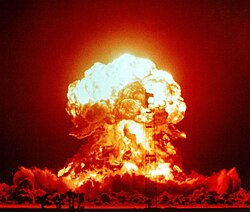
Mass retaliation is the concept of nuclear strategy , which implies a massive retaliatory strike that surpasses the first in destructive power.
The essence of the strategy of massive retaliation is that the state, in the event of aggression against it, reserves the right to disproportionate use of force against the aggressor. Such a strategy works on the principle of mutually guaranteed destruction with the only difference that a retaliatory nuclear strike will follow even in the event of an attack using conventional weapons or a local border conflict [1] .
The term “massive retaliation” was first mentioned by American diplomat John Dulles on January 12, 1954 . In his speech, Dulles said that any military provocation against any of the US allies will be followed by an immediate nuclear strike against the aggressor or provocateur. The most striking example of such a potential local conflict that would entail massive US retaliation against the USSR was the Berlin crisis of 1961 . The Soviet leadership planned to apply the same strategy in relation to the United States itself in case of their attempt at a military solution to the Caribbean crisis .
Thus, in contrast to the strategy of massive retaliation, the concept of a flexible response appeared , providing for the dosed use of force in response to aggression.
Notes
- ↑ Collective of authors. article “Massive retaliation” strategy // Soviet Military Encyclopedia in 8 volumes (2nd edition) / Ed. Ogarkova N.V. - M .: Military Publishing , 1978. - V. 5. - S. 181. - 686 p. - 105,000 copies.
See also
- Flexible response
- Containment
- Nuclear war
- Realistic scare
- Pentomic Division