NK-32 (product “R”) is a dual-circuit three - shaft turbofan engine with a common afterburner (TRDDF) developed at the Kuibyshev Motor Plant under the direction of ND Kuznetsov .
| NK-32 | |
|---|---|
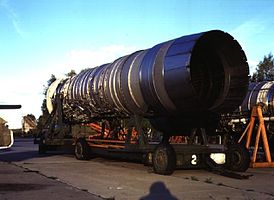 | |
| Type of | Turbofan |
| A country |  USSR / USSR /  Russia Russia |
| Using | |
| Years of operation | since 1983 |
| Application | Tu-160 , Tu-144LL |
| Production | |
| Constructor | Nikolay Kuznetsov |
| Year of creation | 1977 year |
| Manufacturer | Kuibyshev Motor Plant |
| Years of production | since 1983 |
| Total released | about 250 [1] |
| Options | NK-32 for Tu-160 NK-32-1 for Tu-144 |
| Weight and size characteristics | |
| Full mass | 3650 [2] kg |
| Length | 7453 mm |
| Diameter | 1785 mm |
| Performance data | |
| Thrust | 14000 kgf |
| Afterburner rod | 25000 kgf |
| Compressor | weight 365 kg, three-stage fan, 5 medium stages, 7 - high pressure |
| Turbine | one high pressure stage, one medium pressure and two low pressure |
| Turbine temperature | 1302 [3] ° C |
| The combustion chamber | multi-nozzle ring |
| Degree of pressure increase | 26.8 |
| Control | electronic, with hydromechanical duplication |
| Specific fuel consumption | 0.72 [4] kg / kgf · h |
| Bypass Degree | 1.4 |
| Specific thrust | 6.85 [5] kgf / kg |
Content
Design
The compressor has a three-stage fan, five medium pressure stages and seven high pressure stages. [6] The compressor blades are made of titanium , steel and (in the high pressure cascade) a nickel alloy.
The combustion chamber is circular multi-nozzle . The turbine has one high-pressure stage (diameter about 1 m, combustion temperature 1575 K ) with cooled single-crystal blades, one medium-pressure stage and two low-pressure ones. Engine nozzle adjustable, self-made. The control system is electronic, with hydromechanical duplication.
Scope
It is currently used on Tu-160 strategic bombers. The engine was also installed on the “flying laboratory” Tu-144LL .
History
Development began in 1977 . In serial production since 1983 . As part of the development of a second-generation supersonic passenger aircraft (ATP), the NK-321 engine was also developed in the late 1970s. The engine was tested and operated on aircraft Tu-142LL and Tu-144LL .
In 1993, serial production was discontinued. [7]
In December 2006, after the signing of the agreement between Russian Railways and the N. D. Kuznetsov Samara Scientific and Technical Complex , the development of the NK-361 gas turbine engine based on the NK-32 engine for the world's most powerful gas turbine locomotive GT1 began .
In 2016, PJSC Kuznetsov announced that it was resuming serial production of NK-32 engines for Tu-160 missile carriers. [8] In the summer of 2017, the NK-32-02 engines of the installation batch were to be tested, [9] in November of the same year, the new Tu-160M2 was transferred for flight tests. [10] In 2018, it is planned to conclude a contract for the serial production of engines.
Based on the NK-32 engine, it is planned to create an engine for a promising long-range aviation complex ( PAK DA ) [11] .
It is also planned to create a new engine for the An-124 on the basis of NK-32 instead of the D-18T manufactured in Ukraine [12] .
Notes
- ↑ Turbofan dual-circuit engine with afterburner NK-321
- ↑ OJSC Kuznetsov
- ↑ OJSC Metalist-Samara Archived on October 17, 2013.
- ↑ In cruise mode
- ↑ afterburner
- ↑ Zatuchny A.M., Rigmant V.G., Sineokiy P.M. “Strategic missile carrier bomber Tu-160” - M., Polygon Press, 2016, 552 pp., Color. ill., ISBN 978-5-98734-021-9
- ↑ Tu-160 bombers will be equipped with new engines . RIA News .
- ↑ In Samara, the production of NK-32 engines for the Tu-160 missile carriers launched . riafan.ru (October 17, 2016). Date of treatment November 22, 2016.
- ↑ The Kuznetsov plant will manufacture five NK-32-02 engines for the Tu-160M2 by the end of the year .
- ↑ The Ministry of Defense plans to equip all Tu-160 missile carriers with NK-32 engines .
- ↑ The engine for PAK DA will be created on the basis of the Tu-160 engine . RIA News .
- ↑ An-124 Ruslan aircraft will receive Russian engines instead of Ukrainian ones .