Lake Fucino , Lake Fucino ( Italian: Lago Fucino, Lago di Celano , Lat. Fucinus Lacus ) is a former lake in Italy , in the province of L'Aquila east of Rome , drained in 1875. It is famous for the Battle of Lake Fucin during the Allied War , 89 BC. e., and the Navachia , arranged by Princeps Claudius in the 1st century A.D. e.
| Lake fucino | |
|---|---|
| ital. Lago Fucino, Lago di Celano , lat. Fucinus lacus | |
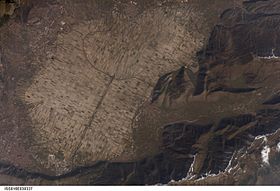 Satellite image of the former bottom of Lake Fucino | |
| Morphometry | |
| Absolute height | 661 m |
| Dimensions | 17.28 × 10.85 km |
| Square | 140 km² |
| Location | |
| A country |
|

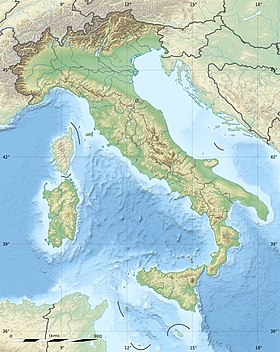


The surroundings of Lake Fucina, since ancient times inhabited by Mars tribes, were colonized by the Romans in the late Republican period . The most famous settlement was Marruvium - modern San Benedetto del Marcy. A shallow lake, with an area of about 140 km², did not have a natural drainage and from time to time flooded arable land and settlements; swampy shores contributed to malaria .
The first proposals to drain the lake are attributed to Julius Caesar ; in addition to economic goals, the project would allow to reconcile troubled Mars. It only came to real work under Claudius . To drain the lake, I had to dig a tunnel through the hills of Monte Salviano.
He took up Futsin Lake in the hope of not only fame, but also profit, as there were people who promised to take the costs of draining themselves to get drained fields for it. Digging in places, drilling holes in places, he built a three-mile drain for eleven years, although thirty thousand workers worked on it without interruption.
Suetonius , The Life of the Twelve Caesars
Emperor Hadrian continued what Claudius started. Since Adrian’s channel went the same way as the incomplete channel of Claudius, it is impossible to determine exactly how Claudius was able to achieve the goal. It is likely that under Claudia the area of the lake was reduced to 90 km², and under Adrian to 57 km². At this level, it was maintained until the fall of the Western Roman Empire. After the fall of Rome, the abandoned drain gradually overgrown and clogged, and by the end of the 6th century, Lake Fucina again reached its historical size.
In 1854, Alessandro Torlonia launched a new project to drain the lake. The work was consistently led by a Swiss engineer, Frans de Montréchard, Enrico Bermont and Alexander Briss. The new main canal was 6.3 km long and 21 m wide. In addition to it, 285 km of small canals were laid in the drained valley, 238 bridges and 4 locks were built . In 1875 the lake was drained - this time completely; Torlonia was awarded the princely title and ownership of most of the new lands.

Today, on the site of the drained lake - fertile agricultural land, only 14,000 hectares , cut into 497 regular plots of 25 hectares. Around them are the cities of Avezzano , Celano , Luco dei Marcy , etc., and directly on the territory of the former lake, in its center - the only urban settlement, Borgo Ottomila , surrounded by numerous farms. From the valley flows the Garigliano River.
In the south of the Fucino basin, there is the Grotta Continenza cave with a rich sequence of archaeological levels from the Late Glacial Maximum to the Early Holocene, covering the period from the Late Upper Paleolithic to Neolithic [1] .
Notes
Links
- Lake Fucina // Brockhaus and Efron Encyclopedic Dictionary : 86 tons (82 tons and 4 additional). - SPb. , 1890-1907.