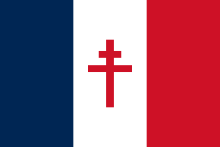

" Fighting France " ( fr. La France combattante ) or " Free France " ( la France libre ) - the patriotic movement of the French for the national independence of France in 1940-1945. The military, who joined this movement, formed the Free French Forces (sometimes called the “French Liberation Forces,” French Forces françaises libres , FFL).
The movement was led by General Charles de Gaulle from headquarters in London (French National Committee, until 1943). The goal was to restore France's independence from the Nazi occupiers and the Vichy collaborators who collaborated with them. Adjacent to the anti-Hitler coalition .
The movement had weapons and participated in a number of operations of the Second World War . The success of the movement was largely facilitated by the support of the resistance movement within France .
On September 29, 1941, the USSR officially recognized Free France [1] and established diplomatic relations with it through the USSR Embassy to the Allied Governments in London.
In November 1942, "Fighting France" sent a group of French pilots to the USSR to jointly fight Nazi Germany, which later became the Normandie-Niemen air regiment.
In September 1943, units of the "Fighting France" took part in the Allied landing operation on the island of Corsica.
Seven divisions of the “Fighting France” participated in the Allied landings in Normandy in 1944 [2] .
On August 24, 1944, de Gaulle triumphantly returned to Paris and set about restoring the French state.
The memory of the “Fighting France” is represented in all the national museums of France, including the Army Museum in the House of the Disabled. The tank museum (Saumur) has a whole hall of armored vehicles and the Resistance Movement. In fact, the entire Normandy-Neman exposition at the Museum of Aviation and Cosmonautics (le Bourget) is also dedicated to Free France and includes its history and authentic exhibits with its symbols [3] .
Rename
On June 3, 1943, the movement was renamed the " French Committee of National Liberation ", its governing body represented France's interests abroad in 1943-1944.
On June 2, 1944, the committee renamed itself the interim government of the French Republic , headed by General Charles de Gaulle.
Notes
- ↑ The Great Patriotic War of 1941-1945. Developments. People. Documents. A brief historical reference / ed. O. A. Rzheshevsky, comp. E.K. Zhigunov. M., Politizdat, 1990. p. 56
- ↑ Tippelskirch Kurt. The history of the Second World War. SPb.: Polygon; M.: AST, 1999
- ↑ Flags of Normandy Neman in a museum | Russian Paris (Rus.) (Neopr.) ? . www.paris1814.com. Date of treatment July 6, 2017.