Arabian Peninsula ( Arabicشبه الجزيرة العربية or Arab. جزيرة العرب - El-Arab [ 1] ), Araviya (from other Hebrew ערבה “arava” - steppe [2] ) is the Asian peninsula located in the south-west of the mainland. The largest peninsula in the world - an area of about 3.25 million km².
| Arabian Peninsula | |
|---|---|
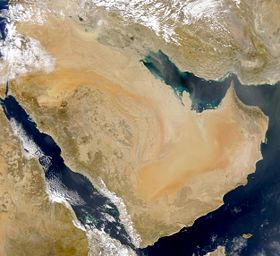 View from space | |
| Specifications | |
| Square | 3 250 000 km² |
| Location | |
| Washer water areas | Red Sea , Persian Gulf , Arabian Sea , Gulf of Oman , Gulf of Aden |
| Country |
|


In the east it is washed by the waters of the Persian and Oman gulfs , in the south - by the Arabian Sea and Gulf of Aden , in the west - by the Red Sea . The northern border of the peninsula is drawn approximately at a parallel of 30 ° north latitude connecting the northern extremities of the Persian Gulf and the Gulf of Aqaba .
Sometimes this border is drawn along the state borders of Saudi Arabia with Jordan and Iraq [3] . It is extended along the meridian for 2 thousand km and in latitude for 2.8 thousand km [4] . The banks are straight, slightly divided, few convenient bays [4] . Geologically , the peninsula forms the Arabian Plate , which was once part of the African continental mass. The Arabian Peninsula is almost completely covered with sandy and rocky (hamada) deserts ( Big Nefood , Rub al-Khali , etc.) [4] . The highest point of the Arabian Peninsula is Mount Nabi Shuayb (3660 m.) [5] .
The modern states of Bahrain , southern parts of Iraq and Jordan , Yemen , Qatar , Kuwait , the United Arab Emirates , Oman and Saudi Arabia are located on the Arabian Peninsula and adjacent islands . In close proximity to the Arabian Peninsula are Egypt , Israel , Lebanon , Jordan and Syria [5] .
Content
Geological structure and relief
The Arabian Peninsula is located on the north-eastern part of the ancient African-Arabian platform . In the west and in the center of the peninsula, metamorphic and crystalline rocks of the Proterozoic of the Nubian-Arabian shield come to the surface, and in the south-west, rocks of the Arabian-Aden-Somali shield. The axial parts of the shields are dissected by young grabens of the Gulf of Aden and the Red Sea. The southern and western parts of the peninsula have repeatedly been revitalized since the end of the Cretaceous . Volcanic cones appeared along the fault ledges to the Red Sea, and basalts flowed out along the lines of young faults. Shields composed of crystalline and metamorphic rocks underwent prolonged denudation , resulting in the formation of a relief of elevated socle plains and plateaus raised to 1800–2300 m. The eastern part of the peninsula is a platform plate in which the basement rocks are submerged under the sedimentary cover of mainly Cretaceous, Jurassic and Cenozoic sandstones and limestones. In the eastern part of the Arabian Peninsula is the historical region of Al-Hasa with elevations of less than 200 meters [5] .
A significant part of the world's oil and natural gas reserves are concentrated on the coast and in the Persian Gulf [3] . In the center of the peninsula cover rocks frame the Nubian-Arabian shield. Massifs of loose sands are widely developed: the deserts of Rub al-Khali , Dehn and Big Nefood . The southern part of the peninsula is framed by a highly elevated (up to 2469 m) Hadramauta plateau, intersected by numerous wadi valleys. The lava plateau in the southwest of the peninsula is an anticlinal mass, overlain by thick sedimentary and volcanic strata. Separate volcanoes and peaks on the lava plateau reach heights of up to 3600 m ( En-Nabi-Shuayb city). Off the coast of the Red Sea peninsula there are many coral islands and sandbanks [3] . Along the western coast of the Red Sea lies a narrow strip of desert with salt marshes, sands and gravel. The southern part of this desert is called Tijama . In the extreme southeast, there is a region of blocky-folded midlands of the Alpine age, which has a broad development of basic and ultrabasic igneous rocks ( El-Akhdar , El-Hajar-al-Sharki ridges, etc.) [5] .
| Title | Location | Square | Note |
|---|---|---|---|
| Big Nefood | north saudi arabia | 103,600 km² | connects with the deserts of Rub al-Khali and Small Nefood (Dehna) |
| Ramlat al-Wahib | Oman | 12,500 km² | the desert was formed in the Quaternary under the influence of southwestern monsoons and northern trade winds of shamal blowing from the east. |
| Small Nefood (Dehna) | center of saudi arabia | 132,000 km² | occupies a narrow (from 20 to 70 km) ancient runoff hollow, stretching for 1200 km from north to southeast |
| Jafra | south of the Qatar Peninsula | in the south of Al-Jafrah goes into the desert of Rub al-Khali | |
| Nafood ed dahi | center of saudi arabia | 50,000 km² | massifs of moving sand dunes. |
| Rub al Khali | south of Saudi Arabia and the UAE, north of yemen and oman | 650,000 km² | is a large basin stretching from southwest to northeast through the Arabian shelf |
| Tihama | southwest saudi arabia West Yemen | 120,000 km² | the desert surface is sometimes disturbed by individual rocky outcrops and numerous dry channels - the wadi, crossing it from west to east |
Climate
The climate of the middle and southern parts of the peninsula is tropical trade wind. January temperature from 14 ° C ( Riyadh ) to 24.8 ° C ( Aden ), July to 33.4 ° C (Riyadh), maximum temperature up to 55 ° C. The climate of the Arabian Peninsula is one of the hottest on the planet. The tropical areas of the peninsula are a zone of negligible moisture. The average annual rainfall is about 100 mm; in the south, precipitation falls mainly in the summer (less than 50 mm / g). In the mountains of the south-eastern part of the peninsula, due to the penetration of monsoons, the annual rainfall increases to 500 mm, and on the western slopes of the mountains of the south-western part to 700–900 mm [5] .
In the far north, the climate is subtropical with winter cyclone precipitation; the summer is dry. Precipitation is approximately 150-300 mm per year. January temperature 10-15 ° C; during intrusions of cold air from the north, the temperature drops to negative values [5] .
Rivers and Lakes
The Arabian Peninsula is characterized by a rare network of rivers and lakes, a small flow of water into the surrounding seas. Permanent watercourses are located in the south and southwest of the peninsula (the Masila , , and others). Wadi cross the peninsula according to the general inclination of the surface from west to east; the largest: Er-Rumma (more than 1000 km) and Ed-Davasir . Most of the wadi end blindly in the desert sands. Of great importance are the karst springs, groundwater in the central part of the Nedzh kuest region. The outcrops of abundant springs on the Persian Gulf (Al-Hasa) are associated with self-flowing formation waters. Due to lack of water, the Gulf countries are forced to build desalination plants [5] .
Soils and vegetation
About 95% of the surface of the peninsula is occupied by tropical deserts with primitive soils or waving and semi-fixed sands. In saline depressions there are solonchak soils and solonchaks with juicy hodgepodge, vaults, etc. In the central regions you can find small areas of cereal steppes, in the south - red-brown soils (desert savannahs dominated by acacias). There are subtropical semi-deserts and deserts in the north of the Arabian Peninsula; on gray soils, gray-brown and brown soils - dry steppes dominated by narrow-leaved cereals, wormwood and shrubs [5] . Around the wells and water sources are oases [3] .
Along the wadi channels, in the oases of the piedmont zones - sparse thickets of acacias, tamarisks, and the tree. The richest tropical monsoon communities of the southern mountains ( tamarind , candelabrum-eared milkweed, acacia, etc.); at an altitude of 1500 to 1800 m, various evergreen shrubs, olive trees and pistachios grow; above - mesophytic meadows. The soils are mountain red-brown, on the volcanic rocks - dark-colored. In the culture - date palm , fruit trees, coffee , cereals, wheat , barley , corn , millet and others [5] .
Fauna
The southern and middle parts of the peninsula belong to the Sahara subregion of the Ethiopian region, the northern - to the Mediterranean subregion of the Palearctic region. On the peninsula you can meet predators (foxes, hyenas, jackals), ungulates (antelopes, gazelles, onagras, etc.), shrews, jerboas. Many reptiles, birds, including migratory ones. On the Arabian Peninsula, there are foci of locust breeding [5] .
Natural areas
The territory of the Arabian Peninsula is divided into 6 natural zones: western Arabia, the volcanic plateau of the southwestern part of the peninsula, high strata plateaus of the southern marginal regions of Hadramaut, the region of kuest stratified plains with wadi valleys, sand deserts, and the midlands of the southeastern part of the peninsula [5] .
- Western Arabia is a desert mid-high basement plateau. It is dissected by deeply embedded wadi channels and stepwise breaks off to the Red Sea.
- The volcanic plateau of the southwestern part of the Arabian Peninsula has increased precipitation, tropical forests in the west and light forests and savannahs in the east.
- There are a significant number of oases in the high strata plateaus of the southern marginal regions of Hadramaut.
- The area of kuest stratified plains with wadi valleys, sometimes covered with sand. This area is characterized by winter-spring vegetation of shrubs and grasses, as well as oases at the outlets of karst sources of oases.
- In the sand deserts (Rub al-Khali, Small and Big Nefood) there are medium-high and low (in the east) stratum plains with rare oases.
- In the region of the middle mountains of the southeastern part of the peninsula there are savannas and dry woodlands [5] .
Population
The Arabian Peninsula is populated almost exclusively by Arabs. The vast majority of the inhabitants of the peninsula profess Islam , which originated here. On the peninsula are the main shrines of Islam - the cities of Mecca and Medina [4] .
Vast sandy beaches, beautiful coral reefs near the coast, monuments of medieval architecture, etc. make the peninsula attractive for tourists [4] .
See also
- South arabia
Notes
- ↑ Instructions for the transfer on maps of the geographical names of Arab countries. - M .: Nauka, 1966 .-- S. 20.
- ↑ Jewish and Chaldean etymological dictionary of the books of the Old Testament / comp. O. N. Steinberg . - Vilna: typography of L. L. Matz, 1878. - T. I. - S. 367. - 532 p.
- ↑ 1 2 3 4 Arabian Peninsula // Geography. Modern Illustrated Encyclopedia / Edited by prof. A.P. Gorkin. - M .: Rosman, 2006.
- ↑ 1 2 3 4 5 Arabian Peninsula // Dictionary of Modern Geographical Names / Edited by Acad. V.M. Kotlyakova. - Yekaterinburg: U-Factoria, 2006.
- ↑ 1 2 3 4 5 6 7 8 9 10 11 12 The Arabian Peninsula - an article from the Great Soviet Encyclopedia . N.V. Aleksandrovskaya.
Literature
- Arabian Peninsula - article from the Great Soviet Encyclopedia . N.V. Aleksandrovskaya.
- Arabia // Brockhaus and Efron Encyclopedic Dictionary : in 86 volumes (82 volumes and 4 additional). - SPb. , 1890-1907.