Mömfis [a] ( dr. Greek Μέμφις , Latin Memphis ; Copt. Menfe, Membe; Arabic. منف Menf ) is an ancient Egyptian city located on the border of Upper and Lower Egypt , on the west bank of the Nile . It existed from the beginning of the 3rd millennium BC. e. and until the second half of the 1st millennium BC. e. Localization on the territory of modern Egypt is the area near the city of El Badrashan and the village of Mit Rahin, south of the city of Cairo in the governorate of Cairo (it could possibly be located somewhat north of these territories).
| Ancient egyptian city | |
| Memphis | |
|---|---|
| egypt. jnbw-hd, mn-nfr, hwt-kA-ptH, mexAt-tA-wj, anx-tA-wj | |
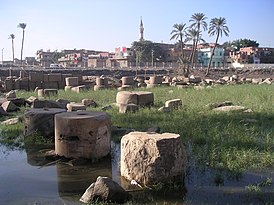 The ruins of the Ramses II Hypostyle Hall in Mith Rahin | |
| Region | Lower egypt |
| Founded | beginning of the 3rd millennium BC e. |
| Other names | Greek and lat. Memphis, Copt. Menfe, Akkad. Me-im-pi, bibl. Mof / Nof |
| Ruined | second half of the 1st millennium BC e. |
| Modern location | Mit-Rakhin ( Cairo Governorate , ARE ) |
From the beginning of the 3rd millennium BC. e. Memphis became the center of the Lower Egyptian 1st septum of Inebu-hedge or Inbu-hedge (in the Greco - Roman period it was called Memphis nom), and, probably, the general Egyptian capital during the periods of the Early and Ancient kingdoms (XXIX — XXII centuries BC) . After the Amarna period (XIV century BC), Memphis was again the official capital of Ancient Egypt (one of two) for a short time.
Due to its exceptional geographical position, it was an important stronghold of various pharaohs, as well as the first city of Ancient Egypt, which had the character of a large cosmopolitan center, where many foreigners lived: Syrians, Phoenicians, Greeks and Jews [1] . The city is known for the burial and temple complexes surrounding it - pyramids , necropolises and temples (in Abusir , Giza , Saqqara , Dakhshur ). In Memphis there was a significant center for veneration of the god Ptah, and the cult of the bull Apis associated with it flourished.
Content
- 1 Toponyms
- 1.1 Exotoponyms
- 1.2 Modern Naming
- 2 History
- 2.1 Legendary Origin
- 2.2 The Ancient Kingdom
- 2.3 Middle Kingdom
- 3 Modernity
- 4 Comments
- 5 notes
- 6 References
Toponyms
| Spelling egyptian hieroglyphic writing | Writing in Coptic | |||||||||||||||
|---|---|---|---|---|---|---|---|---|---|---|---|---|---|---|---|---|
| jnbw-hd - inbuy hendge "White walls" | ||||||||||||||||
one)
| mn-nfr - Men Nefer "Strong beautiful (feast. Pepi I)" | |||||||||||||||
one)
| Hwt-kA-ptH - Hut-ka-Ptah The Temple of Ka Ptah [b] | |||||||||||||||
| mexAt-tA-wj - Mehat-ta- wi "Combining the two lands" | |||||||||||||||
| anx-tA-wj - ankh-ta-wi "Life of two lands" | |||||||||||||||
Initially, the ancient city was called Inbu-hedge ( Egypt. Jnbw-HD ) - "White Walls". There is an assumption that the ancient Greek word "Aygyuptos" - Egypt, is formed from another of the names of Memphis - Hut-ka-Ptah . This name meant “Temple ka Ptah ” ( transl. Egypt. Hwt-kA-ptH) [c] Also translation options: Palace ka Ptah , Abode ka Ptah , Wall / fence of the monastery ka Ptah . </ref>. The ancient Egyptians Hut-ka-Ptah was first the name of the Memphis sanctuary of the creator god Ptah , which passed to the name of the city, and eventually became the name of the surrounding area ( septa ), and later, from the name of this area, the ancient Greeks extended their version of the name to Ancient Egypt [2] . Also, the city was known under the name Ankh-Taui - "Life of two lands" and Mehat-tai-ui - "Combining two lands", which emphasized its strategic position on the border between Upper and Lower Egypt .
The ancient Greek name Memphis ( Μέμφις ) is possibly the Hellenized form in the name of the pyramid of Pharaoh Pepi I ( VI dynasty ) - Mennefer , "Strong beautiful (pyramid of Pepi I)." For the first time, the name Men Nefer among the ancient Egyptians appears in an inscription made during the reign of Pharaoh Ahmos I ( XVIII dynasty ), but it was probably used much earlier. The Romans adopted the Greek name of the city, in Latin the city was also called - Memphis (Memphis). In the early Middle Ages, the Copts had their own city name, in tune with the ancient - Menfe, Membe, etc.
Exotonyms
The ancient inhabitants of Mesopotamia called the city of Me-im-pi ( Akkad. ) In the Bible ( Old Testament and Tanach ) Memphis is referred to as the city of Moth ( al-Heb. מֹף, in Hos. 9: 6 ), and as the city of Nof ( al-Heb. נֹף, in Isa. 19:13 , Jer. 2:16 , 44: 1 , 46:14 , 46:19 , Ezek. 30:13 , 30:16 ).
Modern Naming
The name of the city among modern scholars, according to the Greek-Arabic nomenclature of place names adopted in Egyptology - Memphis.
History
Memphis served as the capital of eight alternating dynasties of the Old Kingdom and reached its peak during the VI dynasty , as the center of worship of the god of creation of Ptah . The alabaster sphinx at the entrance to its iconic temple was considered a symbol of the strength and prestige of the city [3] . The divine triad of Memphis was made by Ptah, his wife Sekhmet (from the New Kingdom ) [4] and their son Nefertum [5] .
With the growth of the power of Thebes, Memphis lost its former influence, but rose with the Persians . In the Roman period, Alexandria remained the main Egyptian city. Memphis retained the second most important value among the Egyptian cities until the founding of Fustat in 641. Memphis was gradually abandoned and turned into a quarry for the nearest settlements. In the XII century, there were impressive ruins of ancient buildings, but later they became less and less.
Gradually the city collapsed. In the first centuries of Christianity, Memphis was the center of the eponymous diocese (currently it is the titular diocese of the Roman Catholic Church ).
Until our time, the city reached completely covered with silt. Entire buildings are almost gone. Memphis is now an open-air museum . Excavations are still ongoing, however, they are complicated by the high level of groundwater and the fact that the ruins of the former capital lie under private estates planted with palm groves.
Legendary Origin
According to the Manetho , the first pharaoh who united Upper and Lower Egypt, Menes founded his capital on the banks of the Nile . He ordered to build a dam, change the direction of the riverbed, flowing near the city, and in place of the old bend filled up - to build a city.
The Greek historian Herodotus , who told a similar story, claimed that during his visit to the city, the Persians who dominated there at that time paid great attention to these dams in order to protect the city from annual spills [6] . The historicity of the legendary Menes is controversial; it can be identical to Narmer , who is depicted on the Pallet of Narmer (c. XXXI century BC). In 2012, a record was discovered in the Sinai indicating a visit to Memphis by the dynastic pharaoh Iri-Khor . Since Iri-Khor lived two generations before Narmer, the latter could not be the founder of Memphis [7] .
In Greek mythology, Memphis was named after the Queen of Memphis , the wife of Epaphos (son of Zeus and Io ), who allegedly founded the city.
Ancient Kingdom
Little is known about the city during the period of the Old Kingdom. According to Manetho, the first years of Menes' reign passed in Tinis , south of the later founded Memphis. Here Menes ordered the construction of the so-called "white walls" ( Egypt. Jnbw-HD ). The ruler of the III dynasty, Djoser, in the ancient necropolis of Saqqara built a funeral complex, which became the royal tomb.
The golden age during the IV dynasty strengthened Memphis' position as the main residence of the pharaohs, who were crowned with a double crown and celebrated the festival of the tail ( cheb-sed ) in the main temple of Ptah. Early evidence of these ceremonies is found in the shrines of Joser. The architecture of the city during this period is close to the architecture of Giza , the royal necropolis of the IV dynasty, focusing on the buildings of previous generations.
Spreading for many kilometers, Memphis was then an ancient metropolis with temples and temenos , ports, connected by roads and canals [8] . The center of the city remained the temple complex of Ptah.
Middle Kingdom
At the beginning of the Middle Kingdom, the capital and court of the pharaoh moved to Thebes in the south. Although the center of political power shifted, Memphis remained an influential trade and cultural center, as evidenced by finds in tombs west of the Ptah temple [9] . Amenhotep I ordered the installation of a large granite table for sacrifices in honor of Ptah [10] .
Modernity
| UNESCO World Heritage Site No. 86 Russian • English • fr. |
In 1979, the necropolises of Memphis - Saqqara , Abusir , Dahshur and Giza , were included by UNESCO in the list of World Heritage Sites .
On April 20, 2015, Russian archaeologists discovered the legendary "white walls" of Memphis [11] .
Comments
- ↑ For convenience, the name of the city with one name in all the epochs of its existence, its name is used according to the Greek-Arabic nomenclature of toponyms adopted in Egyptology - Memphis. Among other things, ancient Egyptian names and names are highlighted in italics (except for names on maps). Most of the dates in the article are given according to authoritative work on Egyptian chronology, which was compiled by about twenty authors edited by E. Hornung, R. Krauss and D. Warburton - “Chronology of Ancient Egypt” (Hornung E., Krauss R. and Warburton DA Ancient Egyptian Chronology - Leiden-Boston-Köln: Brill, 2006 .-- S. 490-495. - 517 pp. - ISBN 90-04-11385-1
- ↑ Also translation options: Ka Ptah Palace, Ka Ptah Monastery, Wall / fence of Ka Ptah Monastery.
- ↑ Also translation options: Ka Ptah Palace, Ka Ptah Monastery, Wall / fence of Ka Ptah Monastery.
Notes
- ↑ Ahmed Badavi Memphis als zweite Landeshauptstadt. NR, Kairo, 1948.
- ↑ Ancient Egypt. Encyclopedia. - “Art Rodnik” , 2008.
- ↑ Roberts, David. Egypt's Old Kingdom // English National Geographic. - 1995. - Vol. 187 , iss. 1 .
- ↑ M.A. Korostovtsev . The religion of ancient Egypt. - Science, 1976 .-- S. 22, 74 .-- 344 p.
- ↑ S. A. Tokarev. Myths of the World: Encyclopedia. - M .: Soviet Encyclopedia , 1982. - T. 2. - S. 430. - 728 p.
- ↑ Herodotus. § 99 // History. - T. 2.
- ↑ P. Tallet, D. Laisnay. Iry-Hor et Narmer au Sud-Sinaï (Ouadi 'Ameyra), un complément à la chronologie des expéditios minière égyptiene (English) // BIFAO. - 2012. - No. 112 . - P. 381–395 .
- ↑ Georges Goyon. Les Ports des pyramides et le Grand canal de Memphis. - 1971. - S. 137-153.
- ↑ Al-Hitta. Excavations at Memphis of Kom el-Fakhri. - S. 50–51.
- ↑ Mariette, Auguste. Monuments divers collected in Egypt and in Nubia. - Paris: A. Franck, 1872 .-- S. 9.
- ↑ Russian archaeologists have discovered the legendary "white walls" of Memphis . News.Science . Date of treatment October 6, 2019.