Lernean hidra ( ancient Greek Ὕδρα , “water snake”. The etymology of the word has its roots in the Indo-European language : PIE * wed “water” → PIE * udrós “water” → PIE * udréh₂ “water animal” [1] ) - in ancient Greek mythology, the daughter of Typhon and Echidna [2] , a snake-like monster with poisonous breath, who lived in groundwater, killed by Hercules as one of his twelve feats.
| Lerna Hydra | |
|---|---|
| Floor | |
| Father | |
| Brothers and sisters | |
Content
Myths
Origin
The Lerna hydra was one of the monsters that Echidna bore from Typhon . The goddess Hera herself fed her [3] [4] . The hydra had many heads [5] , according to different versions of the myth 7 [6] , 9 [7] , 50 [8] or even 100 necks with serpentine heads grew out of one body [9] [10] .
The average head of the monster was immortal, the rest mortal. She settled in the swamps of Lerna under the plane trees at the source of Amimon. From there, the hydra crawled out onto the plain, stole livestock and devastated the surrounding lands [5] [11] [12] .
Hydra was so poisonous that her breath alone killed all life around [7] [12] .
Hercules Second Feat
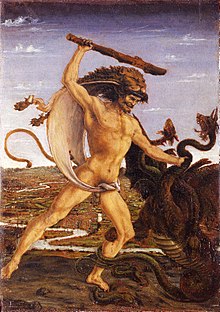
Evrisfey gave the task to kill Hercules monster. Then Hercules in the chariot driven by the driver Iolaus went to the region of Lerna. Arriving at the monster’s habitat, he forced the hydra to crawl, throwing burning arrows into her lair [11] [13] . However, he could not win it. As soon as Hercules cut one head, two or three more immediately grew in its place [11] [6] [14] .
A huge cancer Karkin came to the aid of the hydra and grabbed Hercules by the leg. The hero crushed the cancer in anger [15] .
Seeing that he alone could not cope with the hydra, Heracles called Iolaus. He began to cauterize the burning heads with the heads of the felled heads, preventing them from growing again. In this way, Hercules cut down all the heads of the hydra, including the immortal. Afterwards, he dipped arrowheads into the death-bearing bile of the hydra. Arrows became deadly, even a minor injury became fatal. After that, Hercules buried the body and heads of the hydra, hitting this place with a huge stone [11] [14] .
Evrisfey considered that this feat was not done according to the rules, since Iolaus helped Hercules cauterize the severed heads, and did not deduct it [11] [16] .
In Plato's dialogue Socrates , telling Criton about the dispute with the sophists and , compares himself with Hercules, and them with the hydra and cancer. And in the “State” he writes [17] :
| And it is true that such legislators are the funniest thing: they, as we just said, all the time make amendments to their laws, thinking to put a limit to abuse in business, but, as I have just noted, they don’t give themselves a reference, which in fact are likened to people dissecting the hydra. |
The death of Hercules from the bile of the Lerney hydra
According to one of the myths, Hercules with his wife Dejanira came to the stormy river Even . The centaur Ness proposed to move Deynerira across the river, while Hercules would swim by swimming. When Ness and Dejanira were on the other side, Ness wanted to kidnap Hercules' wife. The son of Zeus sent an arrow poisoned by bile of the Lernean hydra into him [18] [19] .
Before his death, wanting to take revenge on his killer, Ness told Dejnire that clothes were soaked with his blood a powerful love potion. The woman believed and collected the blood of the dying centaur mixed with the poisonous bile of the hydra. A few years later, Hera, who harbored hostility towards his stepson, aroused Dejnire's jealousy. She remembered the words of Ness and sent her husband a tunic dipped in poisonous blood. Unsuspecting Hercules put it on himself [18] [20] .
The poison of the hydra began to penetrate the blood, the tunic stuck to the skin. From unbearable torment Hercules rushed into the flames [18] [21] .
Antique attempts at a rational interpretation of the myth
According to rationalistic interpretation, Lern was a king who did not submit to Eurystheus, and he had the fortress Hydra, which was guarded by 50 brave archers [22] . According to another interpretation, she had many cubs [23] .
In art
At the box of Kipsel, Athena was depicted next to the heroes [24] .
In Astronomy
The naming of two constellations is connected with the myth of the Lernean hydra. According to one version, the constellation Hydra symbolizes the monster defeated by Hercules [25] . Hera, who by all means sought to destroy Hercules, appreciated the help of cancer and placed him in the sky with the same zodiac constellation [26] [16] .
Notes
- ↑ McPherson, 2018 , p. 246–248.
- ↑ Hyginus . The sister of the Nemean lion . Myths. Introduction 39
- ↑ Hesiod, 2001 , Theogony. 313-319, p. 28
- ↑ Graves, 1992 , Second feat: Lernean Hydra, p. 299.
- ↑ 1 2 Pausanias, 1996 , Book II, chapter 37 (4).
- ↑ 1 2 The First Vatican Mythograph, 2000 , Book I. 62. Hydra and Hercules.
- ↑ 1 2 Hyginus Myths, 2000 , 30. The twelve labors of Hercules, those that are ordered by Eurystheus.
- ↑ Palefat, 1988 , About the incredible XXXVIII. About the hydra.
- ↑ Diodorus Sicily, 2000 , Historical Library. Book IV. XI (5, 6).
- ↑ Kozovik, 1989 , Lerneiskaya Gidra, p. 132.
- ↑ 1 2 3 4 5 Apollodor, 1972 , Mythological Library. Book II. V (2).
- ↑ 1 2 Graves, 1992 , Second feat: Lerna hydra (c), p. 299.
- ↑ Kerenyi, Carl . The Heroes of the Greeks. - L .: , 1959. - P. 143. - 439 p.
- ↑ 1 2 Mythological Dictionary, 1990 , Hercules, p. 147.
- ↑ Eratosthenes. Catharism. Cancer, Donkeys and Nurseries
- ↑ 1 2 Graves, 1992 , Second feat: Lerna hydra (g), p. 300
- ↑ Plato . State. Iv. 426e
- ↑ 1 2 3 Ovid Metamorphosis, 1977 , 93–325.
- ↑ Graves, 1992 , Dejanira (i), p. 353.
- ↑ Graves, 1992 , Dejanira (k), p. 353.
- ↑ Graves, 1992 , Apotheosis of Hercules (bf), p. 358-359.
- ↑ Error in footnotes ? : Invalid
<ref>; for footnotesПалефат. О невероятном 38Палефат. О невероятном 38text is not specified - ↑ Heraclitus Grammar . Oh incredible 18
- ↑ Pausanias . Description of Hellas V 17, 11
- ↑ Ridpath, 2001 , p. 128-130.
- ↑ Hyginus Astronomy, 1997 , Cancer, p. 70
Literature
- Apollodorus . Mythological Library / Translation, concluding article, notes, index V. G. Borukhovich. - L .: Science, 1972.
- Hesiod Full collection of texts / Introductory article by VN Yarho. Comments O.P.Tsybenko and V.N. Yarho. - M .: Labyrinth, 2001. - 256 p. - (Antique heritage). - ISBN 5-87604-087-8 .
- Hyginus. Astronomy / translation from Latin and comments by A.I. Ruban. - SPb. : Aletheia, 1997. - (Antique Library). - ISBN 5-89329-017-8 .
- Hyginus . Myths / Translation from Latin, a comment by D. O. Torshilova, edited by A. A. Taho-Godi . - SPb. : Aletheia , 2000. - 360 p. - (Antique library). - ISBN 5-89329-198-0 .
- Diodorus Sicilian . Historical Library (rus.) / Translation, article, comments, and pointer O. P. Tsybenko .. - M .: Labyrinth, 2000. - (Antique Heritage).
- Euripides . Tragedies in 2 volumes (Rus.) / Trans. I.F. Annensky; rep. ed. M.L. Gasparov; will enter Art. V.N. Yarho; Russian Academy of Sciences [RAS]. - M .: Ladomir, 1999. - ISBN 5-86218-157-1 .
- Ovid . Metamorphosis / Translation from Latin S.V. Shervinsky. Notes F. A. Petrovsky .. - M .: Fiction, 1977.
- Pausanias . Description of Hellas / Translation and Notes S. P. Kondratiev , edited by E. V. Nikityuk. Responsible editor prof. E. D. Frolov .. - SPb. : Aletheia, 1996. - ISBN 5-89329-006-2 .
- Palephat . About the incredible / Per. with ancient Greek Art. and comm. VN Yarkho // Herald of ancient history : the journal. - M .: Science, 1988. - № 3.
- The First Vatican Mythograph (Rus.) / Translation from the Latin language, introductory article and commentary by V.N. Yarkho. - Aletheia, 2000.
- Graves Robert. Myths of Ancient Greece . - M .: Progress, 1992. - 624 p. - (Anthropology, ethnography, mythology, folklore). - ISBN 5-01-001587-0 .
- Kozovik I. Ya., Ponomarov, O. D. Vestnik of the Antique Mythology (ukr.) / Editor, A. O. Biletsky. - 2 nd view. - K .: Naukova Dumka, 1989. - 240 p. - 57 000 copies - ISBN 5-12-001101-2 .
- Zaitsev A.I. Hercules // Mythological Dictionary (Rus.) / Editor-in-chief E.M. Meletinsky . - M .: Soviet Encyclopedia, 1990. - 672 p. - ISBN 5-85270-032-0 .
- Indo-European Cognate Dictionary (English) / edited by Fiona McPherson. - Wellington: Wayz Press, 2018. - ISBN 978-1-927166-38-3 .
- ; Stars and Planets. - 3rd ed. - Princeton: Princeton University Press , 2001. - p. 128-130. - 408 p. - (Princeton Field Guides). - ISBN 978-0691089133 .
Links
- Lerna hydra on the site "Encyclopedia of fictional creatures"
- Hydra (in mythology) // The Small Encyclopedic Dictionary of Brockhaus and Efron : in 4 tons. - SPb. , 1907-1909.