
Agiosoritissa ( Greek ἡ Ἁγιοσορίτισσα , comes from the name of the Greek chapel Ἁγία Σορός ( Agia Soros - holy Crayfish) at the Chalkopratic Church of the Virgin in Constantinople ), the Holy Virgin , the Chalkopratic , is usually one of four types of prayers hands.
Known by a number of Byzantine sources no later than the 9th-10th centuries, it was widely used in Byzantine art of the 12th-15th centuries. The iconography goes back to the deesis composition, where the Virgin Mary turns to Christ with prayer (Greek deisis ) for the human race, hence another name - the Intercessor . Researchers also classify the image of the Mother of God from deesis as Agiosoritissa. In the Greek tradition, such icons are referred to as Paraklesis (the petitioner ), most often (especially in art history), this epithet is assigned to the images of the Virgin, holding a scroll with the text of her prayer to the Son.
One of the types of icons representing the Mother of God Paraklesis (Agiosoritissa) in Russian icon painting was called Bogolyubskaya (named after Prince Andrei Bogolyubsky ), who according to legend appeared the Mother of God with a scroll in her right hand and with her left hand stretched out for prayer to Christ who is visible in the air. An original icon located in Vladimir is considered miraculous. On these icons, the deesis composition is "restored", part of which goes back to the icon of Agiosoritissa: the Mother of God is represented standing upright in a prayer appeal to Her Son, depicted in the heavenly segment in the upper corner. Saint Andrei Bogolyubsky falls at the feet of the Mother of God, as well as often and additionally selected characters, the number and composition of which are extremely different in different versions . On the Bogolyubsky icon, the Virgin is portrayed as an intercessor and mediator, but there are ideas of the compositions of Oranta and Hodegetria , showing the way to the adjacent.
In the West, several particularly venerated icons of this type are in Rome , having fallen into the Eternal City from the East in different ways at different times ( Our Lady of Eden , Our Lady of Sanluca (Aracheli) , Our Lady of San Sisto, etc.). All of them are of Byzantine origin and revered for many centuries as miraculous , attracting a lot of Orthodox and Catholic pilgrims from different countries. Despite the fact that scholars date these images back to the 8th – 13th centuries, church chronicles and legends attribute their authorship to the Evangelist Luke . In this regard, this type of image was quite popular in Rome, regardless of its Eastern Christian roots - quite a few lists were made from these revered icons, which subsequently adorned the main altars of the Catholic and Orthodox churches throughout Italy and also became famous for their miracles.
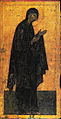
Deesis icon of the Virgin from the iconostasis of the Annunciation Cathedral of the Moscow Kremlin. Theophanes the Greek (?). The end of the XIV - beginning of the XV century
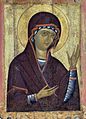
Deesis icon of the Virgin. Tver. The first half of the XV century. TsMiAR , inv. No. KP 441

Bogolyubsky icon of the Mother of God with the upcoming Zosima and Savvatiy Solovetsky. From the Old Believer Prayer Volkova Cemetery. St. Petersburg. XVII century

Our Lady of Edes ( Madonna di Sant Alessio ) from the Church of St. Alexius in Rome . Byzantium, XII century


Literature
- Etingof O. E. Agiosoritissa // Orthodox Encyclopedia . - M .: Church Scientific Center "Orthodox Encyclopedia" , 2000. - T. I. - S. 254. - 752 p. - 40,000 copies. - ISBN 5-89572-006-4 .