Panathenaic (prize) amphorae is a special form of Attic amphorae . Filled with olive oil from the Academy gardens, they were awarded to the winners of the hymnic (sports) and hippic (equestrian sports) competitions at the Panathenaic Games .
The first Panathenaic prize amphoras were presumably awarded at the great Panathenaeum in 566/565. BC e. - it was by this time that the form of the Panathenaic games underwent significant changes. The predecessors of the Panathenaic amphorae are horse-headed amphorae . Panathenaic amphorae were awarded to the winners of the competition until the II century. BC e. The volume of prize vessels was strictly regulated. It was approximately 3 liters less than a meter (an antique measure of liquids of 39.4 liters). In difficult times after the war, prize amphoras were also made in half or even a third of the usual size. The height of the Panathenaic amphora was 60–70 cm. The number of awarded prize amphorae varied depending on the competitive discipline. So the winner of the races on the carts received 140 amphorae, and the loser the finalist in the competitions in throwing a shield - one more.
The shape of the panathenaic amphorae combined the barrel-shaped amphorae intended for transportation (very convex, with a short, narrow neck, and a sharp bottom), with a form common in the 6th century. BC e. an amphora with a leg and a whisk, similar to an echin . At each holiday, Panathenaeus was awarded about 1,500 amphorae. Competitions were held between the pottery workshops, the winners of which received an order for the production of Panathenaic amphorae. In addition to big profits, such an order brought prestige to the pottery workshop. To date, about 1000 amphorae and their fragments have been preserved, which is approximately one percent of the actual number of Panathenaic amphorae made. The most ancient Panathenaic amphora is considered to be the “Burgon Vase” (560 BC).
The main feature of the Panathenaic amphorae is the black-figure style of their painting, which was used on them even after 500 BC. e., when the black-figure vase painting was replaced by the red-figure one . On the front side of the amphora for a long time a single plot was depicted - Athena Promachos , moving from right to left. From the 540-530 centuries. BC e. The image of Athena Promachos began to be supplemented on both sides by two Doric columns crowned with roosters. Perhaps the cocks symbolized the fighting, competitive spirit of the Panathenaic Games. A vertical commemorative inscription was necessarily applied to the left column ( other Greek “τών 'Αθένεθεν Αθλων” , later other Greek “τών' Αθήνεθην Αθλων” - “prize from Athens” ). Since 510 BC e. Panathenaic amphorae are marked in the workshops with the shield of Athena. For a long time, both the form of the Panathenaic amphorae and the plot on their front side were reproduced with special care, not allowing any changes. Only by the 4th century BC e. on the panathenaic amphorae, changes began to be observed. The roosters on the columns were replaced by annually changing symbols of the games, and the markings of the workshops lost their significance. The shape of amphoras has become more feminine. Between 392–391 BC e. and 312-311 years. BC e. Amphorae show the names of archons responsible for the manufacture of amphorae and their contents. These vases can reliably establish the time of their manufacture. Later, the names of treasurers and judges were sometimes indicated on the Panathenaic amphorae. From 363-362 BC e. Athena is depicted on an amphora walking in the opposite direction - from left to right.
On the reverse side of the Panathenaic amphora was an image of a contest, for which a prize was awarded. The style of these images developed differently from the visual trends observed in the style of the front side of vases. From the middle of the 5th century BC e., in addition to the images of competitions, there are scenes of honoring the winners, and from the IV century. BC e. personalized images of Nicky appear on the back of the amphoras.
Prize-winning amphorae were found at excavations and outside the range of settlement of the ancient Greeks, which suggests that the Panathenaic amphorae were a commodity. Amphoras were also often offered to the temples as sacrifices, for example, during the excavations in Tarentum , four Panathenaic vases were found located at the four corners of the sarcophagus . There is evidence that in 415 BC. e. More than a hundred prize amphorae owned by Alcibiades and other German destroyers were sold for half a dram each.
The painting of the panathenaic amphorae was entrusted to many famous Athenian vase-painters , including, for example, Esekios , Eucharis and Cleophrades .
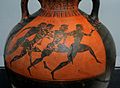
Competitive runners on a panathenaic amphora. 530 BC e.

The Burgon Vase is the oldest surviving Panathenaic amphora. OK. 560 BC e. British Museum . London

Image of Athena on a panathenaic amphora. 332-331 BC e. British Museum . London Found in Capua

Quadriga on a black-figure amphora from Attica . Glyptothek . Munich

Finish in cart racing. Pseudo-Panathenaic amphora. OK. 500 BC e. Glyptothek . Munich


cufgubghdjhnsismzi iajsudhddujs