Sir Cyril Norman Hinshelwood ( Eng. Cyril Norman Hinshelwood ; June 19, 1897 , London , UK - October 9, 1967 , ibid.) - English physicist-chemist, 1956 Nobel Prize in Chemistry (together with N. N. Semenov ).
| Cyril Norman Hinshelwood | |
|---|---|
| Cyril Norman Hinshelwood | |
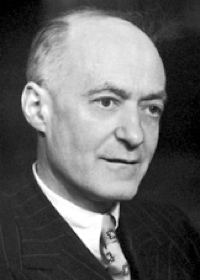 Cyril N. Hinshelwood, 1956 | |
| Date of Birth | June 19, 1897 |
| Place of Birth | London , UK |
| Date of death | October 9, 1967 (aged 70) |
| A place of death | London , UK |
| A country |  United Kingdom United Kingdom |
| Scientific field | physical chemistry |
| Place of work | Oxford University (1937-1964) |
| Alma mater | Oxford University (1924) |
| supervisor | |
| Awards and prizes | Davy Medal (1942) Baker's lecture (1946) Royal Medal (1947)  Nobel Prize in Chemistry ( 1956 ) Nobel Prize in Chemistry ( 1956 )Faraday Lecture (1953) Leverhalm Medal (1960) Copley Medal (1962)  |
Content
- 1 Biography
- 2 Main works
- 3 Nobel Prize
- 4 notes
- 5 Literature
- 6 References
Biography
He graduated from Bayell College of Oxford University ( 1924 ); there is a professor (1937-1964). Member (1929) and president of the Royal Society of London (1955-1960) [1] . Foreign member of the USSR Academy of Sciences (1958) [2] , National Academy of Sciences of the USA (1960) [3] .
Major works
Major works in the field of chain reactions ; studied homogeneous catalysis and the mechanism of reactions of this type. In 1928, when studying the oxidation of hydrogen, he discovered the upper limit of ignition and explained this phenomenon as a result of chain termination in a closed volume during triple particle collisions. Simultaneously with the Soviet scientist N. N. Semenov developed the foundations of the theory of chain reactions. Hinshelwood investigated the kinetics of the decomposition of inorganic and organic substances, such as potassium permanganate , aldehydes , ketones, and others. Since 1938, he dealt with the problem of bacterial growth in various media; found that the adaptation of bacteria to the environment is automatically regulated by the enzymatic balance of the cell ; revealed the dependence of cell growth rate on the content in the environment of carbon dioxide , amino acids , etc.
Nobel Prize
In 1956, Hinshelwood, together with Nikolai Semenov, received the Nobel Prize in Chemistry "For the study of the mechanism of chemical reactions ", in particular for the creation of the theory of chain reactions . In the Nobel lecture, Hinshelwood praised the scientific work of Semenov: [4]
| The study of the reaction of oxygen with hydrogen was the starting point, as a result of which my work at Oxford came into direct contact with the work of Semyonov. Our commitment to his ideas was immediately appreciated, and an exchange of views at an early stage allowed us to establish friendly relations between Semenov and me, which have continued since then. |
Notes
- ↑ Hinshelwood; Sir; Cyril Norman (1897 - 1967); Chemist (English)
- ↑ Profile of Cyril Norman Hinshelwood on the official website of the RAS
- ↑ Cyril Hinshelwood
- ↑ Nobel Prize Laureates: Encyclopedia: Per. from English - M .: Progress. - 1992.
Literature
- Tyutyunnik M.I. Cyril Norman Hinshelwood // Journal of the All-Union Chemical Society named after D.I. Mendeleev. - 1975. - T. 20 , No. 6 . - S. 676-677 .
- Hinshelwood Cyril Norman // Great Soviet Encyclopedia : [30 vol.] / Ch. ed. A.M. Prokhorov . - 3rd ed. - M .: Soviet Encyclopedia, 1969-1978.