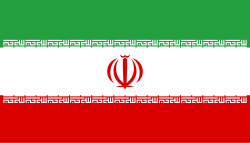
The national flag of the Islamic Republic of Iran ( Pers. پرچم رسمی جمهوری اسلامی ایران ) is the official state symbol of the Islamic Republic of Iran ; one of the main state symbols of Iran, along with the State emblem of the Islamic Republic of Iran and the National Anthem of the Islamic Republic of Iran . Approved by the Head of the Islamic Republic of Iran on July 29, 1980 .
| Flag of the Islamic Republic of Iran | |
|---|---|
| Iran | |
 | |
| Approved | July 29, 1980 |
| Using |   |
| Proportion | 4-7 |
| Flag author | Hamid Nadimi |
| Previous flags | |
 Option flag of Iran ( tricolor ) | |
Content
Description
The Iranian flag reflects the changes that Iran has been through since the beginning of the Islamic revolution and consists of three equal horizontal stripes: green, white and red. The green color represents fertility, order and joy, white is peace, red is courage and blood shed in war.
These colors have existed on the Iranian flag since the beginning of the 20th century , and the shahs also used them. In the center, however, was depicted a lion with a sword, a symbol of ancient Persia .
After the Islamic revolution, the lion was replaced by the version of the word Allah . It consists of four crescents and a sword in the middle [1] . In addition, the words “ Allah Akbar ” (God is great) are inscribed 22 times into the green and red strip. This is an allusion to the Islamic Revolution, which took place 22 days 11 months (22 Bachman) on the Iranian calendar .
The composition of the flag colors corresponds to the colors on the flag of Tajikistan , which is due to the ethnic, cultural and linguistic proximity of the two peoples. [2]
Iranians often call their flag simply “ parcham-e se rang ” (“ tricolor ”).
The national flag of the Islamic Republic of Iran was designed by artist Hamid Nadimi and approved by Ayatollah Khomeini on July 29, 1980 [3] .
Iran flag history
In modern Persian, the concepts of " flag " and " banner " are denoted by the terms " brocade " and " dirasha ", respectively. " Parcham " comes from Sogd. parčam - “ suspension; horsetail or oxtail horsetail, suspended under the crosshair of the spear or tops of the banner . ” [4] [5]
" Dirafsh " through pehl. " Drafš " goes back to the dr.-Pers. " * Drafša- " , equivalent to the ancient Indian " drapsá- ". [6] From the ancient Iranian " * drafša- " also come Avest. "Drafšā-" , Sogd. "'Rδ'šp" [ arδašf / ərδəšf ] [7] and the Bactrian " λraφo ". [eight]
The earliest mention of the use of banners by the ancient Aryans was preserved in the “ Avesta ”. For example, in the first chapter of Videvdata , Bactria is characterized as “ beautiful, with high banners ” - “ Baxδim sriram ərəδβō.drafša- ” [9] . In addition, in “Avesta” several times “bullish banners fluttering in the wind” - “ gaoš drafša- ” [10] , as well as “ banners of the Aryan enemies - Iranians ” are mentioned. [11] Some researchers assume that the banners mentioned in the “Avesta” are close to the well-known “Kavianic shackles” of a later time [12] or to the ancient Roman “Vexillums” - shafts with a red rectangular panel suspended from a crossbar like a modern church banner .
Dirafshi Kaviyani
The most famous in the history of Iran "Kavianskiy" is " Dirafshi Kawiyani ."
According to an ancient legend that was not included in the “Avesta”, but that Abulkasim Firdousi cited in “ Shahname ”, “ Dirafshi Kaviyani ” appeared during the Iranian uprising led by the blacksmith Kave against the foreign usurper Zahhak . [13] Kaveh attached his leather blacksmith's apron to the spear shaft and under such a banner he led the rebels to Faridun , the legal heir of the Peshdadid family, the first dynasty of the mythical kings of Iran . Faridun considered the banner of Kave to be a sign of good, decorated the cloth with a golden four-pointed star, precious stones and ribbons of red , yellow and purple flowers and called it “ Dirafshi Kaviyani ”. [14] The four-beam star gave Faridun to another name, Akhtari Kaviyan ( Kaviyev's Star ).
According to legend, Faridun divided the world between his three sons. The elder Salm went to the West Ecumene (according to another tradition, the Extreme East - China), the youngest Eraj got Iran, and Tura, the middle son of the king - northern lands, which became known as Turan . The tour, along with Salm, treacherously killed Eraj, luring him to Turan. Faridun, having learned about the death of his beloved son, did not forgive Tura and ordered to dig a huge moat on the border between Iran and Turan, which turned into the Amu Darya River . In the most common version of the Iranian epos, recorded in the poem by Firdousi, the Turanians, descendants of Tura, are depicted as the eternal antagonists of the kings of the Iranian Highlands [15] .
After the Faridun state was divided into three kingdoms, each of them had its own symbolism: the Sun became the symbol of Iran, the Crescent became the symbol of Turan:
Turan month no longer shine
Given its sun to Iran overshadow . [sixteen]
" Dirafshi Kaviyani " became the banner of Kayanids - the second dynasty of the mythical kings of Iran , and later - the national flag of Iran during the Arshakids dynasties ( 250 BC. E. - 224 years ) and Sassanids ( 224 - 651 years ).
Achaemenid Empire
The tradition of the use of the Avestan “Cavian banners” was continued in the Achaemenid Empire ( 558 - 330 BC ). The Standard of the Achaemenids is referred to by Xenophon in “ Anabasis ” (I, X) and “ Cyropedia ” (VII, 1, 4) as “a golden eagle raised on a long spear ”. [17] Images of the Achaemenid standards are preserved on the wall paintings of the Apadan Palace in Persepolis . During excavations in the capital of the Achaemenids, archaeologists discovered a standard with the image of a golden eagle with outstretched wings, holding in each paw one golden crown . The standard was red in color and had a border around the red-white-green triangles.
The found standard is on display in the Iranian National Museum of History and Archeology “Museum Iran Bastan” under number 2436.
The symbolic role of gold as a solar metal, while silver correlates with the Moon, is clearly seen in ancient Iranian culture. The symbolism of metals was associated with the division of society among all Iranian peoples into three estates - warriors, priests, and free community members - farmers and herders. [18] According to this scheme, the royal or military class (since the king is necessarily a warrior and comes from the military class) corresponded to gold and red , and to the priestly, silver and white . The estate of free community members initially corresponded to blue , and subsequently - green .
The symbolism of the colors of the flag of Iran goes back to antiquity. According to the Avesta , the free full population of ancient Iranian society was divided into three classes , each of which was associated with a specific color: [18]
- military nobility ( av. raθaē-štar- ) - red color is a symbol of military valor and self-sacrifice in the name of high ideals, therefore it is considered the most esteemed and noble;
- the clergy ( av. āθravan- , aθaurvan- ) - white color - symbolizes spirituality, moral purity and holiness;
- free members of the community (estate of cattle-breeders-farmers) ( avest. vāstrya.fšuyant- ) - green color - symbolizes nature, youth and prosperity. [nineteen]
To this day, the Iranian-speaking peoples of the Pamirs red color symbolizes happiness, well-being and joy, white - purity and clarity, green color - youth and prosperity. [20]
Arshakid dynasty
The Parthian dynasty of Arshakids ( 250 BC. E. - 224 ), which liberated Iran from the Greek-Macedonian dynasty of the Seleucids , from the very beginning proclaims its connection with the legendary kings, the Avestan heroes , as evidenced by the name of their divine ancestor, Kavi Arshan. [21] Arrian also mentions that the Parthians built their kind to the Achaemenid king Artaxerxes II . [22] This idea of presenting itself as the legal successors of the glorious kings of antiquity arose, probably as early as the beginning of the first century. BC er (or earlier). For example, in the Parthian documents found in Nis, the Artaxšahrakān vineyard is mentioned, which, according to the publishers of the documents, "is probably named after the legendary ancestor of Arshakids Artaxerxes II." [23]
Shtandart Arshakidov was a square panel of leather, which was depicted four-star attached to the spear shaft. The stand of the standard was crowned with a figure of a golden eagle with outstretched wings, holding in each paw one golden ball. [24] The golden eagle was obviously borrowed from the Achaemenid standard, the rest from Dirafshi Kawiyan .
Under the Arshakids, the Parthian army used various banners, including silk “dragon-like banners.” According to Shahname , the personal banner of the Parthian kings was a cloth with the image of the Sun. The national flag of Iran was the imperial standard "Dirafshi Kawiyani." [25]
Sasanian Empire
The Persian Sassanid dynasty that replaced Arshakids ( 224 - 651 years ) also raised its lineage to the Achaemenid kings. The connection of the Sasanian monarchs with the Achaemenids is already mentioned in the first version of the “ Book on the Acts of Artashir Papakan ”, which dates back to the 4th century. : this reflects the idea of the kinship of the founder of the Sasan dynasty, on the one hand, with the descendants of Darius , on the other - with the ancient rulers of Pars . Further, in the V century. , the Sassanian shahanshahs extend their genealogy to the Avesta " Kaviyam ", thus including in their dynastic cycle and the Kayanid dynasty. [26]
" Dirafshi Kaviyani " in the Sassanid era was a quadrangular panel with a four-ray star on a pole, topped with a gilded image of an eagle with outstretched wings, holding in each paw one golden ball. [24]
Notes
- ↑ It is legally described as building with a compass and a ruler . Flag Standard of Iran Archival Copy dated June 21, 2012 on the Wayback Machine (pers.)
- ↑ Gafurov B. G. Tajiks: The most ancient, ancient and medieval history. IVAN USSR, Science, M. 1972.
- ↑ Institute of Standards and Industrial Research of Iran (pers.)
- ↑ Hasandust, Mohammad. An etymological dictionary of Persian language. Tehran: Iranian Academy of Persian language and literature, 2004. ISBN 964-7531-28-1 . Vol. I, p. 258 (pers.)
- ↑ Sovetova, O. S., Mukhareva, A. N. On the use of banners in the military affairs of medieval nomads (according to graphic sources) // Archeology of Southern Siberia. Issue 23. (Sat. on the 60th anniversary of V. V. Bobrov) Kemerovo: 2005. P. 92-105
- ↑ Horn , Etymologie, no. 553; AirWb., Col. 771
- ↑ Gharib B. Sogdian Dictionary (Sogdian-Persian-English). - Tehran: Farhangan Publications, 1995. ISBN 964-5558-06-9 p. 56, # 1425 (pers.)
- ↑ Schmitt, Rüdiger . Compendium Linguarum Iranicarum, 1989. translation into Persian, ed. Hassan Rezai-Bagbidi . - Tehran: Kaknus, 1382/2004 - p. 363. ISBN 964-311-403-1 (pers.)
- ↑ Videvdad, 1.7
- ↑ Jasna 10.14
- ↑ Jasna, 57.25; Yasht 1.11, 4.3, 8.56
- Б. B. Litvinsky (ed.), V. Ranov. The History of the Tajik People. T. 1 - Ancient and ancient history. AN RT, Dushanbe, 1998. p. 227
- ↑ Khaleghi-Motlagh, Djalal. DERAFŠ-E KĀVĪĀN. Encyclopedia Iranica. 1st edition. 2007 [1] (inaccessible link) (inaccessible link from 03-04-2011 [3042 days])
- ↑ There are two versions of the flag name value. According to one version, the name comes from the name of the blacksmith Kave and means " Kaviev 's standard ." According to another version, the name comes from the ancient Iranian title " Kawi " ( cf.-pers. " Kai "), which in the " Avesta " designates the leaders of the Iranian tribes, and means "the banner of kings ." At the time of the Indo-Iranian community, the Kawi were not only tribal leaders, but also the high priests (that is, the spiritual leaders) of the tribes. In Eastern Iranian mythology, “ Kawi ” - good “ princes ”, representatives of the legendary family, associated with the Zoroastrian tradition and with the name of the patron saint of Zarathushtra - Kavi Vishtasp. The title of the legendary Kayanid dynasty dates back to the title of Kawi . In the later Zoroastrian literature, Kawi often stands for “ hero .” In the Sogdian language, “ Kawi ” is preserved in the sense of “ ruler, king ” (on Bukhara coins), in religious texts also in the sense of “ bogatyr, hero, giant (see B. Litvinsky (ed.), V. Ranov The history of the Tajik people. T. 1 - The most ancient and ancient history. AN RT, Dushanbe, 1998. p. 223, fn. 139)
- ↑ Shukurov Sh. M., Shukurov R. M., CENTRAL ASIA (experience of the history of the spirit)
- ↑ Ferdowsi . Shahname T. III. (From the legend of Rostem and Khakan Chin to the reign of Lohrasp). Per. with Farsi Ts. B. Banu-Lahuti, comments. A. Azer and Ts. B. Banu-Lahuti. M., 1965. - p. 197–198.
- ↑ Xenophon , Anabasis. King I, Chapter X
- ↑ 1 2 Gafurov B., G. Tajiks: Ancient, Ancient and Medieval History. Ivan USSR, Science, M. 1972. - p. 31
- ↑ Bahar, Mehrdad . Pizhuhishi dar asatir-i Iran (Para-i nukhust va para-i duyum). Tehran: Agah, 1375 [1996]. ISBN 964-416-045-2 . - p. 74 (pers.)
- ↑ Zoolishoeva Sh. F. Symbolism of color in the Shugno-Rushan national dress / / Languages and ethnography “Roof of the World”. - SPb .: Petersburg Oriental Studies, 2005. - 112 p. - p. 39. - ISBN 5-85803-304-2 (err.)
- ↑ Lukonin V. G. Parthianskaya and Sasanian administration // Ancient and Early Medieval Iran. M .: "Science", 1987. 295 pp. - p. 116 and approx. 37
- ↑ Arrian. Parthica, fr. −1 - Syncellus, c. 539. Cit. by: Lukonin V. G. Parthianskaya and Sasanian administration // Ancient and Early Medieval Iran. M .: "Science", 1987. 295 pp. - p. 116
- ↑ Dyakonov I. M., Livshits V. A. Documents from Nisa I c. BC er (preliminary results of the work). M., 1960. (XXV International Congress of Orientalists). Quoted by: Lukonin V. G. Parthianskaya and Sasanian administration // Ancient and Early Medieval Iran. M .: "Science", 1987. 295 pp. - p. 241
- ↑ 1 2 Kaveh Farrokh , Angus McBride . Sassanian Elite Cavalry AD 224-642. 1st edition. Osprey Publishing, 2005. 64 p. - p. 21 ISBN 1-84176-713-1 , ISBN 978-1-84176-713-0
- ↑ Shahbazi A. Sh. Parthian army
- ↑ Lukonin V. G. Parthianskaya and Sasanid administration // Ancient and Early Medieval Iran. M .: "Science", 1987. 295 pp. - p. 116; approx. 40 on p. 241: The beginning of this process is indicated by the legends of the Sasanian coins (starting with the Shapur III coins): the title of the Sassanian monarch is introduced to the title kdy - “kayanid”. The most extensive "legendary" genealogies of the Sassanian kings are contained in the later Arabic translations of "Gvatav-Namak" and historical writings associated with this chronicle. It is possible that the interest of the Sassanian official history to the Eastern Iranian heroic cycle is precisely at the very end of the 4th — 5th centuries. (judging by the legends of the coins) arises partly because in this epoch the Sassanids seized Balkh , the birthplace of Vishtaspa and the “sacred land” of Zoroastrianism . It should be noted that changes in the political concept of the origin of power in the Sasanian era are synchronous with the stages of development of the Zoroastrian canon. It can be assumed that already in the 5th century, the official Sassanian history did not begin with Sasan (as it was during the reign of the first Sassanian shahanshahs, as evidenced, for example, by the data of Shapur's inscriptions in Kaba Zartushta and Cartire's inscriptions) and not even from Darius , (as it was in the era of Shapur II when creating the first version of Karnamak and the new edition of the Zoroastrian canon, conducted by Aturpat Mihraspandan), and from Kayanids, which allowed later to merge the royal historical annals and legendary Zoroastrian history into one set Jun.
References Used
- Gafurov B. G. Tajiks: Ancient, ancient and medieval history. IVAN USSR, Science, M. 1972.
- Bahar, Mehrdad. Pizhuhishi dar asatir-i Iran (Para-i nukhust va para-i duyum). Tehran: Agah, 1375 [1996]. ISBN 964-416-045-2 . (Persian.)
- Zoolishoeva Sh. F. The symbolism of color in the Shugnan-Rushan national dress // Languages and ethnography “Roofs of the World”. - SPb .: Petersburg Oriental Studies, 2005. - 112 p. - ISBN 5-85803-304-2 (err.)
- Hasandust, Mohammad. An etymological dictionary of Persian language. Tehran: Iranian Academy of Persian language and literature, 2004. ISBN 964-7531-28-1 . Vol. I, p. 258 (pers.)
- Sovetova, O. S., Mukhareva, A. N. [ On the use of banners in the military affairs of medieval nomads (according to graphic sources)]. Archeology of Southern Siberia. Issue 23. (Sat. on the 60th anniversary of V. V. Bobrov) Kemerovo: 2005.
- Horn , Etymologie, no. 553; AirWb., Col. 771
- Gharib B. Sogdian Dictionary (Sogdian-Persian-English). - Tehran: Farhangan Publications, 1995. ISBN 964-5558-06-9 (pers.)
- Schmitt, Rüdiger. Compendium Linguarum Iranicarum, 1989. translation into Persian, ed. Hassan Rezai-Bagbidi. - Tehran: Kaknus, 1382 / 2004. ISBN 964-311-403-1 (pers.)
- Vidvdad, 1.7
- Clear 10.14
- Yasna, 57.25; Yasht 1.11, 4.3, 8.56
- Litvinsky B. A. (ed.), Ranov V. A. The History of the Tajik People. T. 1 - Ancient and ancient history. AN RT, Dushanbe, 1998.
- Khaleghi-Motlagh , Djalal. DERAFŠ-E KĀVĪĀN. Encyclopedia Iranica. 1st edition. 2007
- Xenophon , Anabasis. King I, Chapter X.
- Lukonin V. G. Parthian and Sasanian administration // Ancient and Early Medieval Iran. M .: "Science", 1987. 295 pp.
- Arrian . Parthica, fr. −1 - Syncellus,
- Dyakonov I.M., Livshits V.A. Documents from Nisa I in. BC er (preliminary results of the work). M., 1960. (XXV International Congress of Orientalists).
- Kaveh Farrokh, Angus McBride . Sassanian Elite Cavalry AD 224-642. 1st edition. Osprey Publishing, 2005. 64 p. ISBN 1-84176-713-1 , ISBN 978-1-84176-713-0
- Shahbazi A. Sh. Parthian army
See also
- Coat of arms of Iran
- Pan-colored colors
- Tajikistan flag
- Standard of the President of the Republic of Tajikistan