Clever Geek Handbook
πŸ“œ ⬆️ ⬇️

Einstein's theory of heat capacity

Einstein's quantum theory of heat capacity was created by Einstein in 1907 in an attempt to explain the experimentally observed temperature dependence of heat capacity .

In developing the theory, Einstein relied on the following assumptions:

  • Atoms in the crystal lattice behave like harmonic oscillators that do not interact with each other.
  • The oscillation frequency of all oscillators is the same and equalΞ½=Ο‰/2Ο€ {\ displaystyle \ nu = \ omega / 2 \ pi} {\ displaystyle \ nu = \ omega / 2 \ pi} .
  • The number of oscillators in 1 mole of matter is3Na {\ displaystyle 3N_ {a}} {\ displaystyle 3N_ {a}} whereNa {\ displaystyle N_ {a}} {\ displaystyle N_ {a}} - Avogadro number .
  • The energy of their quantization:Ξ΅=nℏω {\ displaystyle \ varepsilon = n \ hbar \ omega} {\ displaystyle \ varepsilon = n \ hbar \ omega} wheren∈N {\ displaystyle n \ in N} {\ displaystyle n \ in N} ,ℏ {\ displaystyle \ hbar} \ hbar - the reduced Planck constant (Dirac constant) .
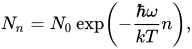
  • The number of oscillators with different energies is determined by the Boltzmann distribution
Nn=N0exp⁑(-ℏωkTn),{\ displaystyle N_ {n} = N_ {0} \ exp \ left (- {\ hbar \ omega \ over kT} n \ right),} {\ displaystyle N_ {n} = N_ {0} \ exp \ left (- {\ hbar \ omega \ over kT} n \ right),}

Wherek {\ displaystyle k} k - Boltzmann constantT {\ displaystyle T} T - thermodynamic temperature .

Internal energy of 1 mole of substance:

U¯μ=3Ρ¯Na.{\ displaystyle {\ bar {U}} _ {\ mu} = 3 {\ bar {\ varepsilon}} N_ {a}.} {\ displaystyle {\ bar {U}} _ {\ mu} = 3 {\ bar {\ varepsilon}} N_ {a}.}

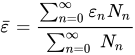
The average energy of one oscillatorΡ¯ {\ displaystyle {\ bar {\ varepsilon}}} {\ displaystyle {\ bar {\ varepsilon}}} is found from the ratio for the average value:

Ρ¯=βˆ‘n=0∞ΡnNnβˆ‘n=0∞Nn{\ displaystyle {\ bar {\ varepsilon}} = {\ sum _ {n = 0} ^ {\ infty} {\ varepsilon _ {n} N_ {n}} \ over \ sum _ {n = 0} ^ { \ infty} {\ N_ {n}}}} {\ displaystyle {\ bar {\ varepsilon}} = {\ sum _ {n = 0} ^ {\ infty} {\ varepsilon _ {n} N_ {n}} \ over \ sum _ {n = 0} ^ { \ infty} {\ N_ {n}}}}

and is:

Ρ¯=ℏωexp⁑(ℏωkT)-one,{\ displaystyle {\ bar {\ varepsilon}} = {\ hbar \ omega \ over \ exp \ left ({\ hbar \ omega \ over kT} \ right) -1},} {\ displaystyle {\ bar {\ varepsilon}} = {\ hbar \ omega \ over \ exp \ left ({\ hbar \ omega \ over kT} \ right) -1},}

from here:

UΒ―ΞΌ=3Naℏωoneexp⁑(ℏωkT)-one.{\ displaystyle {\ bar {U}} _ {\ mu} = 3N_ {a} \ hbar \ omega {1 \ over \ exp \ left ({\ hbar \ omega \ over kT} \ right) -1}.} {\ displaystyle {\ bar {U}} _ {\ mu} = 3N_ {a} \ hbar \ omega {1 \ over \ exp \ left ({\ hbar \ omega \ over kT} \ right) -1}.}

Defining heat capacity as a derivative of internal energy with respect to temperature, we obtain the final formula for heat capacity:
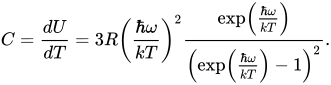
C=dUdT=3R(ℏωkT)2exp⁑(ℏωkT)(exp⁑(ℏωkT)-one)2.{\ displaystyle C = {dU \ over dT} = 3R \ left ({\ hbar \ omega \ over kT} \ right) ^ {2} {\ exp \ left ({\ hbar \ omega \ over kT} \ right) \ over \ left (\ exp \ left ({\ hbar \ omega \ over kT} \ right) -1 \ right) ^ {2}}.} {\ displaystyle C = {dU \ over dT} = 3R \ left ({\ hbar \ omega \ over kT} \ right) ^ {2} {\ exp \ left ({\ hbar \ omega \ over kT} \ right) \ over \ left (\ exp \ left ({\ hbar \ omega \ over kT} \ right) -1 \ right) ^ {2}}.}

According to the model proposed by Einstein, at absolute zero temperature the heat capacity tends to zero, at high temperatures, on the contrary, the Dulong – Petit law is satisfied. ValueΞΈE=ℏωk {\ displaystyle \ theta _ {E} = {\ hbar \ omega \ over k}} {\ displaystyle \ theta _ {E} = {\ hbar \ omega \ over k}} sometimes called Einstein's temperature .

Theory Deficiencies

 
The divergence of the theories of Einstein and Debye

Einstein's theory, however, does not agree well with experimental results due to the inaccuracy of some of Einstein's assumptions, in particular, the assumption that the oscillation frequencies of all oscillators are equal. A more accurate theory was created by Debye in 1912 .

See also

  • Debye Model
  • Dulong Law - Petit
  • Joule's Law - Koppa

Sources

  • Sivukhin D.V. General course of physics. - T. II. Thermodynamics and molecular physics.
Source - https://ru.wikipedia.org/w/index.php?title= Einstein's Heat Capacity Theory&oldid = 93958676


More articles:

  • Catholic church of St. Stephen (Vilnius)
  • Waka (Cook Islands)
  • Big Circus
  • Mariupol (station)
  • Insurance Broker
  • Kawai, Kenji
  • The list of astronauts and astronauts who visited the Mir OS
  • List of 200 largest Russian private companies (2006)
  • Berezniki (Danilovsky District)
  • Akhunui

All articles

Clever Geek | 2019