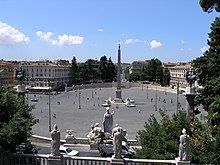
Piazza del Popolo ( Italian: Piazza del Popolo - "People's Square") - a square in Rome , from which rays diverge to the south of Corso (leads to Piazza Venezia ), Babuino (to Piazza di Spagna ) and Ripetta (to the Mausoleum of Augustus ). The corners between the streets are occupied by the very similar in appearance church propels of Santa Maria dei Miracoli (1681) and Santa Maria in Montesanto (1679). The area has an oval shape of 100 × 165 m. From the north it is limited by the gate of the same name - Porta del Popolo . In antiquity, the gates were part of the Aurelian wall and were called the Flaminievs, because to the north of them the ancient Flaminiev road begins, along which the bulk of travelers traveled to Rome for centuries.
The etymology of the name "People's Square" remains unclear. There are two versions:
- The name of the square comes from the poplar grove that used to grow at the tomb of Emperor Nero . The words "poplar" ( lat . Populus) and "people" are homonyms in Latin. This version is based on the legend that the ghost of Emperor Nero visits the site of his tomb at night.
- More historically probable is the version that Pope Paschalius II built in the place near the wall, a chapel with public money (subsequently, the church of Santa Maria del Popolo was built in its place), which later gave the name of the square itself. [one]
In its current form, the Piazza del Popolo broke in 1811-1822. architect Giuseppe Valadier . He connected the square with the Napoleonic staircase to the side of the Pinchio hill, on which the gardens of Villa Borghese extend. In the middle of the square stands a 36-meter Egyptian obelisk , the inscriptions on which praise the acts of Pharaoh Ramses II . This obelisk was transferred from Heliopolis to Rome at the whim of Octavian Augustus in 10 BC. e. For centuries, he stood in the Circus Maximus , and was transferred to the northern gates of Rome at the direction of Pope Sixtus V in 1589. In addition to the obelisk, the square is decorated with a fountain by Giovanni Ceccarini (1822-23): the Neptune fountain and the Roma fountain on the sides of the square, as well as the Obelisk fountain in its center. Historically (until 1826), Piazza del Popolo was the site of public executions. The area is currently closed to car traffic.
Notes
- ↑ Rendina-Paradisi, Le strade di Roma , vol. III, p. 1045.
Links
- Media files related to Piazza del Popolo on Wikimedia Commons