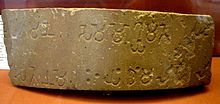
Inscriptions (edicts) of Ashoka - 33 inscriptions that have survived to our time, which, by order of the Indian king Ashoka, were inscribed in the 3rd century BC. on the walls of caves and stone columns , specially erected for this purpose. This is the earliest written monument in India [1] and the first reliable evidence of the existence of Buddhism [2] .
Mysterious Brahmi texts, sometimes quite extensive, were discovered by English colonialists in the territory of modern Pakistan and India . Text decryption was performed in 1837 by James Princsep of Calcutta [3] .
From the point of view of the form of the inscription, the Persian tradition follows (see Behistun inscription ), but their content is very peculiar. Ashoka - the first ruler in history, who claims to abandon the war of conquest and the use of violence for other purposes than the defense of his country [4] .
Contents
The range of issues covered in the edicts is rather narrow: the adoption and dissemination of Buddhism by the king, moral and religious laws, the king’s concern for the well-being of subjects and even animals.
According to edicts, the adoption of Ashoka Buddhism was preceded by a bloody war with Kalinga and the subsequent moral rebirth:
Eight years after the king, kind to the gods, was anointed to reign, a graciously looking one captured Kalinga. One hundred and fifty thousand people were hijacked from there, one hundred thousand were killed and many thousands died. And now, after the capture of Kalinga, the favorite of the gods is diligently preaching the teachings of the Law, love of the Law. Sad favorite of the gods since he conquered Kalinga. For inevitably, the capture of a country not yet conquered is accompanied by the killing, death or theft of people. And from this torment the favorite of the gods sadness, sorrowful and heavy thoughts .
Dharma , according to Ashoka, is kindness, generosity, honesty and chastity. The sovereign pays special attention to the exercise of the judiciary so that fair decisions are made, and judges try to avoid harsh punishments:
In the twenty-six years of my rule, twenty-five times, when many prisoners were immediately granted freedom. I want the law to be the same everywhere and for everyone. I even give three days to those sentenced to death so that their families can have time to apply for clemency .
Ashoka forbade the killing of animals that were not intended to be eaten (for example, as a sacrifice to the gods), limited the number of species that could be eaten:
In the twenty-six years since my coronation, many animals have been taken under protection: parrots, wild ducks, bats, turtles, fish, squirrels, fallow deer, wild and domestic pigeons and all four-legged creatures that are unfit for food; lactating goats, sheep and pigs; cubs under six months old .
Notes
- ↑ Abhidharma Buddhism to 150 AD - Google Books
- ↑ Damien Keown. A Dictionary of Buddhism . Oxford University Press, 2003. ISBN 9780191579172 . Page 118.
- ↑ Journal of the Asiatic Society of Bengal
- ↑ BBC Radio 4 - In Our Time, Ashoka the Great