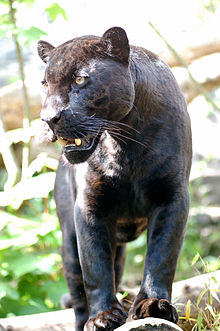
Black panthers are dark-colored individuals of a number of panther species, which are a genetic variant of color - a manifestation of melanism . Black Panther is not an independent species. Most often it is a leopard or jaguar .
Also, “ panther ” is a genus of large animals in the cat family, therefore the word “panther” is often applied not only to individuals with a black color, but also to others with a usual color (reddish or spotted), even white - the so-called “white” panthers. "
Melanism
The black color of panthers is a manifestation of melanism caused by a gene mutation [1] . An example of the strong spread of a mutation that leads to melanism in a feline population is the leopard population in Malaysia , where about 50% of the animals are black in color. In general, among large cats, melanism is usually more common in those populations that live in dense forests - given the lack of lighting, dark animals are less noticeable here than in open areas, which makes it easier for them to survive.
The skin of a black panther is not perfectly black; on it to a greater or lesser extent, emerging spots are always visible. EP P. G in his book “Wild Animals of India” wrote that there are even special “under-panthers”, in which black spots are clearly visible on a light chocolate background [2] .
In addition to color, black and spotted individuals of leopards and jaguars are no different, freely interbreed and produce prolific offspring. Cubs from such pairs can be very different - both spotty and black. But the latter is less common because the black gene is recessive and is often suppressed by the spotting gene.
Black Panther ( Jaguar )
Black Panther ( Leopard )
Black Panther ( Jaguar )
Incomplete Melanism
A concept close to melanism is incomplete melanism or pseudo-melanism (“abundism”) - a condition in which increased pigmentation of the skin or other integuments does not occur evenly, but in separate areas. Pseudo-melanism is found in leopards [3] . In case of abundism, for example, spots or stripes in animals with spotted or striped coloration of the integument can expand up to confluence, which leads to the so-called pseudo-melanism. Melanism and abundism are most often the result of mutations, but can also occur due to other factors, such as the influence of temperature during pregnancy, which can affect the transcription and translation of genes.
In heraldry and mythology
- The heraldic panther is always depicted as “ incensed, ” that is, fire-breathing (furious), with a flame bursting from the mouth and ears. The creature is described as beautiful and good. When the panther wakes up from sleep, she emits a pleasant high singing, and a delightful stream of pleasantly smelling breath comes from her mouth, so that all the animals follow her (except for the dragon, who fears the panther and runs away).
- The Panther was the badge of the English kings Henry IV and Henry VI . Sometimes she is portrayed as an ordinary animal like a panther, sometimes (especially in German heraldry ) as a creature with four horns, cow ears and a long red tongue in the form of a flame.
- On the coat of arms of the African country of Gabon, two black panthers hold a shield and personify "vigilance and courage of the head of the Gabonese state."
In Culture
- Bagheera is a character in the works of Rudyard Kipling.
Notes
- ↑ Sunquist, F. Malaysian Mystery Leopards (English) // National Wildlife Magazine : magazine. - 2007 .-- December ( vol. 45 , no. 1 ). Archived January 16, 2008.
- ↑ Ji E.P. Wild animals of India. - 2nd ed. - M .: Progress, 1966. - T. 1. - S. 24. - 250 p.
- ↑ Gamble, Cyndi. Leopards: Natural History & Conservation. - Voyageur Press, 2004 .-- ISBN 0896586561 .