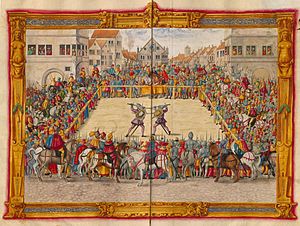
Judicial duel is one of the ways to resolve disputes in medieval Europe , in which the outcome of the dispute was decided by the martial arts of the parties: the winner was declared the winner of the dispute. It was usually used in cases when it was impossible to establish the truth by means of interrogation of witnesses , but none of the parties admitted their wrongness. In essence, a judicial duel is a duel authorized by law.
Content
Origin
Judicial duel, in contrast to the hordes and other forms of “ God's judgment ”, known everywhere, as a method of resolving disputes was provided primarily by Barbarian truths and was used mainly by German peoples (cf. Holmgang ). However, a special form of judicial duel also existed in Ancient Russia , it was called the “ field ”. Judicial duel is not provided by such ancient legal sources as the Torah and the Laws of Hammurabi ; also not included in Roman law .
According to the beliefs of the ancient Slavs , the battle was a dispute, given to the decision of the deity. “Judges the Gods Already” is an ordinary formula that the princes pronounced before the outbreak of hostilities . Therefore, in private strife, if the offended rebelled with a weapon on the offender, the deity was supposed to help the right and punish the violator of the sacred laws .
Judicial duel in Russia (“field”)
Judicial fights in Russia have been known for a long time. According to the Arab writers of the 10th century, Amin Razi and Mukaddesi , who described the traditions of the Rus , "when the king decides the dispute between the two litigants, and they will not be satisfied with his decision, then he tells them: understand with your swords - whose sharper the victory is." The Slavs got a duel called “field”. The field was essentially an analogue of the European horde , but was somewhat different in form.
The first mentions of the field in Russian sources date back to the 11th – 12th centuries. According to one version from the annals , wars were also sometimes decided by martial arts of two elected from different sides. This match took place in front of both enemy armies . His outcome was taken as an indisputable sentence of divine will, which equally obeyed those who were left to win, and those who had to plead condemned [1] . As, for example, the traditional heroic duel at the beginning of the battle to raise the morale of Peresvet and Chelubey , immediately after which the Battle of Kulikovo took place .
The agreement between Smolensk prince Mstislav and Riga and the Gothic coast ( 1229 ) says: “Do not call Rusyns to fight Latina on the field near Russian soil, and Latina not call Rusyns to fight on the field near Rize and on the Gothic birch. As a Latin guest, you fight among yourself near the Russian land with a sword, and with a tree you don’t need the prince, you judge yourself; As a Russian guest, a beating at Rize or at the Gochkom birch is not necessary for Latina, but they will settle down by themselves. ” The meaning of this article is that a Russian cannot challenge a German to a duel in Russian soil, and a Russian German cannot go to Riga and the Gothic coast . The prince should not interfere in the fights of foreigners on Russian soil (do not take legal fees from them), and the Germans - in the fights of Russian people.
Subsequent laws determine the cases when the field was allowed, the weapon with which the fighters had to fight, and the course of the duel itself.
The Pskov Judicial Charter decrees that not only men but also women could enter the field. As a general rule, the battle had to be equal, and therefore minors, the elderly, the sick, clergy, disabled people and women could hire and place hired fighters instead. If a lawsuit was filed by a woman against a woman, then hiring was prohibited.
A duel was also allowed between the defendant and the witness when the latter showed against the former. The testimonies of several witnesses themselves were evidence and their presence made the duel unnecessary.
The battle took place under the supervision of bailiffs. Probably, a posadnik was present at the battle (this is mentioned in the Novogorodsk Ship's Charter ).
In Pskov, the parties went to battle in armor . In Novgorod, the weapons were flops (batons, bastards) and sticks, and shishaki armor and iron plate armor . In Moscow at the beginning of the 16th century, according to the observations of Austrian diplomat Sigismund Herberstein , fighters put on chain mail or plate armor , a helmet and bracers, using a spear, ax and double dagger as weapons [2] .
The same provisions are developed in the Judicial Code of Ivan IV . In addition to representatives of the authorities, there were also solicitors and guarantors from the side of the litigants on the “field”. “Field” was also allowed between witnesses whose testimony contradicted each other. The soldiers dressed in armor , had shields in their hands and fought with batons.
Stoglav forbids the "field" for monks and priests for all crimes except murder .
The custom to resolve disputes “by field” continued to exist throughout the 16th century and disappeared in the 17th century . The Council Code of 1649 does not mention anything about the “field”, replacing it with the oath .
Orthodox Church and Judicial Fights
The church protested against judicial fights. We heard the protest of Metropolitan Photius ( 1410 ):
I also punish this one: whoever calls on the field to come to commune with the priest, otherwise there is no holy communion to him, nor kissing of the godmother; and which priest will give him holy communion, that priest is deprived. And whoever warms (kills), climbs on the field, (and) destroys the soul - according to the great Vasily, the word the murderer is called, does not enter the church, does not accept gifts, nor the Blessed Virgin of communion bread, you will not accept the holy age of eighteen; but don’t bury the murdered, and whoever bury the priest is deprived of priesthood
Mostly the clergy rebelled against witchcraft and enchantment, which fighters resorted to. Maxim Grek complained that, contrary to the evidence of the testimony exposing the guilty, the judges award the “field”, and the offenders rely on that: they always have a “sorcerer and fortuneteller, if only the Satanic can help their fieldman”.
In ancient medical books there are indications of those magical means, possessing which, you can safely go to the duel:
“If you want to be scary, kill the black snake, and kill it with a saber or a knife, take out your tongue, and put the green taffeta and the black one in the boot on the left and put the shoes on the same place. Walking away, do not look back. When you come home, put (serpentine tongue) under the gate into the ground; and who to ask you: where was? and you don’t say anything to him. And when necessary, and you put the same garlic cloves in your same boot, but under your right bosom, tie yourself a washcloth and take it with you when you go to court or fight on the field. ”
“You need to take a green bush from a branch or a birch ... in our swirling nest, and take that bush as the wind-whirlwind pulls in winter or summer, and keep the middle tree in yourselves - to go to court, or to great people, or to fight , and how to fight - keep secretly in the boot in one on the right foot. And whoever keeps that tree in himself, that person is not afraid of anyone. ”
Judicial duel in the Czech Republic
The order of the judicial duel in the Czech Republic was regulated by the “ Near Zemsky Law ” [1] . According to him, the trial of the murder of a relative ended in a duel. Opponents swore an oath before the battle, the weapons consisted of a sword and shield. The competition took place in a special place, fenced with a railing.
A tired fighter could ask for rest up to three times. For a period of rest, a log was laid between the rivals, through which they had no right to cross. The winner cut off his enemy’s head . People of low rank had to beat with sticks.
For a minor orphan, one of the relatives went to the duel. If a widow filed a lawsuit for the murder of her husband or relative, and it came to a duel, the defendant had to stand waist-deep in the pit and from there fight with her. Unmarried women enjoyed the same privilege if they wished, otherwise they would be granted orphaned rights.
Judicial duel in Germany
Judicial duel in England
Judicial duel in France
In the chronicle of the court chronicler of the Duchy of Burgundy Georges Châtelet and the memoirs of the historian and poet Olivier Lamarches , a bloody judicial duel between the noble townspeople Jacquinot Plouvier and Maguo, held in 1455 in the city of Valenciennes (modern Nor department), is described in detail. Rivals with bare heads, whose servants' bodies rubbed fat from neck to ankles, armed with batons and pointed shields with images of saints, came together in a sand-strewn arena. After a fierce exchange of blows, plaintiff Jacotin takes over, dropping the ground of his opponent, rubbing sand in his eyes and twisting his hands, after which the half-dead loser who vainly calls for mercy for the duke Philip Good here is hanged [3] .
U.S. Judicial Combat
See also
- Ordals
- God's judgment
- Duel
Notes
- ↑ Afanasyev, A. N. The Russian Field or the Court of God // Poetic Views of the Slavs on Nature: The Experience of Comparative Study of Slavic Traditions and Beliefs in Connection with the Mythical Tales of Other Related Peoples. In 3 vols. T. 1. - M.: Modern writer, 1995.
- ↑ Herberstein S. Notes on Muscovy / Per. A.I. Malein, A.V. Nazarenko. - M .: MSU, 1988 .-- S. 120.
- ↑ Huizinga Johan . Autumn of the Middle Ages . - M .: Nauka, 1988 .-- S. 107-108.
Literature
- Afanasyev, A. N. The Russian Field or the Court of God // Poetic views of the Slavs on nature: The experience of a comparative study of Slavic traditions and beliefs in connection with the mythical legends of other kindred peoples. In 3 vols. T. 1. - M.: Modern writer, 1995.
Links
- Abramovich-Baranovsky S.S. Judicial duel // Encyclopedic Dictionary of Brockhaus and Efron : 86 volumes (82 volumes and 4 additional). - SPb. , 1890-1907.