The American Swan [1] , or the American Tundra Swan [2] ( Latin Cygnus columbianus ) is a small swan common in the tundra zone of the northern hemisphere. Some ornithologists distinguish the small swan (subspecies C. c. Bewickii ) living in the Palearctic , into a separate species, but most scientists still believe that this is one of two subspecies of the tundra swan. [3] Second subspecies C. c. columbianus is common in North America . Sometimes, Russian populations living east of Taimyr are distinguished as subspecies C. c. jankowskii , however, this practice is not generally accepted.
| American swan |
 |
| Scientific classification |
|---|
| No rank : | Bilateral symmetric |
|
| International Scientific Name |
|---|
Cygnus columbianus
( Ord , 1815 ) |
| Security status |
|---|
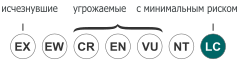
Least concernIUCN 3.1 Least Concern : 22679862 |
|
The Red Book of Russia
rare view |
|
Content
The tundra swan is the smallest of all the swans living in the northern hemisphere - its length is 115–146 cm, its wingspan is 170–195 cm, and its weight is 4–9.5 kg. [4] [5] Subtype C. c. bewickii has an external similarity with the Eurasian whooper swan ( Cygnus cygnus ), however, compared with it, it is noticeably smaller, has a shorter neck and more rounded outlines of the head. The pattern of the beak differs in individual individuals, but unlike the whooper swan, black in it prevails over yellow.
It is distributed throughout the tundra and partly of the North American forest tundra from Alaska to Baffin Island. Settles in the most deaf and inaccessible places. It winters along the Pacific coast of North America to California and the Atlantic to Florida. Found in Russia on Anadyr, the Commander Islands and Chukotka.
- Cygnus columbianus bewickii (Yarrell, 1830)
- Cygnus columbianus columbianus (Ord, 1815)
- The crash of Vickers Viscount under Ellicott City - the collision of an airliner with an American swan
- ↑ E. Koblik, Ya. A. Redkin, V. Yu. Arkhipov. List of Birds of the Russian Federation. - M .: Partnership of scientific publications KMK, 2006. - p. 92. - 256 p. - ISBN 5-87317-263-3
- ↑ Koblik E. А., Redkin Ya.A. The Basic List of Anseriformes of the World Fauna // Kazarka, №10 (2004). - P. 15—46.
- ↑ Cygnus columbianus (English) . The IUCN Red List of Threatened Species .
- Ge Madge, Steve & Burn, Hilary (1987): Wildlife Guidelines, Geese and Swans of the World. Christopher Helm, London. ISBN 0-7470-2201-1
- ↑ Carboneras, Carles (1992): 16. Tundra Swan. In: del Hoyo, Josep; Elliott, Andrew & Sargatal, Jordi (eds.): Handbook of Birds of the World (Volume 1: Ostrich to Ducks): 579, Plate 40. Lynx Edicions, Barcelona. ISBN 84-87334-10-5