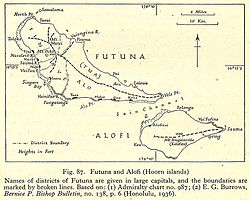
Futuna , Futunans - people in Polynesia , live on the Horn Islands and in New Caledonia . The total number is about 8 thousand people, most of whom live on the islands of Wallis and Futuna [1] .
| Futuna | |
|---|---|
| Abundance and area | |
| Total: 8 thousand | |
| about. Wallis and Futuna , New Caledonia | |
| Tongue | eastern futuna |
| Religion | Christianity ( Catholicism ), traditional beliefs |
| Included in | Polynesians |
Content
Language
The language of the futuna — the eastern futuna — is one of the languages of the Polynesian group of the Austronesian family [2] , which was strongly influenced by the Samoan language, despite the greater geographical distance of the Samoan islands from the area of the Futunian settlement than, for example, the Tonga islands [3] .
Ethnic History and Traditional Social Organization
The ethnic roots of the futun seem to date back to the indigenous population of Samoa , as well as to the migration flows from outer Polynesia in the X - XI centuries [1] .
Historically, the futuna was led by a ruler and his assistant; special privileges were enjoyed by military leaders. There were age classes [1] .
Like most Polynesians , the futun tribes, after the collapse of the matrilineal clan organization, formed the totem-related association - the family community , or large family, which was and remains the main unit of the social system and the fundamental principle of all social ties. Its structure is largely borrowed from the Uvea tribes, in particular, the Futun retains a generational system of kinship terms - relatives are separated only by gender and by generation. Such a community, which includes a total of 30-50 people, consists of 3-4 generations living together, descending along the male line from one common ancestor. The family community owns the land. A plot belonging to it is processed by collective labor, or individual marriage couples receive small plots for use. Certain sections of the marriage couples are inherited through the male line (which indicates the patrilocality of the marriage settlement ), so that the land always remains the property of the community. In the account of kinship with the futun, obvious ambilinearity is manifested (equality of the sexes in social importance also testifies to this), however, men still have a small priority [4] . Monogamous marriage, practiced levirate [1] .
Religion
A large number of family crypts were found in the territory of the Futun’s residence [5] , which indicates the popularity of the worship of ancestors. In addition, Christianity ( Catholicism ) is widespread among the futun tribes, of the local traditional beliefs - totemism and fetishism [1] .
Traditional dwelling
The dwellings of the futuna are rectangular, with a gable roof, pillar construction, usually without walls. Sometimes dwellings are built on platforms [1] .
Life and traditional household activities
The traditional occupations of futun are cattle breeding ( pig breeding and dairy farming ), fishing , turtles hunting, slash-and-burn ( yams , breadfruit , banana ) and irrigation ( rice , taro , maize ) farming , gathering of marine animals, crafts (carpentry, weaving) , manufacture of jewelry from sea shells). Futuna feed mainly on seafood and cultivated crops [1] .
Notes
- ↑ 1 2 3 4 5 6 7 Polinskaya 1999: 588
- ↑ Polinskaya 1999: 615
- ↑ Oceania 1982: 374
- ↑ Potapov 1956: 615
- ↑ Potapov 1956: 616
Sources
- Oceania: reference book / Ans. ed. Mikhalovsky K.V., Nikolaev V.P. M .: Nauka, 1982.P. 374-378.
- Polinskaya M.S. Futuna // Peoples and religions of the world / Chapters. ed. V.A. Tishkov . M .: Big Russian Encyclopedia, 1999.S. 588.
- Potapov S.P. Polynesians // Peoples of Australia and Oceania: Ethnographic Essays / Chapters. ed. Tokarev S.A.M .: Ed. USSR Academy of Sciences, 1956. S. 615-616.
Links
- Futuna Tongue in Ethnologue. Languages of the World .
- The World Factbook: Wallis and Futuna
- S. Percy Smith. Futuna, or Horne Island and its people // The Journal of the Polynesian Society. - 1892. - T. 1 , No. 1 . - S. 33-52 .